

When you start coughing and can’t catch your breath, it’s natural to wonder if something you’re taking is to blame. Many people assume that if a drug causes lung symptoms, it must be hypersensitivity pneumonitis - especially if they’ve heard the term in connection with bird fancier’s lung or farmer’s lung. But here’s the hard truth: medications don’t cause true hypersensitivity pneumonitis. Not in the way environmental triggers do. And confusing the two can delay the right diagnosis - and the right treatment.
What Hypersensitivity Pneumonitis Actually Is
Hypersensitivity pneumonitis (HP) is not an allergic reaction like asthma or hay fever. It’s a specific type of lung inflammation triggered by breathing in tiny particles from the environment - mold, bird droppings, humidifier bacteria, or even dust from grain. These aren’t chemicals you swallow. They’re airborne antigens you inhale directly into your lungs, where your immune system overreacts, causing swelling in the air sacs (alveoli).
Think of it like this: if you’re a bird owner and you clean the cage every day, you might breathe in dried droppings or feather dust. Over time, your body starts recognizing those particles as invaders. That’s when symptoms like cough, fever, and breathlessness show up - usually within hours of exposure. If you stop being around birds, the symptoms often vanish within days. That’s acute HP.
But if you keep breathing in those particles week after week, the inflammation doesn’t go away. Scar tissue starts forming. That’s chronic HP. And once fibrosis sets in, it’s permanent. That’s why early recognition matters. The key is exposure history. You can’t get HP from taking a pill. You get it from breathing in something.
Why Medications Don’t Cause True Hypersensitivity Pneumonitis
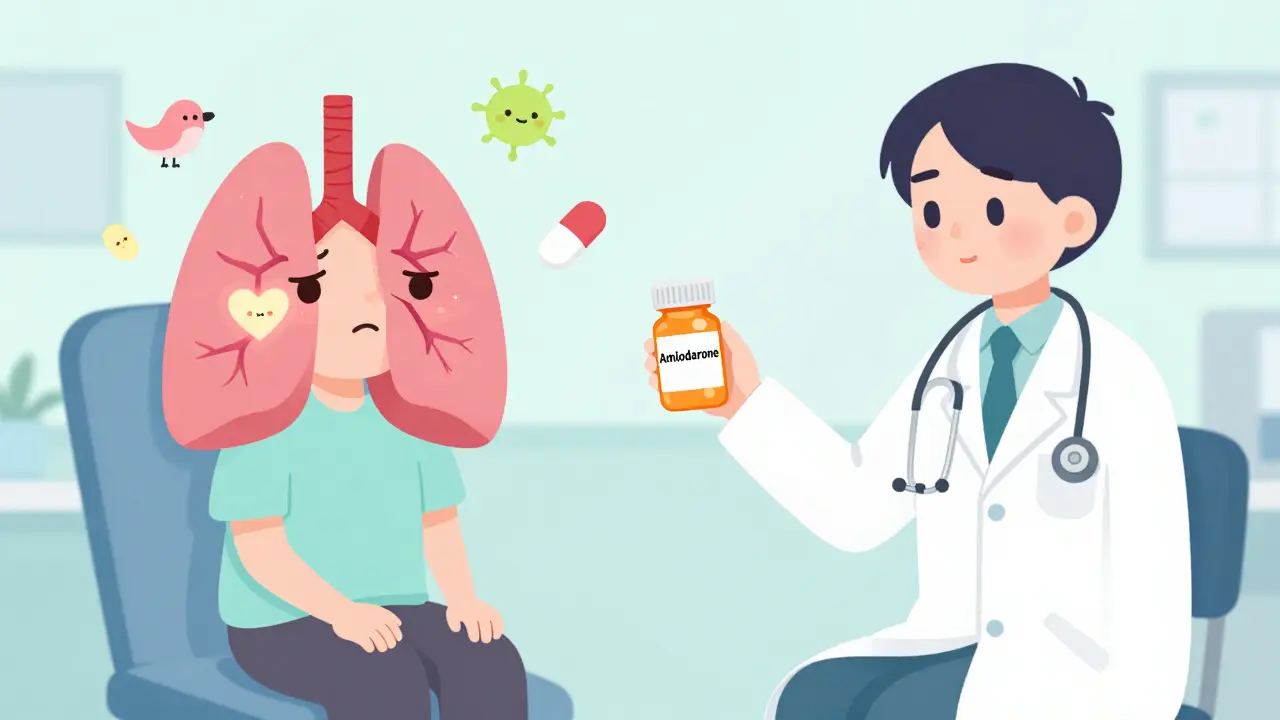
There’s a big difference between drug-induced lung injury and hypersensitivity pneumonitis. Medications like amiodarone, nitrofurantoin, or chemotherapy drugs such as bleomycin can damage the lungs. They can cause cough, shortness of breath, and even scarring. But the way they do it is completely different.
True HP shows up on lung scans as centrilobular ground-glass opacities and mosaic attenuation. Biopsies reveal poorly formed granulomas and lymphocytic inflammation clustered around the smallest airways. These are the fingerprints of HP - and they’re not found in drug-induced cases.
Medication reactions look different. Amiodarone causes phospholipid buildup in lung cells. Nitrofurantoin triggers acute interstitial pneumonitis with lots of white blood cells. Bleomycin causes direct cell death. None of these involve the same immune pathway as HP. No antigen is inhaled. No granulomas form in the same pattern. No lymphocyte spike in bronchoalveolar lavage.
Experts from the Merck Manual, the Pulmonary Fibrosis Foundation, and leading university pulmonology departments all agree: HP is defined by environmental inhalation. Medications aren’t listed as causes. Not because they’re ignored - but because they simply don’t fit the definition.
What Medications Actually Do to Your Lungs
If you’re on a medication and suddenly develop a dry cough or worsening breathlessness, it’s not HP - but it’s still serious. Drug-induced interstitial lung disease (DILD) is real, and it’s underdiagnosed.
- Amiodarone (used for heart rhythm problems) - causes lung scarring in up to 5% of long-term users. Symptoms mimic chronic HP: cough, low oxygen, fatigue. But it’s due to lipid accumulation, not immune sensitization.
- Nitrofurantoin (a common UTI antibiotic) - can cause acute lung injury within weeks of starting. Patients get fever, cough, and low oxygen levels. It’s reversible if caught early and the drug is stopped.
- Bleomycin (chemotherapy) - causes direct toxicity to lung cells. The damage is dose-dependent and often irreversible. No granulomas. No lymphocytosis. Just dead tissue.
- Checkpoint inhibitors (immunotherapy for cancer) - can trigger immune-related pneumonitis. This looks more like an autoimmune attack than an allergic reaction. It’s treated with steroids, but the mechanism is different from HP.
Here’s the catch: all of these conditions look similar on the surface - cough, breathlessness, abnormal chest X-rays. That’s why doctors need to dig deeper. Did you start the drug 2 weeks ago? Do you own parakeets? Have you been cleaning your humidifier? Your history tells the story.
How Doctors Tell the Difference
There’s no single blood test or scan that confirms HP. Diagnosis is like solving a puzzle with five pieces:
- History - Did symptoms start after exposure to birds, mold, or a new job? Or after starting a new pill?
- Imaging - High-resolution CT scans show patterns. HP has ground-glass opacities and air-trapping. Drug injury might show patchy infiltrates or fibrosis without the mosaic pattern.
- Bronchoalveolar lavage - Fluid from the lungs is tested. HP usually has over 40% lymphocytes. Drug injury may show eosinophils or neutrophils instead.
- Biopsy - The gold standard. HP shows granulomas and bronchiolocentric inflammation. Drug injury shows different patterns - organizing pneumonia, eosinophilic infiltration, or diffuse alveolar damage.
- Response to avoidance - If symptoms improve when you’re away from your bird cage or farm, it’s likely HP. If they improve when you stop the pill, it’s likely drug-induced.
One of the most telling clues? If you feel better on vacation - away from home, work, or your pet birds - and then crash when you return, that’s classic HP. If you feel better only after skipping your pill, that’s drug-induced.
What Happens If You Get It Wrong
Misdiagnosing drug-induced lung injury as HP can lead to unnecessary treatment. Steroids are often used for both - but they’re not always the right answer.
If you have amiodarone toxicity and you keep taking it while on steroids, the lung damage keeps getting worse. The steroids mask symptoms, but the drug is still poisoning your lungs. You might end up with irreversible scarring.
Conversely, if you have true HP from mold in your basement and you’re told it’s just a reaction to your blood pressure pill, you’ll keep breathing in the mold. The fibrosis will creep in. You’ll need oxygen. Maybe even a transplant.
One case from Melbourne in 2024 involved a 68-year-old man on amiodarone who developed a persistent cough. His doctor thought it was bird fancier’s lung - he had a pet parrot. But he hadn’t cleaned the cage in months. The real trigger? The drug. Once amiodarone was stopped, his lung function improved by 30% in 8 weeks. The parrot stayed - and he never needed steroids.
What You Should Do If You Have Cough and Breathlessness
If you’re on medication and suddenly feel short of breath:
- Don’t panic - but don’t ignore it either.
- Write down when symptoms started and what you were doing around that time.
- Think about your environment: birds, humidifiers, mold, dusty workspaces.
- Make a list of every medication you’re taking - including supplements.
- See a pulmonologist. Ask for a high-resolution CT scan and a referral for bronchoalveolar lavage if needed.
- Don’t assume it’s HP just because you’ve heard the term.
Early action saves lungs. Whether it’s stopping a drug or removing a bird cage, the sooner you act, the better your chances of recovery.
When to Worry About Permanent Damage
Not all lung inflammation leads to scarring - but some does. Here’s what increases your risk:
- Chronic cough lasting more than 3 months
- Progressive breathlessness - even walking up stairs becomes hard
- Weight loss without trying
- Clubbing of fingers (tips rounded, nails curved)
- Low oxygen levels at rest
If you have these signs, your doctor should check your lung function with spirometry and measure your DLCO (diffusing capacity). If your DLCO is below 40% of predicted, or your FVC is dropping more than 10% over 6 months, you’re at high risk for fibrosis.
For true HP with fibrosis, drugs like nintedanib (used for idiopathic pulmonary fibrosis) are now being tested and show promise in slowing decline. For drug-induced injury, stopping the drug is the only cure.
Final Takeaway
Hypersensitivity pneumonitis isn’t caused by pills. It’s caused by what you breathe. If you’re coughing and short of breath, the answer isn’t always in your medicine cabinet - it’s in your home, your job, or your pet’s cage.
Medications can harm your lungs - but they don’t cause HP. Recognizing that difference isn’t just academic. It’s life-changing. One wrong diagnosis can lead to months of unnecessary steroids. One missed trigger can lead to irreversible scarring.
If you’re struggling to breathe, don’t guess. Get tested. Know the difference. And remember: your lungs don’t care what you call it. They only care if you stop the damage before it’s too late.
Can medications cause hypersensitivity pneumonitis?
No. True hypersensitivity pneumonitis is caused by inhaling environmental antigens like mold, bird proteins, or bacteria from humidifiers. Medications can cause lung injury, but it’s a different condition called drug-induced interstitial lung disease (DILD). The immune response, lung patterns, and biopsy findings are not the same.
What are the symptoms of hypersensitivity pneumonitis?
Symptoms include cough, shortness of breath, fever, chills, fatigue, and chest tightness. In acute cases, they appear 4-8 hours after exposure and resolve quickly if exposure stops. In chronic cases, symptoms develop slowly over months - worsening cough, breathlessness with activity, weight loss, and sometimes clubbing of fingers.
How is hypersensitivity pneumonitis diagnosed?
Diagnosis requires a combination of exposure history, high-resolution CT scan showing specific lung patterns (like ground-glass opacities), bronchoalveolar lavage showing high lymphocytes, and sometimes a lung biopsy showing poorly formed granulomas. Blood tests for antibodies can help identify the trigger, but aren’t always positive.
What’s the difference between HP and drug-induced pneumonitis?
HP is caused by inhaling antigens and shows lymphocytic inflammation and granulomas. Drug-induced lung injury is caused by direct toxicity or immune reactions to medications and shows different patterns like organizing pneumonia or eosinophilic infiltration. Biopsy is the key to telling them apart.
Can stopping a medication fix lung damage?
Yes - if the damage is caught early. Many drug-induced lung injuries improve or even reverse when the medication is stopped. But if scarring (fibrosis) has already formed, it’s permanent. That’s why early recognition matters. The same is true for HP: removing the trigger early can prevent lasting damage.
Is hypersensitivity pneumonitis curable?
Acute HP is often fully reversible if exposure stops. Subacute HP can improve with steroids and antigen avoidance. Chronic HP with fibrosis is not curable, but progression can be slowed with antifibrotic drugs like nintedanib. The goal is to prevent further damage - not reverse what’s already scarred.

Comments
I've seen this happen so many times in clinic. Someone comes in with a cough, we find a bird cage at home, and everyone jumps to HP. But half the time they're on amiodarone and didn't even think to mention it. Just stop the drug first. Easy fix.
lol i had this happen to my uncle. he was on some heart med and kept blaming his parrot. turned out the parrot was fine, the med was wrecking his lungs. doc told him to quit the pill and he was good in 2 months. no steroids, no drama.
The conflation of drug-induced interstitial lung disease with hypersensitivity pneumonitis is not merely a diagnostic error-it is a systemic failure in clinical reasoning, rooted in imprecise terminology and inadequate education.
It's fascinating how the immunopathology of HP is so distinctly bronchiolocentric with lymphocytic infiltration and poorly formed granulomas, whereas drug-induced injury manifests as organizing pneumonia, DAD, or eosinophilic pneumonitis-entirely different mechanistic pathways. The diagnostic criteria are codified in ATS/ERS guidelines for a reason. Ignoring them is irresponsible.
I've worked in Nigeria and India-people there know this stuff intuitively. If your cough started after you got that new heart pill, you don’t blame the birds. You stop the pill. Simple. We need more of this common sense in medicine, not just fancy scans.
This is so true. Back home in Nigeria, we don’t have fancy CTs all the time. We ask: 'When did you start feeling bad? Did you change anything? New medicine? New bird? New job?' That’s how we catch it. Sometimes the simplest questions save the most lungs.
Honestly this post gave me chills. I was diagnosed with 'HP' last year and was on steroids for 6 months. Turned out it was nitrofurantoin from a UTI I had. Stopped the med, and within 3 months I could run again. Thank you for putting this out there. So many people are suffering because of mislabeling.
i had no idea meds could do this. i thought it was just allergies or mold. so glad i read this before blaming my cat for my cough lol
In India, we have over 1.4 billion people, and yet our medical education still clings to outdated Western classifications. Hypersensitivity pneumonitis? Please. We see drug-induced lung injury every day from antibiotics, TB drugs, even Ayurvedic supplements. But we call it 'pneumonitis' because the term sounds scientific. We need to stop pretending our patients have European disease patterns. Our air is dirty, our meds are unregulated, and our doctors are overworked. Stop blaming the parrots. Start looking at the pill bottles.
This is an excellent breakdown. I always tell my patients: if your symptoms improved after stopping the drug, it’s likely drug-induced. If they improved after leaving your house or workplace, it’s environmental. Don’t overcomplicate it. History is still the most powerful diagnostic tool we have.
i love how you laid this out. it’s like a detective story but for your lungs. so many people panic and think it’s cancer or something deadly. this helps so much. thank you for writing it so clearly
Just had a patient last week who was told he had bird fancier’s lung. Turned out he’d been on amiodarone for 18 months. No birds. Just a guy who thought his cough was from his neighbor’s pigeons. Stopped the med, got better. No steroids. Just stopped the poison. Sometimes medicine is that simple.