

Citrus Drug Interaction Checker
Most of us know the warning: don't eat grapefruit with certain medications. It’s a standard disclaimer on statin bottles and blood pressure prescriptions. But here is the catch-grapefruit isn’t the only citrus fruit that messes with your medicine. Two other fruits, often overlooked in health discussions, carry nearly identical risks. They are pomelo and Seville orange, which contain potent compounds that can dangerously amplify the effects of drugs.
If you take prescription medications, assuming that sweet oranges or lemons are safe while avoiding grapefruit might leave you exposed. Pomelo, a large, mild-tasting citrus native to Southeast Asia, and Seville orange, the bitter variety used primarily in marmalades, share the same biochemical 'poison' as grapefruit. Understanding these interactions is critical because they can turn a routine daily dose into a medical emergency.
The Hidden Chemistry Behind Citrus and Drugs
To understand why these fruits are dangerous for some patients, we need to look at what happens inside your gut. When you swallow a pill, your body doesn't just absorb it immediately. Before entering your bloodstream, the drug passes through your intestines, where enzymes break down a portion of it. This process, known as first-pass metabolism, acts as a filter.
The key player here is an enzyme called CYP3A4. This enzyme lives in the lining of your small intestine and helps metabolize roughly 50% of all commonly prescribed drugs. Normally, CYP3A4 does its job efficiently. However, pomelo and Seville orange contain specific chemical compounds called furanocoumarins.
Furanocoumarins, specifically bergamottin and 6',7'-dihydroxybergamottin, act like a wrecking ball for CYP3A4. They bind to the enzyme irreversibly. Think of it like pouring glue into a machine's gears. Once the enzyme is blocked, it cannot break down the drug. As a result, much more of the medication enters your bloodstream than intended. This isn't a temporary slowdown; it’s a shutdown that lasts until your body produces new enzymes, which takes time.
Pomelo vs. Grapefruit: A Dangerous Cousin
You might think pomelo is safer because it tastes sweeter and less acidic than grapefruit. That is a dangerous assumption. In fact, research suggests pomelo can be even riskier.
A study published in the Journal of Agricultural and Food Chemistry found that pomelo contains bergamottin concentrations ranging from 1.5 to 2.5 μM, compared to 1.0 to 2.0 μM in grapefruit. Some cultivars of Seville orange show levels up to 30% higher than grapefruit. Dr. David Bailey, who discovered the grapefruit-drug interaction phenomenon in 1989, famously described pomelo as "grapefruit's bigger, more dangerous cousin" due to this higher concentration of inhibitory compounds.
The clinical impact is stark. A 2018 study in the British Journal of Clinical Pharmacology showed that pomelo juice increased the systemic exposure (AUC) of simvastatin by 350%, whereas grapefruit juice increased it by 300%. For a patient taking simvastatin to lower cholesterol, this spike can lead to muscle damage, a condition known as rhabdomyolysis, which requires immediate hospitalization.
| Citrus Fruit | Bergamottin Concentration (μM) | Interaction Severity | Common Form |
|---|---|---|---|
| Grapefruit | 1.0 - 2.0 | High | Juice, Fresh Fruit |
| Pomelo | 1.5 - 2.5 | Very High | Fresh Fruit, Juice |
| Seville Orange | 3.0 - 4.0 | Extreme | Marmalade, Peel |
| Sweet Orange | Negligible | None | Juice, Fresh Fruit |
The Seville Orange Trap: Marmalade Risks
Seville orange presents a unique challenge because most people never eat the fruit raw. It is too bitter. Instead, it is the primary ingredient in traditional marmalades, particularly those made in Spain and the UK. The peel of the Seville orange contains the highest concentration of furanocoumarins.
When you spread marmalade on toast, you are consuming concentrated amounts of these inhibitors. A case report published in Transplantation Proceedings documented a transplant patient whose tacrolimus levels skyrocketed by 400% after eating Seville orange marmalade. Tacrolimus is an immunosuppressant with a narrow therapeutic window; too little, and the body rejects the organ; too much, and it causes kidney toxicity. The patient required hospitalization to stabilize their levels.
The danger is compounded by lack of awareness. According to a 2022 FDA compliance review, only 37% of pomelo and Seville orange products carry drug interaction warnings, compared to 78% for grapefruit products. Many consumers do not realize that "bitter orange" or "Seville orange" listed on a marmalade jar poses the same risk as drinking a glass of grapefruit juice.

Which Medications Are Affected?
Not every drug interacts with pomelo or Seville orange. The risk is highest for medications that are metabolized by the CYP3A4 enzyme and have a narrow therapeutic index. If a drug has a wide safety margin, a slight increase in dosage might not cause harm. But for many common prescriptions, the stakes are high.
Here are the primary categories of drugs at risk:
- Statins: Simvastatin (Zocor), atorvastatin (Lipitor), and lovastatin. Increased risk of muscle breakdown and liver damage.
- Calcium Channel Blockers: Felodipine, nifedipine, and amlodipine. These treat high blood pressure. Interaction can cause dangerously low blood pressure, dizziness, and swelling.
- Immunosuppressants: Cyclosporine and tacrolimus. Critical for organ transplant recipients. Toxicity can lead to organ failure.
- Anti-anxiety and Sleep Aids: Midazolam and triazolam. Can cause excessive sedation and respiratory depression.
- Anticoagulants: Some newer blood thinners may also be affected, though warfarin is generally not metabolized by CYP3A4.
The University of Florida Center for Pharmacogenomics maintains a list of over 107 medications with significant interaction potential. If your medication ends in "-vastatin" or "-dipine," you should exercise extreme caution.
How Long Does the Effect Last?
A common misconception is that you just need to avoid eating the fruit at the exact same time as taking your pill. This is incorrect. Because furanocoumarins cause irreversible inhibition of CYP3A4, the effect lingers long after the fruit is digested.
Dr. Shiew Mei Huang from the FDA’s Division of Clinical Pharmacology explains that the inhibition can last up to 72 hours. Your body must synthesize new enzyme proteins to restore normal function. This means if you eat a pomelo on Monday morning, your ability to metabolize sensitive drugs remains impaired until Thursday.
The FDA recommends a minimum avoidance period of three days before and during treatment with sensitive medications. Even small amounts matter. Studies show that as little as 200 mL (about one cup) of juice can trigger significant interactions. For Seville orange marmalade, even a single slice of toast can contain enough peel extract to cause issues.
What About Other Citrus Fruits?
It is important to distinguish between the risky citrus fruits and the safe ones. Not all citrus is created equal when it comes to drug interactions.
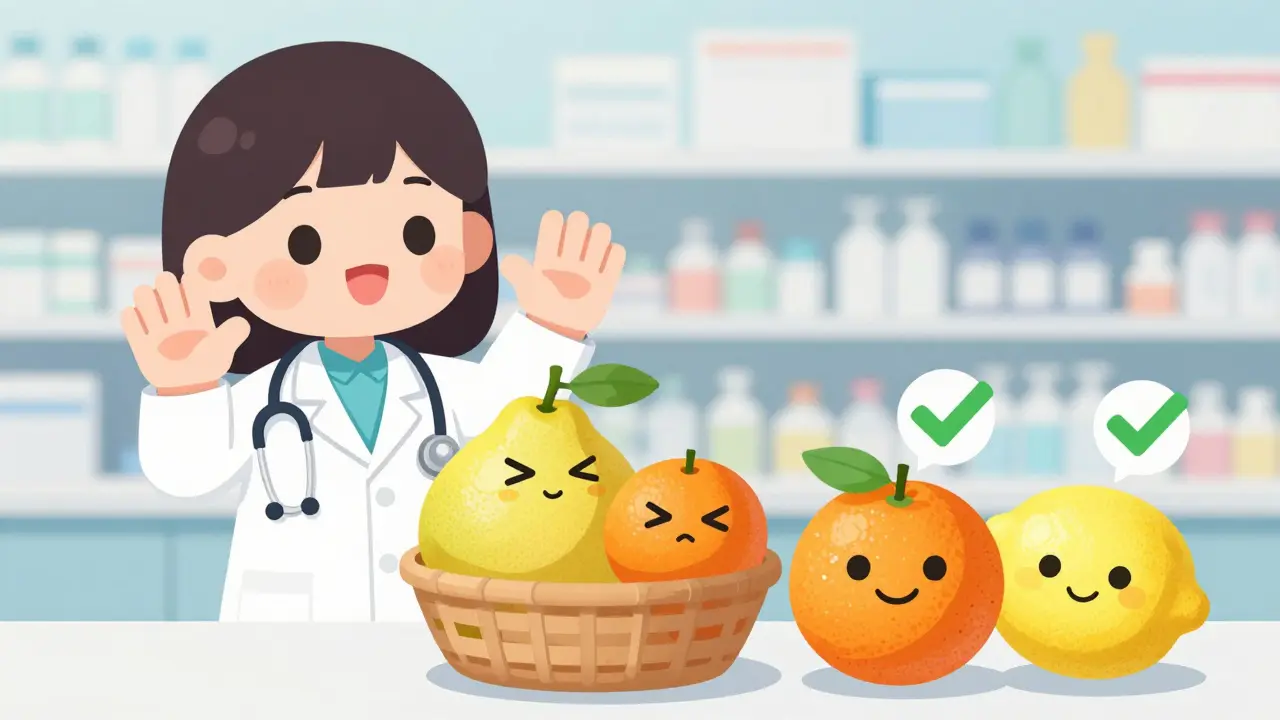
Sweet oranges (like Valencia or Navel oranges), tangerines, mandarins, and lemons do not contain significant levels of furanocoumarins. They are generally safe to consume with medications. Pink grapefruit is just as risky as white grapefruit, so color is not a reliable indicator of safety.
Limes are also generally considered safe, although some rare varieties may contain trace amounts of inhibitors. However, for the vast majority of patients, switching from grapefruit or pomelo to sweet orange juice is a safe alternative.
Practical Steps for Patients and Providers
The gap in awareness is widening. While healthcare providers are well-trained on grapefruit interactions, screening for pomelo and Seville orange is inconsistent. A 2023 survey by the American Pharmacists Association found that only 42% of community pharmacists routinely screen for these specific interactions.
If you take prescription medications, take these steps:
- Ask specifically: Don't just ask about grapefruit. Ask your doctor or pharmacist, "Does my medication interact with pomelo, Seville orange, or bitter orange marmalade?"
- Read labels: Check ingredient lists on jams and marmalades. Look for "Citrus aurantium" or "Seville orange."
- Be cautious with supplements: Some herbal supplements use bitter orange extract for weight loss or energy. These can also inhibit CYP3A4.
- Monitor symptoms: If you experience unusual muscle pain, severe dizziness, or excessive drowsiness after introducing a new citrus fruit into your diet, contact your provider immediately.
Regulatory bodies are catching up. The European Medicines Agency issued a scientific opinion in 2019 stating that pomelo and Seville orange should be treated as equivalent to grapefruit until proven otherwise. The FDA has also proposed expanding warning labels to include all furanocoumarin-containing citrus fruits, with implementation expected in the near future.
Is pomelo safe to eat if I take statins?
No, pomelo is not safe if you take statins like simvastatin or atorvastatin. Pomelo contains furanocoumarins that inhibit the CYP3A4 enzyme, leading to significantly higher levels of the drug in your blood. This increases the risk of serious side effects like muscle damage (rhabdomyolysis). You should avoid pomelo entirely or consult your doctor for an alternative medication.
Can I eat Seville orange marmalade with my blood pressure medication?
You should avoid Seville orange marmalade if you take calcium channel blockers like felodipine or nifedipine. The peel of the Seville orange contains high concentrations of bergamottin, which blocks drug metabolism. Even a small amount of marmalade can cause your blood pressure to drop dangerously low, leading to dizziness or fainting.
How long does the interaction last after eating pomelo?
The interaction can last up to 72 hours (3 days). The compounds in pomelo irreversibly bind to the CYP3A4 enzyme in your gut. Your body needs time to produce new enzymes to restore normal drug metabolism. Therefore, you should avoid pomelo for at least three days before and during the course of sensitive medications.
Are sweet oranges and tangerines safe with medications?
Yes, sweet oranges, tangerines, mandarins, and lemons are generally safe. They do not contain significant levels of furanocoumarins, the compounds responsible for inhibiting drug-metabolizing enzymes. They are a safe alternative to grapefruit, pomelo, and Seville orange for patients on interacting medications.
Does cooking or juicing reduce the risk of drug interactions?
No, cooking or juicing does not eliminate the risk. Furanocoumarins are heat-stable and remain active in juices, jams, and marmalades. In fact, concentrated forms like marmalade (which uses the peel) may pose an even higher risk due to the density of the inhibitory compounds.
Why is pomelo considered more dangerous than grapefruit?
Pomelo often contains higher concentrations of bergamottin and other furanocoumarins than grapefruit. Studies have shown that pomelo can increase drug exposure more significantly than grapefruit. For example, pomelo juice increased simvastatin levels by 350% compared to 300% for grapefruit juice in clinical studies.