
For years, millions of people took a daily low-dose aspirin to prevent their first heart attack or stroke. It seemed simple: one pill, cheap and easy, a tiny shield against cardiovascular disease. But the science has changed. Aspirin is no longer a blanket recommendation for heart health - and for many, continuing it could be more dangerous than skipping it.
Why the Rules Changed
Back in the 1990s, studies showed aspirin could lower the risk of a first heart attack. That led to widespread advice: if you’re over 50, take a baby aspirin every day. But those early studies didn’t fully account for the risks. Over time, bigger, longer trials revealed something troubling: the bleeding risks often canceled out the benefits. The U.S. Preventive Services Task Force (USPSTF) updated its guidelines in 2022, and it was a major shift. They now say: do not start aspirin for primary prevention if you’re 60 or older. Why? Because for every 1,000 people over 60 taking aspirin daily for 10 years, about 1.6 will have a major bleeding event - like a stomach bleed or brain hemorrhage - while only 0.9 will avoid a heart attack. That’s not a win. That’s a net loss. The American Heart Association and American College of Cardiology agree. Routine aspirin for people without heart disease is no longer standard care. The old advice was based on averages. The new advice is based on your individual risk - and your individual risk of bleeding.Who Definitely Should Skip Daily Aspirin
If you fall into any of these groups, you should not be taking daily aspirin unless a doctor specifically tells you otherwise - and even then, it’s rare.- Age 60 and older: This is the clearest cutoff. The bleeding risk rises sharply with age. By 70, your stomach lining is more fragile, your blood vessels are more brittle, and even minor trauma - like a cough or a fall - can trigger internal bleeding. Aspirin makes that worse.
- History of stomach ulcers or GI bleeding: If you’ve ever had a bleeding ulcer, or even just severe heartburn that required medication, aspirin is a bad idea. About 4% of U.S. adults have had an ulcer. For them, aspirin isn’t prevention - it’s a trigger.
- Taking other blood thinners or NSAIDs: If you’re on warfarin, apixaban, rivaroxaban, or even regular ibuprofen or naproxen, adding aspirin multiplies your bleeding risk. About 18% of adults over 65 are already on one of these drugs. Combining them is dangerous.
- High risk of falls or frailty: Especially if you’re older and unsteady on your feet, even a small bump can lead to a brain bleed. Aspirin thins your blood. That’s not helpful when your body is already vulnerable.
- Known bleeding disorders: Conditions like hemophilia or von Willebrand disease make any blood thinner risky. Aspirin is not safe here.
Who Might Still Benefit - But Only With Care
It’s not all black and white. For some people under 60, the math still works - but only if you’re very careful. The USPSTF says adults 40 to 59 might consider aspirin if they have a 10% or higher risk of a heart attack or stroke in the next 10 years - and they don’t have any bleeding risk factors. That’s a narrow window. How do you know your 10-year risk? Doctors use a tool called the Pooled Cohort Equations. It factors in your age, sex, race, blood pressure, cholesterol, diabetes status, and smoking. If you’re a 55-year-old man with high LDL, borderline blood pressure, and who smokes, your risk might be 14%. That’s a candidate for discussion. But here’s the catch: even if your risk is high, you still need to check your bleeding risk. A 58-year-old woman with controlled blood pressure and normal cholesterol but a history of frequent nosebleeds? Aspirin is likely not for her. Some cardiologists look beyond the standard calculator. If you’ve had a coronary calcium scan (CAC) and your score is over 100 - especially over 300 - your risk is much higher than the calculator suggests. In those cases, some experts still recommend aspirin, even if you’re over 60. But this isn’t mainstream advice yet. It’s still being studied.
The Hidden Dangers: Bleeding Is Silent Until It’s Not
Most people don’t realize how serious aspirin-related bleeding can be. It doesn’t always mean vomiting blood or passing black stools. Sometimes, it’s just fatigue, dizziness, or unexplained bruising. A brain bleed can start quietly - a headache you write off as stress, a slight confusion you blame on aging. In a 2023 Mayo Clinic survey, 41% of adults over 60 kept taking aspirin even after hearing the new guidelines. Why? Fear. They were afraid stopping would cause a heart attack. But the data shows: if you’re over 60 and have no heart disease, stopping aspirin doesn’t increase your risk of a first heart attack. It just removes the bleeding risk. And the side effects are common. On Drugs.com, 68% of users over 65 who took aspirin daily reported stomach pain or heartburn. One in five stopped because of it. That’s not a minor inconvenience. That’s a real, measurable harm.What About People With Diabetes?
Diabetes increases heart disease risk - so it’s tempting to think aspirin helps. But the latest 2025 AHA/ACC guidelines say: only consider it if you’re 40 to 70, have a 15% or higher 10-year risk, and no bleeding risk. Even then, it’s a Class IIb recommendation - meaning “might be considered,” not “recommended.” New research suggests a twist: people with diabetes and high Lp(a) - a genetic cholesterol particle - might benefit more. One 2024 study found aspirin cut CVD events by 19% in this group. But if your Lp(a) is normal? No benefit. That’s why blanket advice fails. You need testing, not guessing.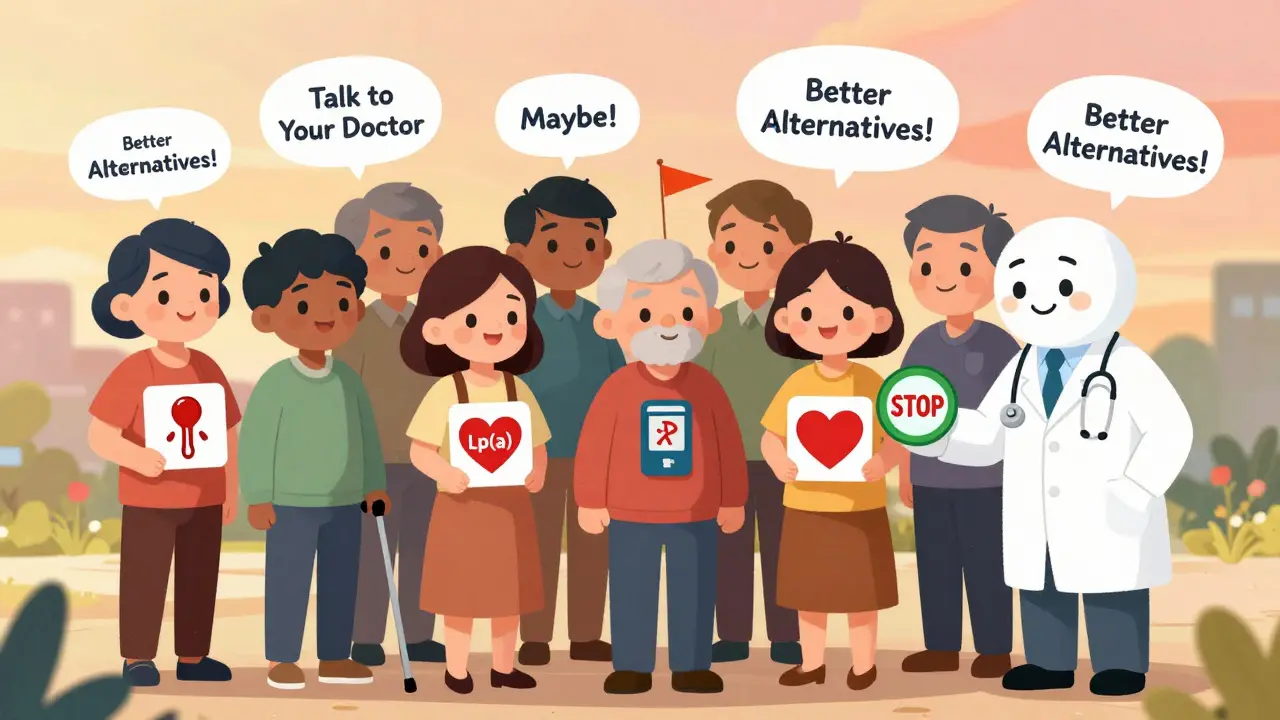
What You Should Do Right Now
If you’re taking aspirin daily and you don’t have heart disease, here’s what to do:- Don’t stop cold turkey. If you’ve been on it for years, talk to your doctor first. Abruptly stopping can, in rare cases, trigger a clot.
- Ask for your 10-year CVD risk score. Use the ACC/AHA calculator. It’s free and online. Know your number.
- Review your bleeding risk. Have you had ulcers? Are you on other meds? Do you fall often? Are you over 60?
- Ask about alternatives. Better ways to reduce heart risk: exercise, quitting smoking, controlling blood pressure, managing cholesterol with statins if needed. These have stronger evidence than aspirin.
- Bring up the 2022 USPSTF guidelines. Many doctors still follow old habits. Be the one who asks, “Is this still right for me?”
Why So Much Confusion?
Patients report conflicting advice all the time. Why? Because not all doctors are up to speed. Primary care doctors, who see the most patients, have cut aspirin prescriptions by 42% since 2018. Cardiologists? Only 58%. Why the gap? Cardiologists see patients who already have heart disease - and for them, aspirin is still essential. But primary prevention is different. Also, patients are emotionally attached. “I’ve taken this for 15 years - it must be helping.” But correlation isn’t causation. You might feel fine because you exercise, eat well, and don’t smoke - not because of aspirin.The Bottom Line
Aspirin for primary prevention is not a one-size-fits-all solution. For most people over 60, it’s no longer worth it. For some under 60 with high heart risk and low bleeding risk, it might still make sense - but only after careful discussion and testing. The goal isn’t to take more pills. It’s to take the right ones. And for millions, the right choice is to stop.Should I stop taking aspirin if I’m over 60 and have never had a heart attack?
Yes, unless your doctor has a very specific reason to keep you on it. The 2022 USPSTF guidelines strongly recommend against starting or continuing daily aspirin for primary prevention in adults 60 and older because the risk of serious bleeding outweighs the small benefit in preventing first heart attacks or strokes. Talk to your doctor before stopping, but don’t assume it’s still helping you.
Is aspirin still good for people with diabetes?
It’s not automatic. The 2025 AHA/ACC guidelines say low-dose aspirin may be considered for adults with diabetes aged 40-70 who have a 10-year ASCVD risk of 15% or higher and no increased bleeding risk. But if your Lp(a) levels are normal, aspirin likely won’t help. Testing is key. Don’t take it just because you have diabetes.
What if I’ve been on aspirin for 10 years - is it too late to stop?
No, it’s not too late. Stopping aspirin after long-term use doesn’t increase your risk of a first heart attack - especially if you’re over 60 and have no heart disease. The risk comes from continuing, not stopping. Talk to your doctor about tapering if you’re concerned, but don’t delay the conversation out of fear.
Can I take aspirin only when I feel unwell, like a headache, instead of daily?
Yes - and that’s actually safer. If you’re not using aspirin for heart protection, taking it occasionally for pain or fever doesn’t carry the same bleeding risk as daily use. The danger comes from consistent, long-term exposure. Use it as needed, not as a habit.
What are better alternatives to aspirin for preventing heart disease?
Focus on proven, safer strategies: regular physical activity (at least 150 minutes a week), quitting smoking, eating a diet low in processed foods and high in vegetables, managing blood pressure and cholesterol with medication if needed, and maintaining a healthy weight. Statins, when appropriate, have stronger evidence than aspirin for primary prevention - and much lower bleeding risk.
I have a high coronary calcium score - should I still take aspirin?
This is a gray area. A CAC score over 100, especially over 300, means you have significant plaque buildup - and your heart disease risk is higher than your age or cholesterol alone suggest. Some cardiologists still recommend aspirin in these cases, even over 60. But it’s not standard. Discuss it with your doctor. Ask if the benefits outweigh your personal bleeding risk. New trials are underway to clarify this.

Comments
So we’re telling people to stop taking a $5-a-year pill because it might cause a bleed… but we’ll charge them $1,200 for a statin and call it ‘preventive care’? 🤔💸 I mean, I get it-science evolves-but why does medicine always feel like a game of whack-a-mole with our wallets? I’ve been on aspirin since 2015. My dad died of a heart attack at 58. I’m not stopping until someone shows me the data that proves I’m *more* likely to bleed than survive. 🤷♂️
Stop aspirin. Start thinking.
Okay but let’s be real-this whole ‘aspirin is dangerous’ thing feels like Big Pharma quietly whispering to doctors: ‘Hey, we’ve got this new blood thinner that’s way more profitable.’ I mean, sure, bleeding risk is real-but so is the fact that 41% of people over 60 are still taking it because they’re not dumb. And if you’re gonna scare people with ‘silent brain bleeds,’ why not also tell them that sitting on their couch binge-watching Netflix for 8 hours a day is basically a time-release clot machine? Hypocrisy much? 🤨
The USPSTF guidelines are statistically sound but culturally naive. Most patients don’t understand risk ratios-they understand ‘my doctor said take it.’ That’s why misinformation persists. You can’t fix public health with a PDF.
Hey, if you’re reading this and you’re on daily aspirin-first, thank you for being proactive about your health! 🙌 Now, don’t panic. This isn’t about guilt, it’s about *choice*. Talk to your doc. Ask for your 10-year risk score. Check if you’re on other meds. Did you know 1 in 5 people stop aspirin because of stomach pain? That’s your body saying ‘hey, maybe this isn’t for me.’ And guess what? Walking 30 minutes a day, eating more greens, sleeping better-those things actually *build* your resilience. Aspirin was a bandaid. Now we’re getting to the root. You’ve got this. One conversation at a time. 💪
I’ve been on aspirin since my 50th birthday. I’m 64 now. I’ve never had a heart issue. I do have mild gastritis. I stopped last year after reading this. No side effects. No heart attack. Just… quieter. I feel better. I didn’t need a pill to feel safe. I needed to trust my body more than a guideline. I’m glad I listened.
Let me get this straight: America’s medical system spends billions on pills to prevent problems caused by our 12-hour workdays, 3000-calorie diets, and zero sleep-but we’re too cheap to fix the root causes? So we tell seniors to stop aspirin… but don’t fix their food deserts, their lack of access to gyms, or their loneliness? This isn’t prevention. This is triage with a side of moral superiority. 🇺🇸 #StopTheBandAidCulture
Aspirin was the aspirin of my youth-the little white tablet that meant ‘I’m doing something right.’ Now it feels like a relic, a placebo for anxiety wrapped in medical authority. I stopped six months ago. My GP raised an eyebrow. My wife said, ‘Good. You’ve been moody since you started it.’ I’ve since taken up gardening. I’m sleeping better. My blood pressure’s down. Funny how the body heals when you stop trying to medicate your way out of living.
Dear friends, thank you for caring about your health. Every choice you make matters. Whether you choose to continue or stop aspirin, please do so with love-for your body, your family, and your future. Small steps, taken with wisdom and kindness, lead to lasting change. You are not alone. We are all learning together. 💖