
When you pick up a generic drug at the pharmacy, you expect it to work just like the brand-name version. That expectation isn’t based on trust alone-it’s backed by strict rules enforced by the FDA. These rules are called Current Good Manufacturing Practices (CGMP), and they’re not optional. Every generic drug sold in the U.S. must be made under the same conditions as its brand-name counterpart. If the factory doesn’t follow these rules, the drug can’t be sold. Period.
What CGMP Really Means for Generic Drugs
CGMP stands for Current Good Manufacturing Practices. The word "current" isn’t just fluff. It means manufacturers must use up-to-date technology, not outdated methods from decades ago. The FDA doesn’t just check if a drug works-it checks how it’s made. This includes everything from the cleanliness of the factory floor to how workers are trained, how equipment is cleaned, and how each batch of medicine is tested.
These rules aren’t new. They were first written into law in 1978 under 21 CFR Parts 210 and 211. But they’ve been updated constantly. For example, in May 2023, the FDA issued a new requirement: every shipment of glycerin, propylene glycol, and other high-risk ingredients must be tested for toxic contaminants like diethylene glycol. This wasn’t a random decision. It came after deadly cases in Pakistan where contaminated ingredients led to kidney failure in children. The FDA didn’t wait for another tragedy. They acted.
Generic drug makers don’t get a pass. They must meet the same standards as Pfizer, Merck, or any other big pharma company. In fact, the FDA reviews CGMP compliance as part of every Abbreviated New Drug Application (ANDA). That’s the paperwork a generic company must submit to get approval. No compliance? No approval. Simple as that.
The 11 Key Areas of FDA’s CGMP Rules
The FDA’s rules are broken down into 11 subparts under 21 CFR Part 211. Each one covers a different part of manufacturing. Here’s what matters most:
- Personnel (Subpart B): Every employee who touches the drug must be trained and documented. No exceptions. Quality control staff must have real authority to stop production if something’s off.
- Facilities (Subpart C): Air must be filtered. Surfaces must be cleanable. Temperature and humidity must be monitored. A dirty room? That’s a violation.
- Equipment (Subpart D): All machines must be calibrated and maintained. If a tablet press hasn’t been checked in six months, the batch is rejected.
- Components (Subpart E): Every single batch of active ingredient-whether it’s made in the U.S., India, or China-must be tested before use. No shortcuts.
- Production Controls (Subpart F): Every step of making the drug must be documented and validated. This includes mixing, drying, compressing, and coating. You can’t just guess it’s working-you have to prove it.
- Packaging (Subpart G): Labels must be double-checked. Wrong label? That’s a recall waiting to happen.
- Storage (Subpart H): Temperature-sensitive drugs must be kept cold. If the fridge breaks, the whole batch is quarantined.
- Laboratory Controls (Subpart I): Stability testing must track how the drug changes over time. If a pill degrades after six months, it can’t be sold.
- Records (Subpart J): Every record must be kept for at least one year after the drug expires. Paper logs, electronic systems, audit trails-all must be secure and tamper-proof.
- Returned Products (Subpart K): If a customer sends back a bottle, it can’t just be restocked. It must be inspected and either destroyed or reprocessed under strict rules.
These aren’t suggestions. They’re legal requirements. And the FDA doesn’t just show up once a year. Domestic facilities get inspected about 1.3 times per year on average. Foreign facilities? Less often-but that’s changing.
Why CGMP Compliance Is So Expensive (and Hard)
Meeting CGMP isn’t cheap. A mid-sized generic manufacturer spends an average of $2.3 million a year just on compliance. Why? Because the rules are detailed, unforgiving, and constantly evolving.
One big cost driver is electronic records. FDA’s Part 11 requires digital systems to have audit trails, user authentication, and data integrity controls. A Reddit user named "GenericChemist42" shared how their 50-person facility spent 14 months and $1.2 million just to switch from paper to electronic batch records. That’s not unusual.
Another headache? Training. Employees need 80 to 120 hours of CGMP training every year. That’s like a full month of work. And if an inspector finds a gap? That’s a warning letter. Or worse-a shutdown.
Foreign manufacturers face even more scrutiny. In 2022, 63% of all FDA warning letters about data integrity issues were sent to foreign plants. Many of these facilities are in India and China, which supply most of the world’s generic drugs. But they’re inspected less often than U.S. plants. Critics say that’s unfair. The FDA says it’s changing. By 2027, they plan to increase foreign inspections by 25%.
What Happens When CGMP Fails
When CGMP breaks down, people get hurt.
In 2022, 12 generic versions of metformin were recalled because they contained NDMA-a known carcinogen. The FDA traced it back to poor cleaning procedures and unvalidated manufacturing processes. No one had checked if leftover chemicals from one batch were contaminating the next.
Another case: in 2021, a generic heart drug was found to have inconsistent potency. Some pills had too little active ingredient. Others had too much. The root cause? Inadequate process validation. The company hadn’t tested enough batches to prove their method was reliable.
These aren’t rare. They’re symptoms of a system under pressure. Small manufacturers struggle to keep up. Large ones invest millions to stay ahead. But when compliance slips, patients pay the price.
How the Industry Is Adapting
Not everyone is stuck in the past. Some companies are using new tech to meet-and even exceed-CGMP standards.
Teva Pharmaceutical, for example, switched to continuous manufacturing for a generic cardiovascular drug. Instead of making pills in batches, they made them in a steady flow. It cut batch failures from 4.2% to 0.7%. And yes-it passed FDA inspection.
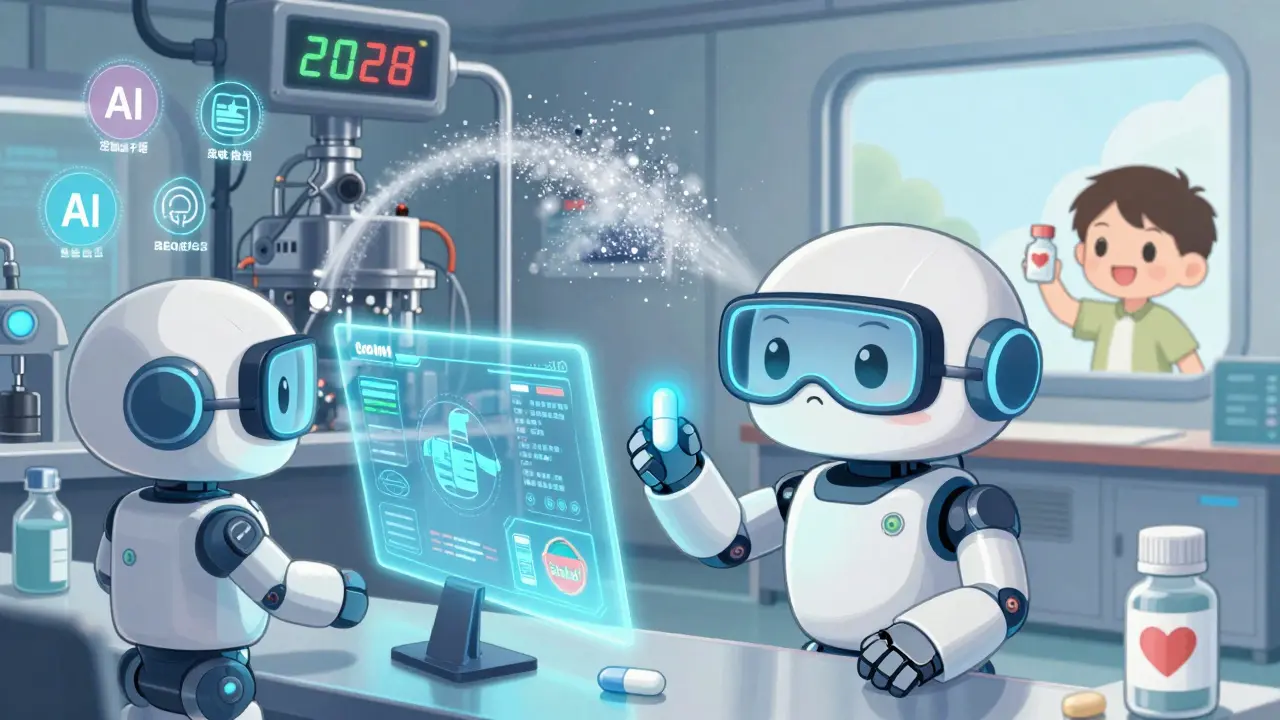
Others are using AI to predict quality issues before they happen. Imagine a system that watches temperature, pressure, and humidity in real time and flags a problem before a single pill is made. That’s not science fiction. By 2028, McKinsey predicts 65% of manufacturers will have these systems in place.
Electronic Quality Management Systems (eQMS) are also becoming standard. By 2023, 65% of large manufacturers had adopted them. These tools automate record-keeping, reduce human error, and make audits faster.
Still, adoption is slow. Only 18% of all generic drug facilities use advanced manufacturing tech. Why? Because validating new systems under CGMP is complex. The FDA is working on draft guidance for continuous manufacturing, expected in 2024. That could change everything.
The Bottom Line
CGMP isn’t about bureaucracy. It’s about safety. Every pill you take should be safe, pure, and effective. That’s not a luxury-it’s a right. The FDA’s rules exist because people have died from dirty, poorly made drugs. And every time a generic drug is approved, the FDA is saying: "We’ve checked the factory. We’ve seen the records. We trust this."
For manufacturers, CGMP is a cost. For patients, it’s peace of mind.
Are CGMP requirements different for generic drugs vs. brand-name drugs?
No. The FDA requires generic drugs to be made under the exact same Current Good Manufacturing Practices (CGMP) as brand-name drugs. The law doesn’t allow for lower standards just because a drug is generic. This ensures that a generic version is pharmaceutically equivalent to the original-same active ingredient, same strength, same quality. Pfizer and other manufacturers confirm this in public documentation: generics must meet "the same strict standards" as branded products.
What happens if a generic drug manufacturer violates CGMP?
Violations can lead to serious consequences. The FDA may issue a Warning Letter, which publicly names the company and demands corrective action. If the issue isn’t fixed, the agency can block the drug from being sold, seize inventory, or even pursue civil penalties. In extreme cases, facilities are shut down. The 2022 metformin recalls happened because of CGMP failures in cleaning and process validation. The FDA doesn’t tolerate repeated or serious breaches.
Do all generic drug factories get inspected the same way?
No. Domestic facilities are inspected more frequently-about 1.3 times per year on average. Foreign facilities historically received fewer inspections, but that’s changing. The FDA’s 2023-2027 strategic plan commits to increasing foreign inspections by 25%. However, data from 2020-2022 shows foreign facilities received 43% fewer warning letters per inspection than U.S. plants, raising concerns about enforcement gaps. The FDA says it’s improving oversight, but critics argue disparities still exist.
How much does CGMP compliance cost a generic drug company?
For a mid-sized generic manufacturer, annual compliance costs average $2.3 million. This includes training, equipment maintenance, validation studies, electronic record systems, and hiring qualified staff. Large companies spend far more-some over $10 million a year. A 2021 Avalere Health study found CGMP compliance adds 12-15% to total manufacturing costs. For small firms, this can be a barrier to entry, which is why many rely on contract manufacturers with existing infrastructure.
What’s the biggest challenge in meeting CGMP today?
The biggest challenge is data integrity. Many companies struggle to meet FDA’s Part 11 requirements for electronic records, especially audit trails, user access controls, and data backup. A 2023 Pharma Intelligence survey found 78% of firms had trouble implementing these systems. Other major issues include supply chain controls for active ingredients and inconsistent interpretation of rules between FDA inspectors. Some manufacturers report that one inspector might flag a minor paperwork error, while another overlooks the same issue.
Is CGMP going to change in the next few years?
Yes. The FDA is shifting toward real-time quality assurance. Instead of testing finished batches, future inspections will focus on continuous monitoring using sensors and AI. Draft guidance for advanced manufacturing, including continuous production, is expected in 2024. The agency is also tightening rules around supply chain security and component testing, especially after incidents like the 2022 diethylene glycol contamination. By 2028, most manufacturers will likely use predictive analytics to prevent quality issues before they occur.

Comments
Okay so let me break this down for you people who think the FDA is some kind of hero. The FDA doesn’t inspect every single batch. They don’t even inspect every facility every year. And guess what? A lot of the ‘generic’ drugs you’re taking? Made in India or China by companies that pay off inspectors or use fake documents. I’ve seen the reports. The FDA’s own audits show 60% of foreign facilities have serious violations and still get approved. They’re not protecting you-they’re protecting Big Pharma’s monopoly. If you think your $4 generic is just as safe as the $400 brand name, you’re living in a fantasy. The system is rigged. And no, I’m not a conspiracy theorist-I’m just the guy who read the actual FDA inspection reports. You want peace of mind? Buy the brand. Or better yet, don’t take any of it.
Bro, I just want to say-this is actually one of the most important things people need to know. I work in a pharmacy and see people skip their meds because they’re ‘too expensive’ or ‘not the same.’ But this? This is why generics are safe. It’s not magic. It’s science, paperwork, and a ton of people working behind the scenes to make sure your blood pressure pill doesn’t turn into poison. Kudos to the FDA for not taking shortcuts. And to the workers in those factories? You’re heroes. No one talks about you, but you’re the reason millions stay alive.
I have a cousin who works in a generic drug lab in Hyderabad. She told me last week that they had to destroy 17 pallets of metformin because the humidity control failed for 4 hours. Just FOUR HOURS. And you know what? The FDA didn’t even show up for that inspection-they were supposed to come in 3 weeks. She said the plant manager just said ‘it’s fine’ and shipped it anyway. And now? People are dying. Not because the science is bad. Because the system is broken. They cut corners because the profit margin is 3%. That’s not capitalism. That’s negligence. And the FDA? They’re too busy inspecting 300 U.S. plants while ignoring the 1,200 overseas ones that make 80% of our pills. This isn’t about regulation-it’s about greed. And we’re all paying for it with our health.
So the FDA says they inspect every facility. But do they? Or do they just say they do? I mean, if you’re a company and you know inspections are random and infrequent, why not just fake the records? It’s cheaper. And who’s gonna catch you? A guy with a clipboard who flies in once every 2 years? I’ve worked in QA. I know how it works. The system is designed to look like it’s working, not actually work. The real problem isn’t the rules-it’s the enforcement. And the enforcement is a joke. We’re all just pretending.
It is imperative to elucidate that the regulatory framework governing Current Good Manufacturing Practices (CGMP) is codified under Title 21 of the Code of Federal Regulations, Parts 210 and 211. The substantive compliance obligations are non-negotiable and are enforced through a combination of pre-approval inspections, for-cause audits, and routine surveillance. However, the disparity in inspection frequency between domestic and foreign establishments constitutes a systemic vulnerability, particularly given the outsized reliance on supply chains from jurisdictions with divergent regulatory capacities. The 2022 NDMA contamination incident was not an anomaly-it was an inevitable consequence of structural under-resourcing and jurisdictional arbitrage.
If your life depends on a pill made in a factory with no air filters, you deserve better. And if the FDA lets that happen? They’re complicit.
USA FIRST!!! Why are we letting China and India make our medicine??? We need to bring it home!!! $$$ $$$ $$$
I get why people are frustrated. But let’s not throw the baby out with the bathwater. The system isn’t perfect-but it’s still the best we’ve got. I’ve seen bad batches. I’ve seen recalls. But I’ve also seen people who couldn’t afford their meds before generics, and now they’re alive because of them. It’s messy. It’s imperfect. But it saves lives. Let’s fix the gaps, not trash the whole thing.
OMG this was so interesting!! I had no idea about the 11 subparts!! I just thought they checked if the pill looked right 😅 I just started working in a pharmacy and I’m learning so much!! I love how detailed this is!! Also-can someone explain Part 11 again? I think I missed it?? 😊
Just wanted to say-this is why I respect the FDA. Not because they’re perfect, but because they try. I know people hate them, but if they didn’t exist, we’d be back to the 1930s where people died from cough syrup made with antifreeze. We need more transparency, sure. But we also need to not pretend the system is a joke just because it’s hard. It’s hard because lives are on the line.
Bro I work in a lab in India and we make generics for US. We follow all rules. We have audits every 3 months. We test every batch. We use AI to monitor temp. I know some places cut corners, but not us. We care. We have families too. Don’t blame all of us because of a few bad apples. We want to do right. Just give us time and fair inspections.
Let me tell you something profound, my dear naive consumers. The entire pharmaceutical-industrial complex is a carefully choreographed illusion. The FDA? A puppet. The generic manufacturers? Pawns. The real power lies with the patent trolls, the private equity firms that own the contract labs, and the shadowy regulatory consultants who write the very guidelines they claim to enforce. You think you’re getting medicine? No. You’re getting a meticulously documented performance of safety. The pills are real. The system? A theater. And we, the people, are the audience clapping politely while the stage burns.
You think CGMP is about safety? Nah. It’s about control. The FDA doesn’t want you to have cheap medicine. They want you to have expensive medicine they approve. That’s why they make compliance so hard. Small labs can’t afford it. Big labs buy the inspectors. It’s not about quality-it’s about market dominance. The real crime isn’t contamination. It’s monopoly. And the FDA? They’re the gatekeeper. They don’t protect the people. They protect the system. Wake up.
I’m not saying the system is perfect. But I’ve worked with inspectors. They’re not bureaucrats-they’re scientists. They’re tired. They’re underfunded. They’re flying to factories in the middle of nowhere just to check if a thermometer is calibrated. And you know what? Most of them hate writing warning letters. They’d rather help you fix it. The problem isn’t the inspectors. It’s that we don’t fund them enough. And we act like they’re the enemy. Maybe we need to stop yelling and start helping.
Let’s be real-data integrity is the Achilles’ heel. The FDA’s Part 11 requirements are a nightmare for legacy systems. I’ve seen plants with 20-year-old Excel sheets labeled as ‘audit trails.’ They think ‘save as’ counts as version control. Meanwhile, the FDA’s inspectors are trained on 2010 guidance and still use clipboards. The gap isn’t between countries-it’s between technology and regulation. We’re still using 1978 rules to police 2024 AI-driven manufacturing. That’s not oversight. That’s a time capsule.