
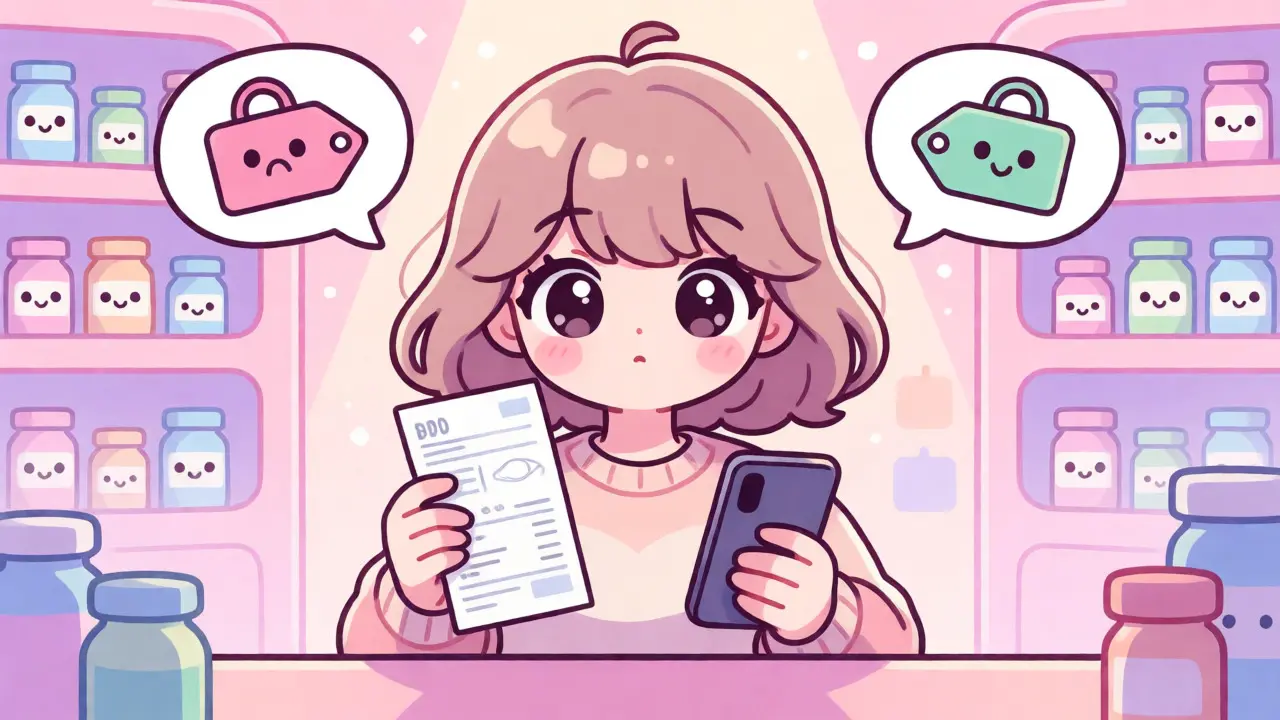
You just picked up a prescription for generic atorvastatin. The pharmacist quotes you $45. You walk out, open your phone, and see it listed for $12 on a different site. What gives? Is the cheap one fake? Are you being ripped off? Or is there just no standard way to check generic prices across the board?
The truth is messy but manageable. Most people assume that because a drug has the same active ingredient, the price should be similar everywhere. It isn’t. Pricing in the pharmaceutical world is opaque, fragmented, and heavily influenced by which middlemen get paid. But you don’t need a degree in pharmacology or economics to navigate this. You just need to know where to look and what numbers actually matter.
Why Your Pharmacy Quote Isn’t the Final Price
When you ask a local pharmacist for a cash price, they’re often giving you their "list price." This number rarely reflects what insurance companies negotiate or what online discount cards offer. Pharmacies make money on volume and on drugs where margins are high. For common generics like lisinopril or metformin, margins can be razor-thin at big chains, so they might not aggressively discount them unless you have specific insurance.
Online platforms change the game because they aggregate data from hundreds of pharmacies, mail-order services, and direct-to-consumer labs. They remove the information asymmetry. In retail, we’ve had price comparison engines like Google Shopping for decades. According to industry analysis, these tools save shoppers an average of 18.7% per transaction. In healthcare, that gap can be even wider-sometimes hitting 50% or more for uninsured patients buying generics.
But GoodRx isn’t the only player. Tools like SingleCare, RxSaver, and Blink Health operate similarly but pull from different networks. A quick test: search for "amlodipine 5mg" on three different apps. You’ll likely see three different "lowest" prices. Why? Because each app has different contracts with pharmacy benefit managers (PBMs) and different inventory agreements with retailers.
How Comparison Engines Work (And Where They Fail)
Most online pharmacy comparison sites work by scraping public pricing feeds and applying proprietary coupons. When you see a price of $9.99 for a 30-day supply of generic sildenafil, that’s usually a promotional rate tied to a specific coupon code. If you forget to print or show that code, you pay full retail.
Here’s the catch: many sites list prices that are technically available but practically difficult to get. Some require you to sign up for a membership. Others require you to buy a 90-day supply to unlock the low monthly rate. And some display prices from mail-order pharmacies that take two weeks to ship, which doesn’t help if you need meds today.
A 2025 analysis by SEO.ai noted that while major comparison engines process billions of listings, accuracy issues persist. About 63% of negative user feedback relates to outdated pricing. In the pharma space, this means you might drive to a pharmacy, show the coupon, and hear, "Sorry, that price expired yesterday," or "We don’t carry that manufacturer." Always call ahead.
| Platform | Best For | Hidden Costs | User Rating Trend |
|---|---|---|---|
| GoodRx | Widest pharmacy network; good for urgent needs | None for basic use; premium features cost extra | High trust, but ads clutter interface |
| SingleCare | Consistent discounts on chronic meds | Requires free account signup | Stable pricing; less volatile than GoodRx |
| Amazon Pharmacy | Prime members; auto-refill convenience | Shipping delays if not Prime; limited stock | Rising popularity; mixed reviews on support |
| Costco Pharmacy | Lowest base prices without coupons | Membership fee ($65/year); must visit in person | Very high satisfaction among members |
The Manufacturer Factor: Not All Generics Are Created Equal
This is where most people stop looking. They find the cheapest price and assume all pills are identical. FDA rules say generics must have the same active ingredient, strength, dosage form, and route of administration. But they don’t mandate the same inactive ingredients (fillers, binders, dyes) or the same manufacturing tolerances.
For most healthy adults, these differences don’t matter. But if you’re sensitive to certain dyes or fillers, or if you’re taking narrow-therapeutic-index drugs (like levothyroxine for thyroid issues), switching manufacturers frequently can cause side effects or efficacy changes. Cheap online prices often come from lesser-known manufacturers who bid low to win market share.
Before you lock in a price, check the manufacturer name listed on the site. If you’ve had success with Teva or Mylan in the past, try to filter results for those brands. Sometimes paying $3 more for a trusted manufacturer is worth avoiding a doctor’s visit for unexpected side effects.
Strategies to Beat the System
Don’t rely on one source. Here’s a practical workflow I use when refilling prescriptions:
- Start with your insurance: Check your plan’s formulary. Sometimes the copay is lower than any cash price. Use your insurer’s website first.
- Cross-reference with GoodRx and SingleCare: Search the same drug on both. Note the lowest price and the pharmacy location.
- Check Costco or Walmart: If you live near a Costco, log in to their online portal. Their base prices for generics are often unbeatable without needing coupons. Same for Walmart’s $4 generic list.
- Call the pharmacy: Confirm they have the stock and will honor the coupon. Ask, "What is the cash price with the [Coupon Name] applied?"
- Consider mail-order: If you’re stable on your meds, a 90-day supply via mail order can cut costs by 30-50%. Just factor in shipping time.
One pro tip: set price alerts. Apps like GoodRx allow you to track a specific medication. If the price drops below a threshold, you get a notification. This works well for non-urgent refills where timing is flexible.
Pitfalls to Avoid
Beware of "too good to be true" prices from unknown websites. If a site isn’t verified by NABP (National Association of Boards of Pharmacy) DotCom Certification, be cautious. Fake pharmacies exist. They might sell counterfeit drugs or never ship anything. Stick to established players or local pharmacies linked through reputable aggregators.
Also, watch out for dynamic pricing. Just like airline tickets, pharmacy prices can fluctuate based on demand, inventory levels, and even your browsing history (though less aggressively than travel sites). Don’t panic if the price jumps $2 between searches. That’s normal volatility.
Finally, remember that saving money shouldn’t compromise care. If a cheaper option requires you to switch pharmacies every month, you lose continuity. Your pharmacist gets to know your interactions and history. Losing that relationship can lead to missed warnings about drug interactions. Balance cost with consistency.
Frequently Asked Questions
Are generic drugs really safe?
Yes. The FDA requires generic drugs to prove bioequivalence to the brand-name version. This means they deliver the same amount of active ingredient into your bloodstream at the same rate. While inactive ingredients may vary, the safety and efficacy standards are rigorous. Millions of people safely use generics daily.
Why do prices vary so much between pharmacies?
Pharmacies compete differently. Some focus on volume and accept lower margins. Others rely on insurance contracts that dictate reimbursement rates. Cash prices are set independently and can reflect local competition, overhead costs, and strategic promotions. Online tools reveal these discrepancies by aggregating real-time data.
Can I use a GoodRx coupon if I have insurance?
Generally, no. Insurance and coupons don’t stack. However, you should compare the insurance copay against the GoodRx cash price. Often, the cash price with a coupon is lower than the insurance copay, especially for low-cost generics. If you choose the coupon, you won’t meet your deductible for that purchase.
Is it better to buy 30 days or 90 days?
Buying 90 days is almost always cheaper per unit. Many pharmacies and online retailers offer significant discounts for bulk purchases. However, ensure you’re stable on the medication. If your doctor might change your dose soon, sticking to 30 days avoids waste.
Do online pharmacies require a prescription?
Legitimate online pharmacies always require a valid prescription from a licensed provider. They will verify it with your doctor’s office before shipping. If a site sells antibiotics or controlled substances without asking for a prescription, it’s likely operating outside US regulations and poses a safety risk.

Comments
omg this is so true i saved like $30 last week just by checking singlecare before going to cvs
the pharmacist looked at me weird when i showed the app but whatever money talks right??
also goodrx sometimes has that weird glitch where it says price is 10 then its 40 at counter ugh
The fundamental issue here isn't just 'opaque pricing' as you put it, but the systemic failure of the PBM (Pharmacy Benefit Manager) triad model which creates artificial arbitrage opportunities.
When you cite an 18.7% savings metric, you are ignoring the actuarial reality that these discounts are often subsidized by higher list prices on non-formulary drugs or inflated reimbursement rates negotiated behind closed doors. The consumer-facing transparency provided by GoodRx or SingleCare is merely a veneer over a deeply inefficient market structure where the payer, provider, and patient incentives are misaligned.
Furthermore, your suggestion to cross-reference with Costco ignores the marginal utility cost of membership fees for sporadic users. For a chronic condition requiring monthly refills, sure, the amortization works. But for acute prescriptions, the friction cost outweighs the benefit.
You also glossed over the bioequivalence nuances regarding narrow therapeutic index drugs. While FDA standards are rigorous, the clinical variance in inactive ingredients can lead to significant pharmacokinetic deviations in sensitive populations. Dismissing this as a minor concern for 'most healthy adults' is dangerously reductive given the aging demographic profile of prescription drug consumers.
Ultimately, relying on dynamic pricing algorithms without understanding the underlying contractual obligations between pharmacies and PBMs leaves patients vulnerable to bait-and-switch tactics that aren't captured in simple price comparisons.
wait wait wait 🛑 stop everything 💅
i literally spent 2 hours yesterday trying to figure out why my levothyroxine was costing more than my lunch 🤯
the fact that we have to be our own healthcare analysts is actually insane 😩
like hello?? i went to med school not business school lol
but yeah the manufacturer thing is HUGE 👀 i switched brands because of a coupon and felt terrible for a month until i realized it was the fillers 📉
so annoying that we have to do all this homework just to take meds 🙄
anyway thanks for the tip about calling ahead 📞 i always forget that part and end up standing there looking stupid 🤡
Actually... no. That's not how it works. You're missing the point entirely. It's not about "finding" prices; it's about gaming the system. And frankly? Most people don't have the time. Or the energy. Or the desire to compare five different apps just to save three dollars. Three dollars! Is that worth your sanity? Probably not. Unless you're unemployed. Then maybe. But even then. The hassle factor is real. Very real. Don't believe the hype. It's mostly noise. Pure noise.
ugh another article telling us we need to work harder to afford basic survival items
i tried goodrx once and drove 20 mins to a pharmacy that had the deal only to find out they were out of stock
wasted gas wasted time wasted my will to live
just let me pay my insurance copay and go home please
this whole "comparison shopping" thing is just capitalism making us feel guilty for being poor
if the price is hidden it’s their fault not mine
stop blaming the victim for not doing enough research while they’re sick
it’s exhausting and frankly a bit tone deaf
i give up
going back to bed
this hits close to home honestly
my mom used to stress so much about pill costs
she’d call every pharmacy in town
and still feel ripped off
it’s hard when you’re already feeling unwell
to have to become a detective too
the advice about sticking with one pharmacy for continuity is really important though
that relationship matters more than saving a few bucks sometimes
glad you mentioned that balance
we forget that care is human too
Oh wow, what a fantastic read! Truly inspiring stuff! I love how optimistic you are about navigating this mess! We totally can beat the system if we just try hard enough! Keep fighting the good fight everyone! This is exactly the kind of empowerment content we need in today's economy! Go get those savings! You've got this! Let's turn that frown upside down and check those coupons! Amazing job highlighting the power of consumer choice! Really uplifting perspective!
While the practical tips are serviceable, the analysis lacks depth regarding the structural inequities inherent in US healthcare pricing models. One cannot simply 'beat' a system designed by monopolistic entities through individual consumer action alone. The focus on generic price comparison assumes a level playing field that does not exist, particularly for uninsured populations who bear the brunt of retail markups. A more robust discussion would address policy-level interventions rather than merely offering tactical workarounds for systemic failures. Nevertheless, the data points provided are accurate within their limited scope.
Your assertion that online platforms remove information asymmetry is fundamentally flawed. They do not remove it; they obscure it further by introducing algorithmic opacity and conditional pricing structures that require specific user behaviors to unlock. Furthermore, the reliance on NABP certification as a sole safeguard against counterfeit drugs is naive at best and negligent at worst. Many legitimate-looking sites operate in regulatory gray areas that exploit international shipping loopholes. Your advice to 'call ahead' places an undue administrative burden on the patient, effectively shifting labor from the healthcare provider to the consumer. This is not efficiency; it is abdication of responsibility. The financial implications of switching manufacturers for narrow-therapeutic-index drugs are not trivial side notes but critical safety concerns that deserve far more prominence than a brief paragraph buried in the middle of the text. Your tone suggests a casual ease that belies the genuine anxiety many patients face when managing chronic conditions on fixed incomes.
honestly americans complain too much
in india we pay peanuts for same meds
you guys spend more on coffee than atorvastatin usually
why make it so complicated?
just go to local shop
they know you
they give discount
no need for fancy apps
apps charge data plans and battery life
real community commerce is better
you trust the person handing you the pill
not some random website with ads
americans always overthink simple things
go outside talk to humans
save money save soul
done deal
great post
the pbm explanation is key
people dont realize the middlemen take cuts
good reminder to check formulary first
insurance copay vs cash price is crucial
thanks for the workflow tips
very helpful
keep it up