

Imagine taking a pill that is chemically identical to the one you’ve taken for years, yet suddenly your stomach churns or your skin breaks out. It feels like a mystery, but the culprit might not be the medicine itself. It could be the excipients-the "inactive" ingredients mixed into the tablet. While we focus on the active pharmaceutical ingredient (API) that treats our condition, these supporting components play a massive role in how your body reacts to the drug. For most people, excipients are harmless fillers. But for sensitive individuals, they can trigger real intolerance issues, especially when switching between brand-name drugs and generics.
What Are Excipients?
To understand why tolerances change, we first need to define what an excipient actually is. The U.S. Food and Drug Administration (FDA) defines excipients as any inactive ingredients intentionally added to therapeutic products that are not intended to exert a therapeutic effect at the intended dosage. Think of them as the vehicle that delivers the passenger (the API) to its destination. Without excipients, many medications would be impossible to manufacture, store, or swallow.
Their primary jobs are practical: they provide bulk to tiny doses of active ingredients, help tablets dissolve at the right speed, prevent sticking during manufacturing, and extend shelf life. Common examples include lactose (a filler), magnesium stearate (a lubricant), and croscarmellose sodium (a disintegrant). While labeled "inactive," this term is misleading. As Dr. David S. Kroll noted in *The Scientist*, chemicals like polyethylene glycol are often inactive in one context but are the key active ingredient in over-the-counter laxatives. They are biologically active; they just aren’t the *therapeutic* agent for your specific condition.
The Hidden Variability in Generic Drugs
Here is where things get tricky for patients. When a company develops a generic version of a brand-name drug, federal law requires it to prove bioequivalence. This means the generic must deliver the same amount of active ingredient into your bloodstream within the same time frame as the original brand (typically within 80-125% of the reference product’s pharmacokinetic parameters). However, there is no requirement for generics to use the exact same excipients as the brand-name counterpart.
A landmark 2019 study published in *Science Translational Medicine* by researchers from Brigham and Women's Hospital and MIT highlighted this issue starkly. They analyzed 42,052 oral medications and found that the average oral drug contains 8.8 different excipients. More alarmingly, they discovered that 90.2% of all oral medications contain at least one adverse reaction-associated inactive ingredient (ARAII). Because manufacturers can choose different formulations, two generic versions of the same medication-even from different companies-can have completely different excipient profiles. If you switch pharmacies or if your insurer changes its preferred generic manufacturer, you might unknowingly ingest a new set of inactive ingredients.
| Feature | Brand-Name Drug | Generic Drug |
|---|---|---|
| Active Ingredient | Identical chemical structure | Identical chemical structure |
| Bioavailability | Reference standard | Must match reference (80-125%) |
| Excipients | Fixed proprietary formula | Can vary significantly between manufacturers |
| Cost | Higher (R&D costs included) | Lower (typically 80-85% cheaper) |
| Tolerance Risk | Consistent for patient | Variable if manufacturer switches |
This variability creates a blind spot. You might tolerate Brand X perfectly for five years, then switch to Generic Y and experience nausea, bloating, or headaches. It isn’t necessarily that the generic is "worse"; it’s that the inactive ingredients are different, and your body is reacting to those specific additives.

Common Excipients That Trigger Intolerance
Not all excipients are created equal in terms of safety for sensitive individuals. Some are far more likely to cause adverse reactions than others. Understanding these common culprits can help you identify potential triggers.
- Lactose: Found in approximately 40-60% of oral solid dosage forms, lactose is used as a filler to add bulk to tablets. For patients with lactose intolerance, even small amounts can cause abdominal pain, bloating, flatulence, and diarrhea. While severe intolerance usually requires larger doses (>12g daily), highly sensitive individuals may react to as little as 1-2 grams.
- Artificial Dyes: Colors like FD&C Blue #1, Yellow #5, and Red #40 are used to make pills visually distinct. These dyes are known allergens for some people, potentially causing skin rashes, migraines, or gastrointestinal distress. A user on Reddit’s r/pharmacy community reported severe GI distress after switching to a generic thyroid medication containing FD&C Blue #2, which they were previously unaware they were sensitive to.
- Magnesium Stearate: Often used as a lubricant to prevent pills from sticking to machinery, magnesium stearate is derived from vegetable or animal fats. Some holistic health advocates claim it affects absorption, though scientific consensus varies. However, it remains a point of contention for those avoiding certain fat sources.
- Sulfites and Parabens: Used as preservatives to extend shelf life, sulfites can trigger asthma attacks in sensitive individuals, while parabens have been linked to skin sensitivities in topical applications.
- Gluten: While rare in modern formulations, trace amounts of gluten can sometimes be present in older formulations or specific binders, posing a risk for patients with celiac disease.
The FDA’s Inactive Ingredient Database (IID) tracks approved concentrations for these substances, but the database is primarily designed for regulatory compliance rather than patient-friendly allergy screening. This gap leaves patients and doctors to navigate the complexities of ingredient lists manually.
Why Do Patients React Differently?
You might wonder why your neighbor takes the same generic without issue while you suffer side effects. The answer lies in individual biological variability and the "context of use." Factors such as genetics, gut microbiome composition, and pre-existing conditions influence how your body processes inactive ingredients.
Dr. Giovanni Traverso, senior author of the 2019 MIT study, emphasized that the assumption that inactive ingredients are universally inert is fundamentally flawed. His team identified 38 specific excipients associated with adverse reactions. Furthermore, the route of administration matters. Oral solids have more flexibility in excipient choice compared to ophthalmic (eye drops) or parenteral (injectable) drugs, where regulations are stricter. For instance, injectable generics must contain identical excipients at identical concentrations to the reference drug, except for minor buffers or preservatives. This strictness exists because direct injection bypasses the digestive system’s filtering mechanisms, making tissue tolerance critical.
Chronic exposure also plays a role. Taking a medication once a day for ten years means your body is exposed to those excipients 3,650 times. Over time, low-level sensitivities can accumulate or manifest as new allergies develop. Additionally, dose dumping-a phenomenon where inappropriate excipients cause the drug to release too quickly-can lead to sudden spikes in drug concentration, mimicking side effects that are actually formulation errors.
How to Manage Excipient Sensitivities
If you suspect your symptoms are linked to inactive ingredients, don’t stop taking your medication abruptly. Instead, take a systematic approach to identify and mitigate the issue.
- Track Symptoms and Timing: Note when symptoms start relative to taking the medication. Do they occur immediately? Hours later? Does switching brands correlate with symptom onset?
- Check the Ingredients List: Use resources like the FDA’s Pillbox database or the National Library of Medicine’s DailyMed to view the full list of inactive ingredients for both your current generic and previous brand/generic versions. Look for differences.
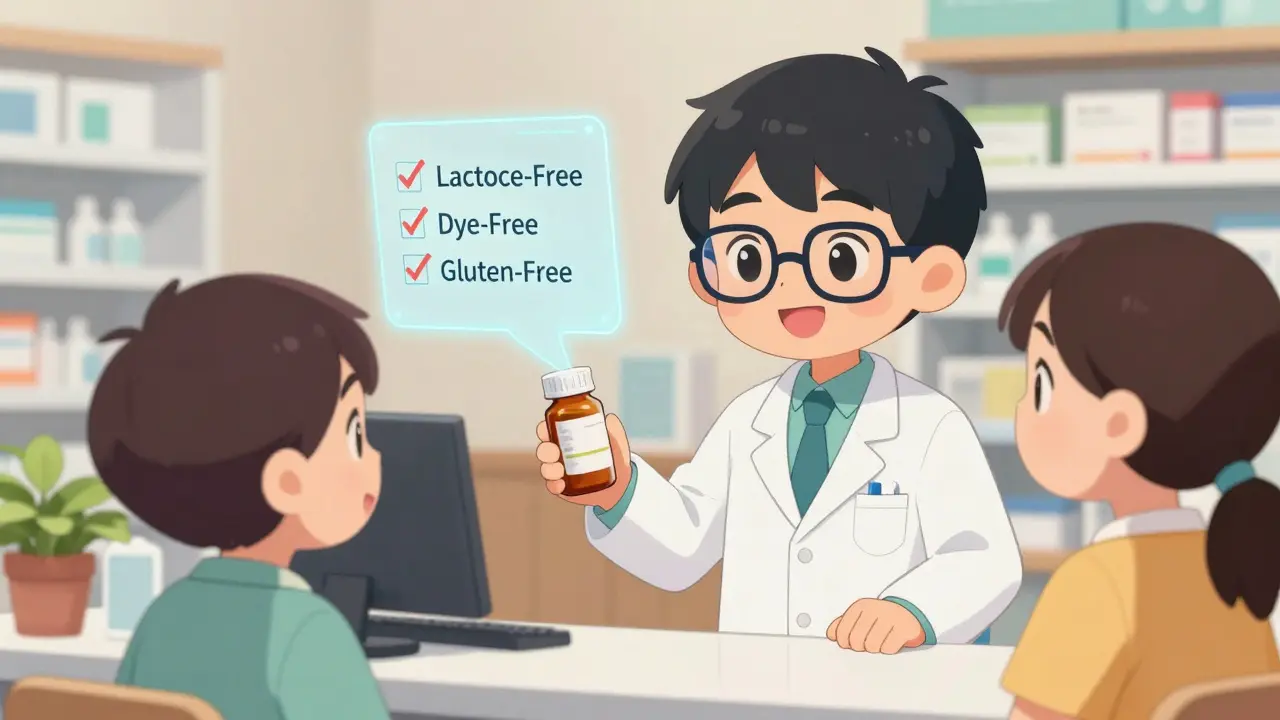
- Consult Your Pharmacist: Pharmacists are trained to identify formulation differences. A 2022 survey found that 68.3% of independent pharmacists had patients report adverse reactions linked to excipient switches. Ask if another generic manufacturer uses a different formulation without your suspected trigger (e.g., lactose-free or dye-free).
- Request a Specific Manufacturer: In some cases, your doctor can write “Dispense as Written” or specify a particular manufacturer’s generic on the prescription. This ensures consistency, preventing unexpected switches.
- Consider Specialty Formulations: The market for specialty excipients (gluten-free, lactose-free, dye-free) is growing rapidly, reaching $18.7 billion globally in 2022. Ask your provider if a specialized formulation is available for your condition.
Documentation is key. If you confirm a sensitivity, ensure it is recorded in your medical records as a specific excipient intolerance (e.g., "Intolerant to FD&C Blue #1") rather than a general drug allergy. This helps future providers avoid similar pitfalls.
The Future of Excipient Safety
Awareness around excipient safety is evolving. The FDA launched the "Excipient Safety Modernization Initiative" in 2023 to update databases with patient-reported outcomes. Meanwhile, researchers at MIT developed an AI-powered tool in 2022 that predicts individual excipient tolerance based on genetic markers, suggesting a future where personalized medicine extends beyond active ingredients to the entire pill composition.
Regulatory bodies are also shifting. The European Medicines Agency published a reflection paper in 2022 on excipient qualification, and the FDA plans to require complete excipient disclosure in electronic prescribing systems by 2025. These changes aim to close the information gap between manufacturers, prescribers, and patients. Until then, staying informed and proactive about what goes into your pills is the best defense against unexpected intolerance issues.
Are generic drugs less effective than brand-name drugs?
No. Generic drugs must demonstrate bioequivalence to the brand-name drug, meaning they deliver the same amount of active ingredient into your bloodstream within the same timeframe. The difference lies in the inactive ingredients (excipients), which do not affect therapeutic efficacy but can influence tolerance and side effects in sensitive individuals.
Can I ask my pharmacist for a specific generic manufacturer?
Yes. While insurance plans often prefer the lowest-cost generic, you can request a specific manufacturer if you have experienced intolerance issues with others. Your doctor may also need to specify "Dispense as Written" or note the manufacturer on the prescription to override automatic substitution policies.
How do I find out what inactive ingredients are in my medication?
You can check the FDA’s Pillbox database or the National Library of Medicine’s DailyMed website. Enter your drug name and look for the "Inactive Ingredients" section. Alternatively, ask your pharmacist to show you the package insert or contact the manufacturer directly for detailed formulation data.
Is lactose common in generic pills?
Yes, lactose is used as a filler in approximately 40-60% of oral solid dosage forms. If you are lactose intolerant, always check the inactive ingredient list. Many manufacturers now offer lactose-free alternatives, but they may not be the default generic option provided by pharmacies.
Do eye drops and injections have the same excipient rules as pills?
Stricter rules apply to non-oral routes. Ophthalmic (eye drop), otic (ear drop), and parenteral (injectable) generic products are required to contain identical excipients at identical concentrations as the reference listed drug, with very few exceptions. This is because local tissue tolerance is critical for these delivery methods.