
Imagine walking into a hospital where the staff is so stretched that the remaining nurses are working double shifts just to keep the lights on. This isn't a nightmare scenario; it's the current reality for many facilities. With the U.S. Health Resources & Services Administration projecting a shortage of up to 3.2 million healthcare workers by 2026, the industry is hitting a breaking point. We aren't just talking about a few missing slots on a schedule; we're seeing a systemic collapse that threatens patient safety and clinician mental health. To survive, health systems are moving past simple "help wanted" ads and implementing aggressive healthcare workforce shortage mitigation strategies that rethink how medicine is actually delivered.
Quick Wins: Tactical Staffing Fixes
When a unit is dangerously understaffed, hospitals can't wait for a four-year degree program to graduate new students. They need boots on the ground now. This has led to a massive surge in temporary staffing. For instance, about 12.7% of U.S. hospitals relied on travel nurses during peak demand periods in 2023. While effective in a pinch, this is an expensive gamble. Many systems are now trying to pivot toward internal staffing models. Kaiser Permanente reported in 2024 that building their own internal pools reduced their reliance on external agencies by 28%.
Beyond just hiring, hospitals are getting creative with who does what. About 43% of hospitals have implemented cross-training, allowing staff to move between departments based on where the need is greatest. It's not a perfect solution-nobody likes being a "float" nurse-but it prevents total system failure during surges. Additionally, recruiting internationally has become a staple, with 18% of U.S. hospitals bringing in talent from abroad to fill critical gaps.
The Digital Shift: Virtual Nursing and AI
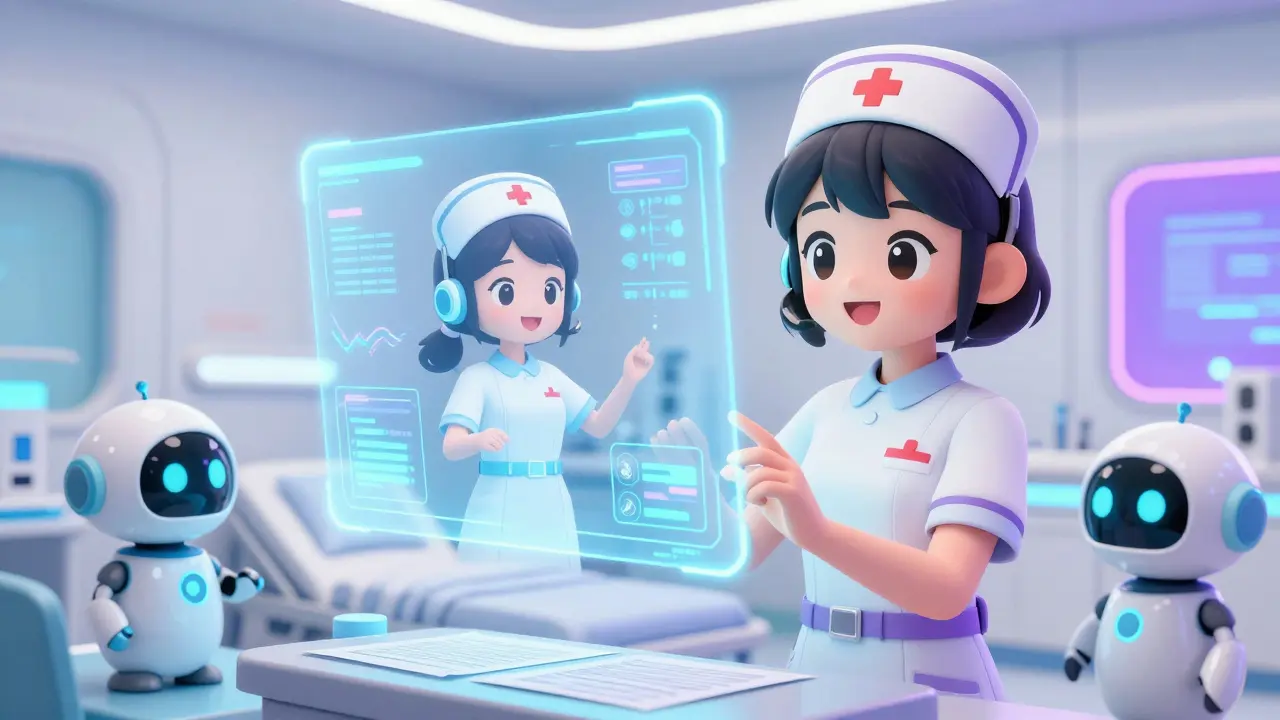
If you can't find more people, you have to make the people you have more efficient. This is where technology steps in. Virtual Nursing is no longer a futuristic concept; it's a lifeline. Adoption of telehealth nursing jumped from 35% to 68% between 2022 and 2024. By having an experienced nurse monitor patients via camera and handle discharge paperwork remotely, the bedside nurse can actually focus on physical care.
Then there is the AI explosion. We are seeing a massive shift toward Intelligent Automation. IDC projects a 51% increase in generative AI spending from 2024 to 2025. It's not about replacing doctors, but about killing the paperwork. Look at Baptist Health: by using AI-powered intelligent document processing, they slashed their administrative burden by 37%. When a clinician spends less time fighting with an electronic health record, they have more time for patients, which directly reduces burnout.
| Strategy | Primary Goal | Observed Result (Approx.) |
|---|---|---|
| Virtual Nursing | Bedside Support | 68% Adoption Rate (2024) |
| AI Document Processing | Admin Reduction | 37% Lower Admin Burden |
| Flexible Scheduling | Burnout Prevention | 19% Reduction in Burnout |
| Internal Staffing Models | Cost Control | 28% Less Agency Reliance |
Fighting Burnout with Flexibility and Support
Why are people leaving? It's rarely just about the money. Burnout is an epidemic, with 63% of healthcare workers reporting symptoms in 2024. If the job feels like a conveyor belt of stress, no sign-on bonus will keep a nurse for more than a year. This is why flexible scheduling has become a top priority. Pilot programs in 37% of major hospital systems have seen burnout rates drop by 19% simply by giving staff more control over their hours.
Mental health support is another critical pillar. When hospitals actually invest in wellness programs, turnover drops. Data from the Journal of Healthcare Management showed a 17% decrease in turnover for facilities with robust mental health support. It turns out that acknowledging the trauma of the job actually makes people stay. Coupled with career development pathways-which have increased retention by 23%-hospitals are finally treating their staff as long-term assets rather than disposable labor.
Long-Term Talent Pipelines
Tactical fixes are like putting a bandage on a deep wound; you eventually need surgery. The "surgery" in this case is reforming how we train healthcare workers. We are seeing the rise of accelerated nursing programs, which have nearly doubled their graduates over the last decade, adding about 8,000 new nurses to the workforce annually.
Another interesting trend is micro-credentialing. About 29% of health systems now use these short, focused certifications to let staff prove competence in specific niches without needing a full new degree. This boosts job satisfaction by 18% because it gives workers a sense of progression. Even the way we handle retirement is changing. Johns Hopkins University School of Nursing found that phased retirement programs-where faculty work fewer hours but keep full benefits-increased clinical faculty retention by 22%.
The Power of Strategic Partnerships
No single hospital can solve a national shortage. The most successful systems are those that build ecosystems. Mayo Clinic, for example, partnered with community colleges in Minnesota, which boosted their healthcare worker pipeline by 47% between 2022 and 2024. It's a simple logic: if you train the local population, they are more likely to stay and work in their own community.
On a larger scale, we're seeing a push for policy change. The Resident Physician Shortage Reduction Act of 2023 is a prime example, with organizations like Kaiser Permanente pushing for 14,000 additional residency slots. Without increasing the number of slots where doctors can actually train, all the recruitment bonuses in the world won't matter because there simply aren't enough qualified physicians to hire.
The Bottom Line: What Actually Works?
The data is clear: a single-pronged approach fails. You can't just throw money at the problem with $25,000 sign-on bonuses, and you can't just buy a few AI tools and call it a day. The winners are the systems integrating multiple layers of defense. Intermountain Healthcare is a great case study here; they combined flexible scheduling, AI integration, and community college partnerships to drop their vacancy rates from 18% down to 7% in just two years.
The path forward requires a balance of high-tech automation and high-touch human support. If we can remove the "drudge work" through AI and give clinicians their lives back through flexible scheduling, we might actually stop the bleeding. Until then, the pressure remains high, and the innovation must accelerate.
How is AI helping with the healthcare worker shortage?
AI is primarily reducing the administrative load on clinicians. By using tools like Intelligent Document Processing (IDP), systems have reduced administrative burdens by as much as 37%, allowing nurses and doctors to spend more time on patient care and less on paperwork, which in turn lowers burnout.
What is virtual nursing and does it actually work?
Virtual nursing involves using telehealth technology to allow a remote nurse to handle tasks like admissions, discharges, and patient monitoring. Adoption has grown to 68% of healthcare systems as of 2024, effectively acting as a force multiplier for the staff physically present on the floor.
Do sign-on bonuses actually help with long-term retention?
While sign-on bonuses (averaging $15,000-$25,000 in 2024) are effective for immediate recruitment, they don't solve retention. Long-term retention is better driven by flexible scheduling, mental health support, and career development pathways, which have shown retention increases of up to 23%.
What is micro-credentialing in a healthcare context?
Micro-credentialing consists of short, targeted certification programs that allow healthcare workers to demonstrate competence in specific skills or areas without completing a full degree. This has been adopted by 29% of systems and has increased job satisfaction by 18%.
How are rural areas handling these shortages differently?
Rural areas are leaning heavily into community partnerships. For example, Mayo Clinic's partnerships with local community colleges in Minnesota increased their worker pipeline by 47%, proving that growing talent locally is more sustainable than relying on traveling staff.

Comments
the internal staffing model is def the way to go. save money and keep people happy!!
It's great to see systems focusing on burnout prevention. A little bit of flexibility goes a long way in keeping a team together.
Oh please, "Virtual Nursing" is just a fancy term for surveillance. They aren't trying to help the bedside nurses; they're installing digital panopticons to track every second of a worker's movement while the corporate overlords hoard the profits. It is all part of a larger agenda to dehumanize medicine and replace actual human intuition with a cold, calculated algorithm that only cares about throughput and billing codes. Wake up people! They want us dependent on a screen so they can cut costs and eventually replace the humans entirely with AI that doesn't require a salary or health insurance. The "administrative burden" isn't the problem, the greed is the problem. This is just a mask for the total systemic takeover of the healthcare industry by tech giants who have no business in patient care. It's absolutely disgusting how they frame this as a "lifeline" when it's actually a noose tightening around the neck of professional autonomy. Total garbage!
The implementation of Intelligent Document Processing (IDP) is merely a front for the ingestion of biometric data into a centralized, opaque repository... for the purposes of algorithmic social engineering!!! The systemic fragility is a manufactured crisis, designed to facilitate a transition toward an automated, technocratic hegemony... where the human element is rendered obsolete by design!!!
The sheer lack of rigor in these metrics is honestly appalling... the data suggests a trend, but it fails to adress the underlying incompetence of mid-level managment... quite a pathetic attempt at a solution!!!
I wonder if these community college partnerships work the same way in other countries? It seems like such a sweet way to keep the local vibe alive while getting the training done.
STOP COMPLAINING AND START EXECUTING! If you want to save the system, you stop whining about the hours and you lean into the training! GET IT DONE!
There is a profound irony in using technology to solve a crisis of human connection... we must ask if the soul of care is lost when it is mediated by a screen... the balance is delicate!!!
The whole thing feels like a kaleidoscope of desperate fixes. It's a wild ride trying to patch a sinking ship with high-tech glitter and a few mental health workshops, but I guess that's the dance we're doing now.
The synergy between micro-credentialing and the clinical pipeline is a total game-changer for workforce agility. It basically optimizes the human capital ROI while mitigating the attrition risk associated with traditional long-form degrees. Honestly, it's a masterclass in strategic scaling for a high-burnout environment!