
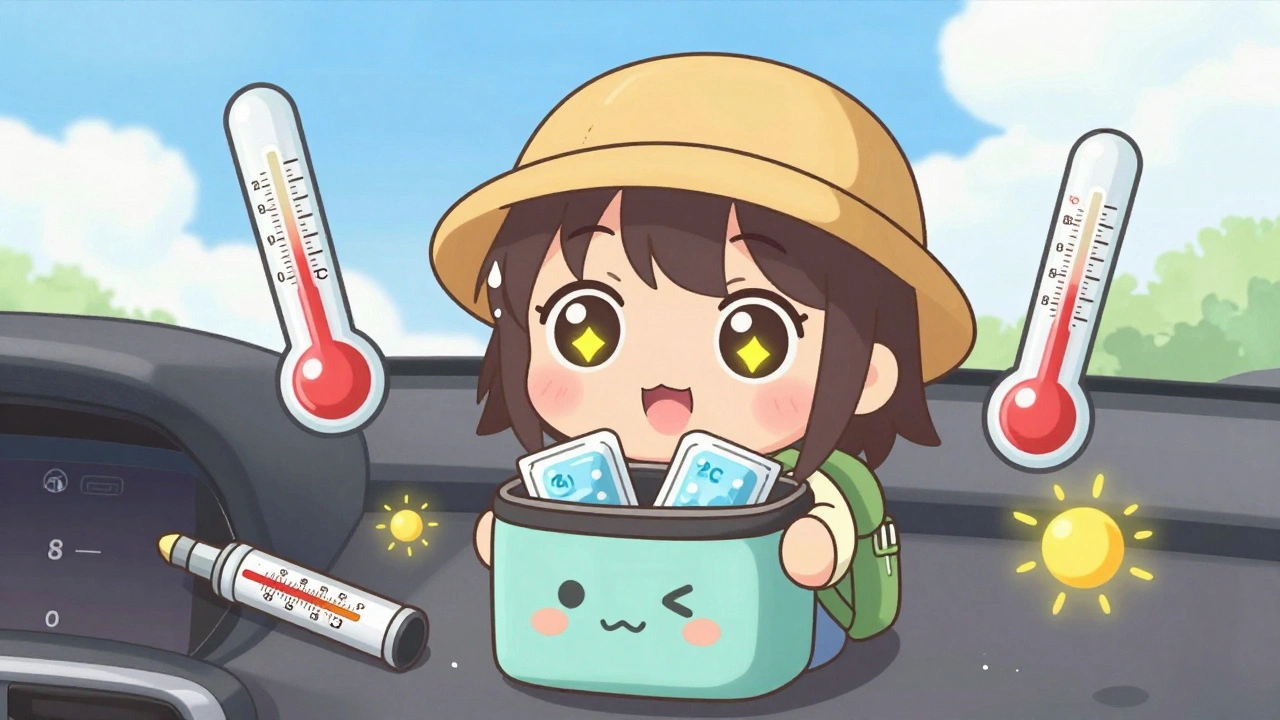
When you’re traveling with medications like insulin, vaccines, or biologics, the weather outside can be just as dangerous as the road ahead. A car parked in the sun can hit 60°C inside - hotter than a sauna. Meanwhile, a bag left on a freezing airport tarmac can drop below -10°C. If your meds aren’t protected, they can lose potency, turn cloudy, or become completely useless. And no, you can’t just rely on ‘it’s fine for a few hours.’ The science is clear: temperature-sensitive medications degrade fast when exposed to extremes.
Know Your Medication’s Temperature Zone
Not all meds need the same care. The first step is knowing what range your medication needs. There are three main categories:- Ambient (15°C-25°C): Most pills, capsules, and some liquid antibiotics. These are the least sensitive. Keep them out of direct sunlight and don’t leave them in a hot car.
- Refrigerated (2°C-8°C): Insulin, many vaccines, epinephrine pens, and biologic drugs. These are the most common troublemakers. Even a few hours above 8°C can reduce insulin’s effectiveness by over 1% per hour.
- Cryogenic (below -150°C): Rare for personal use - mostly for specialized vaccines or tissue samples. If you’re carrying these, you’re likely working with a medical team. Skip this section unless you’re in that group.
Check the label. If it says ‘Store in refrigerator,’ treat it like a perishable grocery item. Don’t assume it’s okay just because it’s been fine before. Stability data doesn’t lie - and neither do pharmacists.
Hot Weather: Don’t Let the Sun Kill Your Meds
In summer, the biggest risk isn’t heat - it’s trapped heat. A car dashboard can hit 70°C in 20 minutes. Your insulin pen? It doesn’t stand a chance.Here’s what actually works:
- Keep meds with you - never in the trunk or checked luggage. Airplane cargo holds can reach 45°C or drop below freezing.
- Use an insulated lunch bag with two frozen gel packs. This setup can keep insulin at 2°C-8°C for up to 8 hours in 35°C weather. No fancy gear needed.
- Wrap the bag in a towel. It slows heat transfer and prevents condensation from soaking your meds.
- Avoid leaving meds in a parked car, even with the windows cracked. One study found that 68% of pharmacy-reported temperature excursions happened because packages were left outside after delivery.
- Use a small digital thermometer. You don’t need a $500 logger - just a $15 one that shows real-time temp. Check it every few hours.
Real story: A man in Brisbane left his insulin in his car while grabbing coffee. The temp hit 95°F (35°C) for 45 minutes. The insulin turned cloudy. He didn’t notice until his blood sugar spiked. The pharmacist confirmed: degraded. He had to buy a new vial - and pay out of pocket.
Cold Weather: Freezing Is Just as Bad as Overheating
People think cold is safe. It’s not. Insulin freezes at -2°C. Once frozen, even if it thaws, the protein structure breaks down. It won’t work. Vaccines? Same deal.Winter risks are often overlooked because they’re less obvious. Here’s how to handle them:
- Never leave meds in an unheated car overnight. Even a garage can drop below freezing.
- Keep them close to your body - inside your coat, in a pocket, or in a heated bag. Body heat is your best friend.
- If flying, carry meds in your carry-on. Cargo holds can dip below -20°C during long flights.
- Use insulated containers with phase-change materials. These aren’t just ice packs - they’re engineered to stay in the 2°C-8°C range even when outside temps are -15°C.
- Don’t wrap meds in foil or plastic alone. That traps moisture and causes freezing faster.
A logistics manager at Pfizer shared in a LinkedIn post that during the 2022-2023 winter, their team saw 17% more excursions below range than above - mostly because transport vehicles weren’t designed for extreme cold. If professionals get it wrong, so can you.
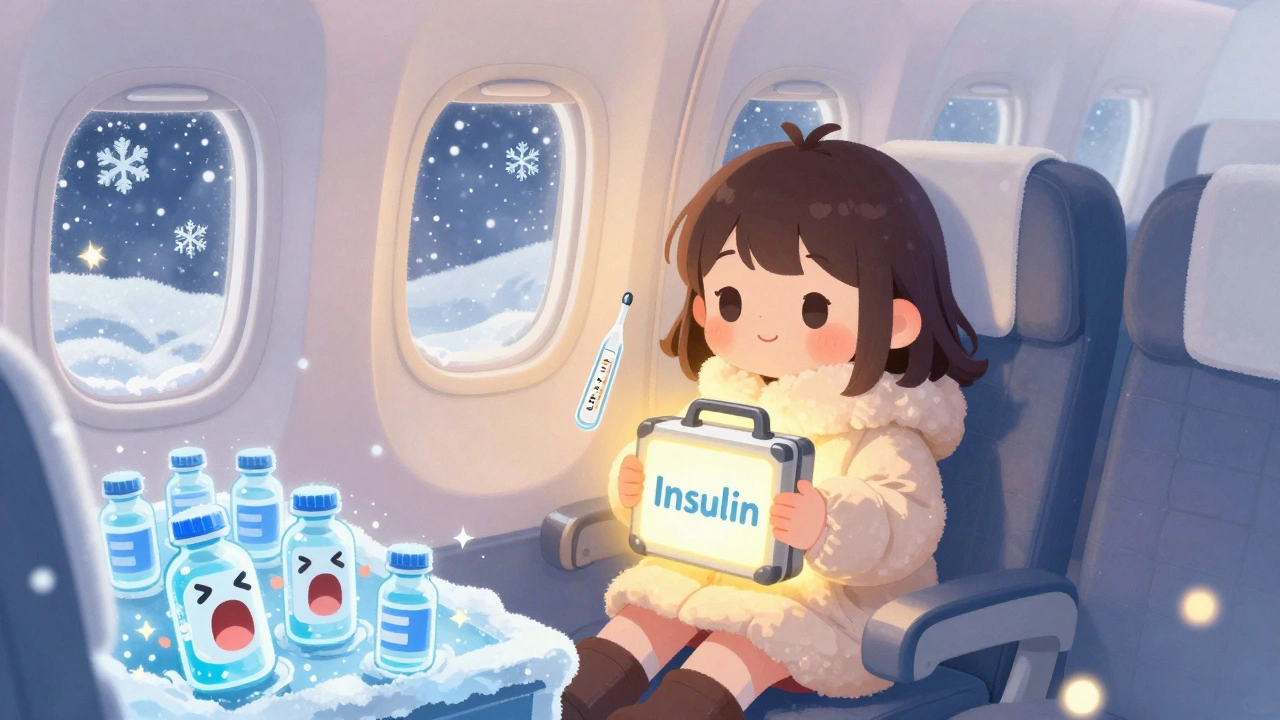
Traveling by Air? Do This First
Air travel is the most dangerous scenario for meds. Temperatures in baggage holds swing wildly. And TSA? They don’t care about your insulin.Follow this checklist:
- Carry all meds in your personal item - not checked luggage.
- Bring a doctor’s note or prescription label. It won’t stop a search, but it speeds things up.
- Use a TSA-approved cold pack. Some gel packs are designed to stay cool for 24+ hours and are allowed through security.
- Don’t freeze your meds before flying. If they’re refrigerated, keep them at 4°C - not frozen.
- Ask for a temperature-controlled storage option at your destination if you’re staying more than a day. Some hotels offer mini-fridges.
One traveler used the TempAid 2.0 case - a medical-grade insulated carrier - on a 14-hour flight. It held 2°C-8°C for 48 hours. The only downside? It weighed 1.5 kg. But it saved her insulin. She’s now a fan.
What About Ice Packs and Coolers?
You don’t need fancy gear. A regular insulated lunch bag with two frozen gel packs works for most people. But here’s the trick:- Freeze the packs solid - not slushy.
- Wrap them in a towel or cloth. Direct contact with meds can cause freezing.
- Use one pack on top, one on the bottom. Heat rises - so you need cold from both sides.
- Replace packs every 12-24 hours if you’re on a long trip.
Don’t use dry ice unless you’re trained. It can drop temps below -78°C - way too cold. And it’s regulated. You need special paperwork to fly with it.
Monitoring: You Don’t Need a Lab
You don’t need a $1,000 data logger. But you do need to know the temp.Buy a simple digital thermometer with a probe. Put it in the same bag as your meds. Check it every few hours. If it hits 10°C or higher for insulin - replace it. If it drops below 0°C - replace it.
Real-time monitors with GPS alerts exist, and they’re great for clinics and pharmacies. But for personal use? A $20 thermometer does 90% of the job. The FDA says it’s not about average temperature - it’s about the highest and lowest points. That’s what kills your meds.
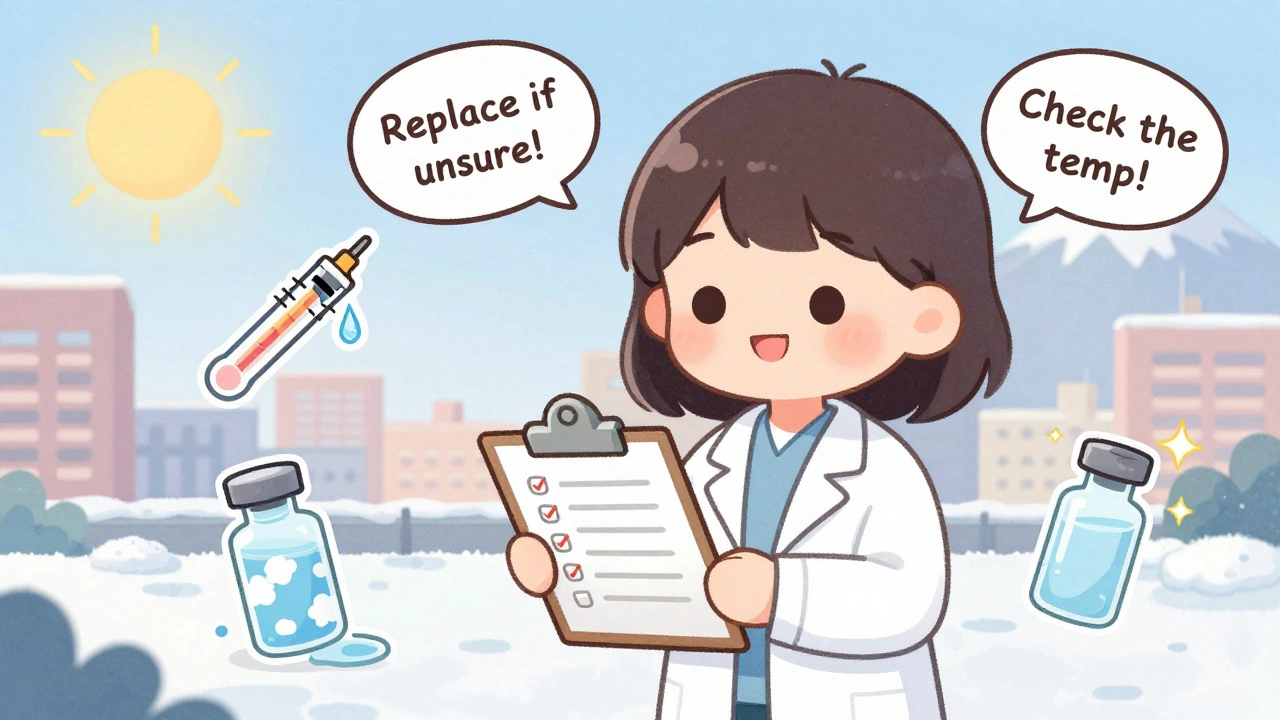
What to Do If Your Meds Get Too Hot or Too Cold
If you suspect damage:- Don’t use it. Even if it looks fine.
- Call your pharmacist. They can tell you if it’s still safe based on exposure time and temp.
- For insulin: If it’s cloudy, clumpy, or discolored - throw it out.
- For vaccines: If they’ve been above 8°C for more than 1 hour - don’t use them. Potency drops fast.
Some meds can tolerate short excursions - but only if the manufacturer’s stability data says so. Never guess. Always ask.
Documentation Matters - Even for You
Pharmacies and airlines require records. So should you.Keep a simple log:
- Date and time
- Location
- Temperature reading
- Any incidents (e.g., “left in car for 30 mins”)
Why? If something goes wrong - like a hospital refusing your meds - you’ll have proof you did everything right. The FDA requires records kept for 3 years after expiration. You don’t need to be that formal, but a note in your phone helps.
Final Rule: When in Doubt, Replace It
Medications aren’t like food. You can’t taste them to see if they’re bad. You can’t see the damage. A degraded insulin pen looks identical to a fresh one. But it won’t work.Here’s the bottom line: If you’re unsure whether your meds were exposed to unsafe temps - replace them. The cost of a new vial is nothing compared to the cost of a hospital visit from a failed dose.
Climate change is making extreme weather more common. In Melbourne, we’ve seen heatwaves hit 47°C and cold snaps drop to -2°C in the same week. Your meds can’t adapt. You have to.
Plan ahead. Pack smart. Check the temp. And never assume it’s fine.

Comments
OMG YES THIS. 🥵 I left my insulin in the car for 20 mins during a heatwave and it went cloudy. I didn’t even realize until my BG hit 420. Now I carry it in my fanny pack like a precious artifact. Also, frozen gel packs + towel = life saver. 🙌
Stop pretending you need fancy gear. I’ve been flying with insulin for 12 years. Lunch bag, two frozen packs, one towel. Done. TSA doesn’t care. No doctor’s note needed. Just don’t be an idiot and leave it in the cargo hold. Also, if your meds are freezing? You’re doing it wrong. Body heat > everything.
lol so the FDA says ‘don’t guess’ but also says ‘replace if unsure’? Sounds like a corporate loophole to sell more insulin. 🤡 I bet the pharma companies love this. ‘Oops, your vial got warm? Here’s a $300 replacement!’ Meanwhile, my cousin in Puerto Rico just reuses his insulin after a 3-day power outage. He’s still alive. Coincidence? I think not.
Let’s be clear: temperature excursions are a pharmacokinetic nightmare. The Arrhenius equation doesn’t care about your convenience. Even a 1°C deviation beyond the 2–8°C window accelerates degradation exponentially. That $15 thermometer? It’s not a luxury - it’s a necessary diagnostic tool. And yes, if you’re using foil, you’re actively increasing the risk of ice nucleation. Please stop.
I just wanted to say thank you for this. I’m new to managing insulin on the road and this actually made me feel less scared. I bought the lunch bag + gel packs thing you mentioned and it’s been perfect. Also, the thermometer tip? Genius. I didn’t even think to check. I’m gonna start logging temps now too. You’re right - it’s not about being paranoid, it’s about being prepared.
For those traveling internationally: always carry a copy of the WHO’s temperature stability guidelines for biologics. It’s in the public domain. Also, if you’re carrying epinephrine pens, know that the auto-injector’s propellant is pressure-sensitive - heat causes leakage, cold causes failure to activate. Don’t just ‘hope for the best.’ Use a phase-change material cooler. They’re not expensive. The FDA’s 2023 guidance on transport validation applies to patients too. You’re not just carrying meds - you’re carrying your own clinical protocol.
Look, I’ve been tracking weather anomalies since 2015 and I can tell you - this isn’t just about meds. The government’s pushing this ‘temperature control’ narrative to distract from the real issue: the weather manipulation programs. You think those gel packs are just for insulin? Nah. They’re calibrated to absorb EM waves from the satellites. I’ve seen the patents. They’re hiding the truth. Also, your phone thermometer? It’s not measuring temp - it’s measuring your soul’s exposure to 5G. Put your meds in a Faraday cage lined with aluminum foil and carry them in your left sock. Only then will you be safe. 🌍❄️📡