

When you take carbamazepine for epilepsy or nerve pain, you’re not just taking a pill-you’re managing a complex chemical conversation inside your body. This isn’t like taking a simple painkiller. Carbamazepine, even in its generic forms, actively changes how your liver processes other medications. It speeds up the breakdown of drugs you might be taking for blood pressure, depression, birth control, or even infections. And if you’re switched between different generic versions without careful monitoring, your seizure control can slip-sometimes dangerously so.
Why carbamazepine isn’t like other generics
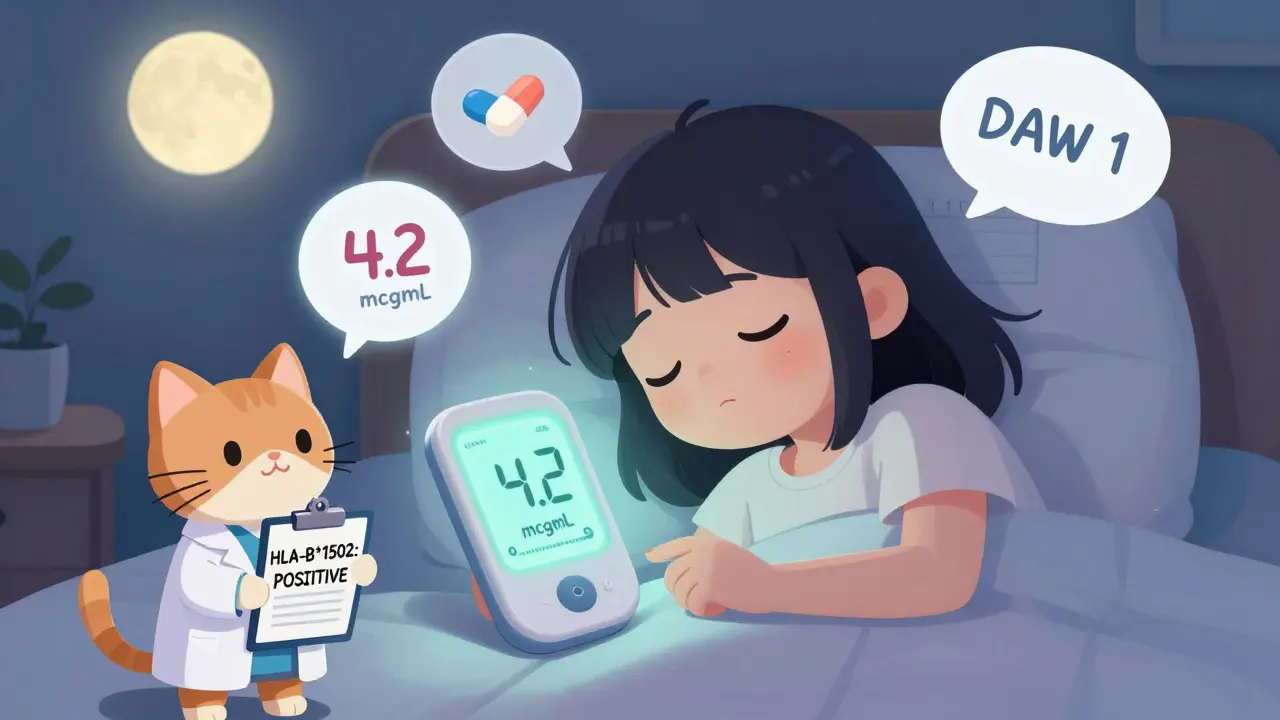
Most generic drugs are straightforward swaps. If a brand-name drug and its generic have the same active ingredient and meet bioequivalence standards, they’re considered interchangeable. But carbamazepine breaks that rule. It’s classified as a narrow therapeutic index (NTI) drug. That means the difference between a dose that works and one that causes harm is tiny. Its therapeutic range is 4-12 mcg/mL in the blood. Go below 4, and seizures may return. Rise above 12, and you risk dizziness, nausea, or even life-threatening toxicity.
Adding to the complexity, carbamazepine doesn’t just sit there. It induces enzymes in your liver-specifically CYP3A4, CYP2C9, and UGTs-that break down not only itself but also dozens of other medications. This is called autoinduction. Within days of starting carbamazepine, your body starts metabolizing it faster. That’s why your doctor might start you on 200 mg twice daily, then bump you up to 400 mg after a week. What worked yesterday might not be enough tomorrow.
What drugs are affected by carbamazepine?
Carbamazepine’s enzyme induction doesn’t pick and choose. It hits hard and wide. If you’re on any of these, your levels could drop dangerously low:
- Warfarin (blood thinner) → higher risk of clots
- Cyclosporine or tacrolimus (transplant drugs) → organ rejection risk
- Birth control pills → unintended pregnancy
- Statins (cholesterol drugs) → reduced effectiveness
- Some antidepressants, antifungals, and HIV medications
The FDA lists over 50 drugs that interact this way. The problem? Many patients don’t know. A 2022 study in Therapeutic Drug Monitoring found that 41% of patients on carbamazepine were also taking at least one interacting drug-and only 18% of their prescribers had adjusted doses accordingly.
Generic switches: the silent risk
There are 32 approved generic versions of immediate-release carbamazepine and 18 of extended-release in the U.S. alone. They all meet FDA bioequivalence standards: same active ingredient, same dose, and absorption within 80-125% of the brand. Sounds safe, right? Not always.
A 2018 study in Epilepsia tracked 327 patients switched between generic brands. Twelve percent had breakthrough seizures or new side effects. Nearly 8% ended up in the emergency room. Why? Because bioequivalence studies are done on healthy volunteers-not people with epilepsy, liver disease, or who are taking six other meds. In real life, small differences in how fast the tablet dissolves, or how the coating behaves in an empty stomach versus a full one, can throw off blood levels.
Extended-release versions are especially tricky. The beads inside capsules from one manufacturer might be slightly larger or coated differently than another’s. For patients with gastroparesis (delayed stomach emptying), this can mean the drug doesn’t release properly. One patient on Reddit reported her seizure frequency jumped after switching to a generic made by Nostrum Pharmaceuticals. Her doctor later confirmed the formulation had different dissolution properties.

Gender, genetics, and metabolism
Men and women don’t process carbamazepine the same way. Women have 20-25% higher activity of CYP3A4, the main enzyme that breaks down carbamazepine. That means, on average, women clear the drug faster. Hormonal changes during the menstrual cycle, pregnancy, or while on birth control can cause wild swings in blood levels. A 2021 JAMA Neurology study found women of childbearing age had 22% more breakthrough seizures after switching generics than men.
Genetics matter too. About 15% of people of Asian descent carry the HLA-B*1502 gene variant. For them, carbamazepine carries a 10-fold higher risk of Stevens-Johnson Syndrome-a life-threatening skin reaction. The FDA recommends genetic testing before starting, especially for patients with ancestry from Southeast Asia. Even if you’ve taken carbamazepine before without issue, if you’re switching generics after years, you’re still at risk.
What you should do
Here’s what actually works in real life:
- Stay on the same brand. If your current generic works, don’t let your pharmacy switch it without your knowledge. Ask for the manufacturer name. If it’s different, say no.
- Get blood tests. When switching generics-or even starting carbamazepine-ask for a serum level check at 7-10 days and again at 4 weeks. A drop of more than 15% means you need a dose adjustment.
- Use "dispense as written" (DAW 1). Tell your doctor to write this on the prescription. It legally blocks automatic substitution by the pharmacy.
- Keep a drug list. Update it every time you start or stop a medication-even over-the-counter ones. Share it with every provider you see.
- Know your HLA-B*1502 status. If you’re of Asian descent, ask about testing before starting carbamazepine. Alternatives like levetiracetam or lacosamide may be safer.
What the experts are saying
Dr. John Pellock, a leading epilepsy specialist, calls carbamazepine "one of the most problematic AEDs for generic substitution." The American Academy of Neurology’s 2019 guidelines explicitly advise against switching carbamazepine in patients with poorly controlled seizures. The FDA itself is now researching better ways to test extended-release generics, because current methods don’t reflect real-world use.
And it’s not just about seizures. A 2023 review in Epilepsy & Behavior Reports found carbamazepine was involved in 28.6% of all reported generic-related adverse events among epilepsy patients-second only to lamotrigine. That’s not a small number. That’s a pattern.
The bottom line
Carbamazepine generics are cheaper. But cost shouldn’t come at the cost of your health. This isn’t a drug you can swap like you would ibuprofen. Its enzyme induction, narrow therapeutic window, and sensitivity to formulation changes make it one of the most dangerous medications to switch without oversight. If you’re on carbamazepine, don’t assume all generics are equal. Track your levels. Know your manufacturer. Speak up if something feels off. Your brain is worth the extra step.

Comments
Let me tell you something nobody’s gonna say out loud: carbamazepine generics are a fucking gamble, and pharmacies treat it like they’re swapping out toilet paper. I’ve seen patients crash into the ER because some bean counter at the PBM decided ‘Nostrum’ was cheaper than ‘Tegretol’-and suddenly, their seizure count went from once a month to three times a day. It’s not bioequivalence, it’s bio-roulette. And don’t even get me started on how the FDA tests these things in healthy 22-year-olds who’ve never had a headache, let alone a seizure. Real people? We’re not lab rats. We’re people with broken brains trying not to die while insurance companies play Tetris with our meds.
And don’t give me that ‘it’s the same active ingredient’ crap. Ever tried smoking the same weed from two different growers? One makes you float, the other makes you hallucinate your dog talking. Same THC, different delivery. That’s carbamazepine. The coating, the filler, the damn bead size-it all matters. Your body isn’t a spreadsheet. It’s a goddamn orchestra, and one wrong instrument and the whole symphony collapses.
And yeah, I know you’re thinking ‘but it’s cheaper!’-well, guess what? Emergency room visits cost more than the 30 extra bucks you ‘saved.’ Your life isn’t a line item. Stop treating it like one.
Okay but… what if this is all a Big Pharma psyop? 🤔
I mean, think about it. The FDA approves these generics, right? But then they quietly admit the testing doesn’t reflect real-world use? And suddenly, people are having seizures after switching? Coincidence? Or did someone realize that if they made the testing just *barely* good enough, they could keep pushing cheaper versions while keeping the lawsuits just below the radar? 🧐
And why is it always the *extended-release* ones that mess people up? Those little beads? Sounds like a Trojan horse. Maybe they’re embedding tracking chips. Or worse-slow-release mind control agents. 🤖
My cousin took a generic and started seeing geometric patterns. Doctor said ‘it’s the drug.’ I said ‘nah, it’s the *filler*.’
HLA-B*1502? That’s not just genetics. That’s a marker for who’s been flagged by the system. They know who’s gonna break. They just let it happen until the lawsuit money rolls in. 🤷♂️
I just want to say how deeply important this information is-and how grateful I am that someone took the time to lay it out so clearly.
So many people are scared to speak up when their medication changes. They think, ‘Maybe it’s me. Maybe I’m overreacting.’ But you’re not. Your body knows. Your brain knows. And if something feels off after a switch, it’s not in your head-it’s in the formulation.
Please, if you’re reading this and you’re on carbamazepine: don’t be afraid to ask for your manufacturer. Don’t be afraid to ask for a blood test. You deserve stability. You deserve safety. And you are not alone in this.
Thank you for sharing this. It could save someone’s life.
bro i just switched to a new generic last month and my head’s been fuzzy as hell. thought i was just stressed or something. now i’m like… oh. maybe it’s not me. maybe it’s the damn beads.
also i had no idea carbamazepine was doing all that enzyme junk. i’m on zoloft and a statin and didn’t think twice. now i’m scared to take my vitamins. 😅
thanks for the post. i’m calling my doc tomorrow to ask for daw1. if they give me grief, i’m gonna print this out and slap it on their desk. no cap.
Same. Took carbamazepine for years. Switched generics because insurance changed. Got dizzy, nauseous, felt like my brain was made of wet paper. Went back to the old one-boom, back to normal. No blood test needed. My body knew.
Also, women-your hormones are not your enemy. They’re just doing their job. But the system? It forgot you exist.
Stay safe. Track your pills. And if your pharmacy tries to swap without asking? Say no. Loudly.
The notion that bioequivalence in healthy volunteers is sufficient for NTI drugs like carbamazepine is a profound failure of regulatory science. The current paradigm assumes pharmacokinetic equivalence equates to clinical equivalence, which is demonstrably fallacious in populations with comorbidities, polypharmacy, or altered hepatic metabolism. The FDA’s reliance on AUC and Cmax metrics-derived from fasted-state studies-ignores the dynamic pharmacodynamic interplay in epileptic patients with fluctuating absorption kinetics, particularly those with delayed gastric emptying or concomitant CYP3A4 inducers.
Furthermore, the absence of population-specific pharmacogenomic stratification in generic approval protocols represents a critical oversight. The HLA-B*1502 risk stratification, while acknowledged, remains underutilized due to cost and access barriers, rendering the regulatory framework not merely inadequate, but ethically negligent.
Until the FDA mandates real-world therapeutic monitoring and formulation-specific clinical outcome trials for NTI generics, this is not pharmaceutical innovation-it is pharmacological negligence masquerading as cost containment.
Just a quick heads-up: if you’re on carbamazepine, write down the manufacturer name on your phone. Take a picture of the pill. Keep a list of every med you take-even aspirin.
And if you feel weird after a switch? Don’t wait. Call your doctor. Don’t assume it’s ‘just stress.’
You’re not overreacting. You’re being smart.
Wow. So after 20 years of being told ‘all generics are the same,’ I’m supposed to believe that the FDA is just… winging it? And now I’m supposed to be a detective just to not have a seizure? Congrats, America. You turned medication into an escape room.
Also, ‘ask for your manufacturer’? Like, I’m supposed to argue with a pharmacist who’s been told to swap it? Good luck with that. They’ve got a quota to meet, honey. You’re not a patient. You’re a line item.
But hey, at least the new generic looks the same. So… progress?
Just got my blood levels back after switching to a new generic. My carbamazepine dropped 22%. I didn’t even notice until I had a tiny tremor during a meeting. Scared the crap outta me.
Called my doc. He said ‘oh yeah, that happens.’ Didn’t even sound surprised.
So I’m asking now: can we just… make a list? Like a crowd-sourced thing? Where people post what generic they’re on, what manufacturer, and if they had issues? Maybe we can build a map of which ones are safe and which ones are Russian roulette.
And can we get this info on the pill bottle? Like a little barcode that tells you the dissolution profile? That’d be cool.
Thanks for the post. I’m gonna start keeping a log. Maybe it’ll help someone else.