

When you sign a contract - whether you're buying software, hiring a contractor, or selling a business - you're not just agreeing to pay or deliver something. You're also agreeing to take on risk. And that’s where liability and indemnification come in. These aren’t just legal buzzwords. They’re the real-world safety nets that decide who pays when things go wrong.
What Indemnification Actually Means
Indemnification is a simple idea: one party agrees to cover the other’s losses. If your software vendor’s code gets hacked and customer data leaks, and your contract says they’ll indemnify you, they pay for the fallout - not you. That includes legal fees, fines, notification costs, and even lost revenue.
This isn’t optional in most business deals. According to legal analysts, indemnification clauses appear in nearly every commercial contract. Why? Because no one wants to be stuck with someone else’s mistake. The legal definition is clear: to indemnify means to compensate for damages or losses caused by a specific event, like a breach of contract, negligence, or a third-party lawsuit.
But here’s the catch - it’s not automatic. It only kicks in if the contract says so, and only for what’s written in it. Vague language like “we’ll cover any losses” gets you nothing in court. You need specifics.
The Seven Must-Have Elements in Every Indemnity Clause
A good indemnification clause doesn’t leave anything to chance. Here’s what you need to see in writing:
- Scope of Indemnification - What exactly is covered? Legal fees? Third-party claims? Tax penalties? Environmental fines? The clause must list them. If it says “damages from negligence,” that’s too broad. “Damages from failure to comply with GDPR” is better.
- Triggering Events - What makes the obligation active? Was it a breach of warranty? A patent infringement? A data breach? The clause must name the exact events that start the payment duty.
- Duration - How long does this protection last? Some clauses expire when the contract ends. Others last years - especially for things like tax liabilities or intellectual property claims. In M&A deals, fundamental reps (like ownership of assets) often survive 3-5 years; non-fundamental ones (like employee benefits) may last only 12-18 months.
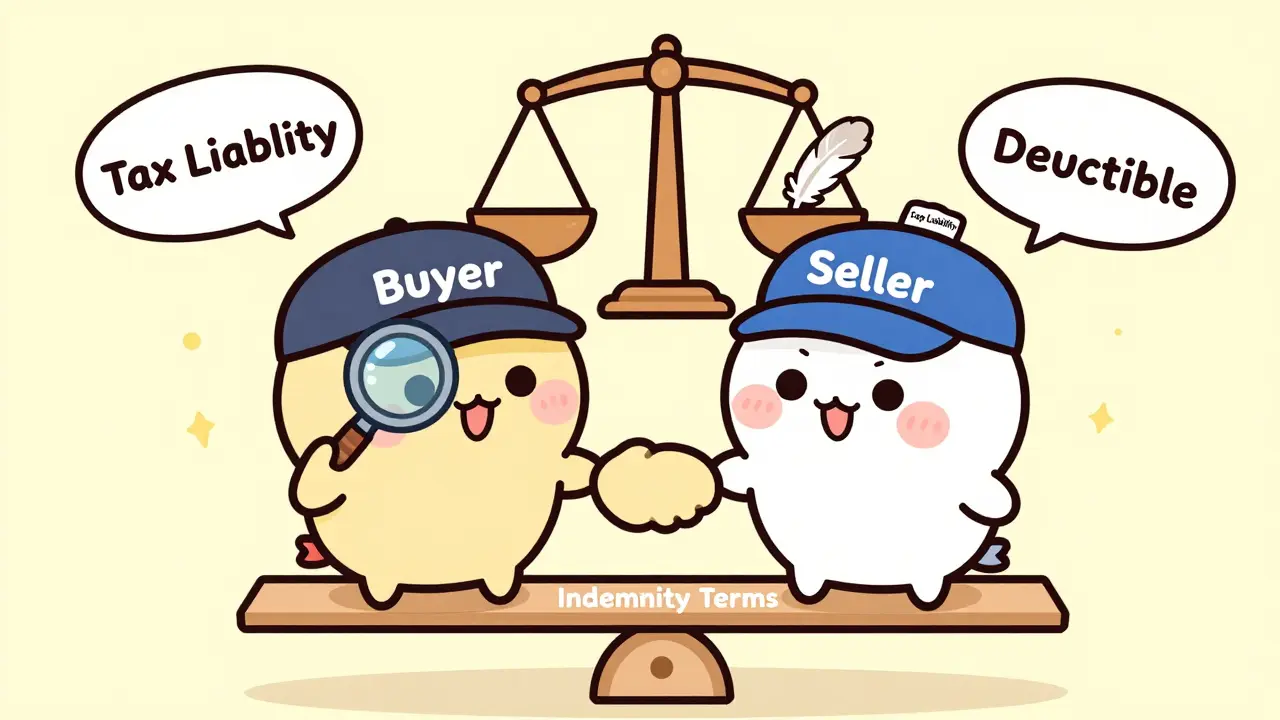
- Limitations and Exclusions - No one covers everything. Most contracts exclude indirect damages (like lost profits) or punitive damages. Some cap total liability at the contract value. Others set a deductible - you absorb the first $50,000, they pay after that.
- Claims Process - You can’t just send a bill. You must notify the other party in writing within 30 days, provide evidence, and give them a chance to defend the claim. Miss the deadline? You might lose your right to indemnification.
- Insurance Requirements - Does the indemnifying party need to carry insurance? If so, what kind? General liability? Cyber? Errors and omissions? And what’s the minimum coverage amount? If they’re supposed to cover $2M in claims but only have $100K in insurance, you’re still on the hook.
- Governing Law and Jurisdiction - Where will disputes be settled? In New York? California? Under federal law or state law? This determines which rules apply and where you’ll have to sue.
Unilateral vs. Mutual Indemnification
Not all indemnity clauses are created equal. There are two main types:
- Unilateral - Only one party pays. This is common when one side has more power. A big corporation buying software from a small vendor will almost always demand the vendor indemnify them for IP infringement. The vendor has little choice.
- Mutual - Both sides cover each other. This happens in joint ventures, construction contracts, or service agreements where both parties might cause harm. For example, if a contractor damages your property, they indemnify you. If you accidentally injure their worker, you indemnify them.
Unilateral is the norm in B2B deals. Mutual is rare unless both parties have equal leverage. If you’re the weaker party, pushing for mutual indemnity is a tough sell - but worth trying if you’re exposed to similar risks.
Indemnify, Defend, Hold Harmless - What’s the Difference?
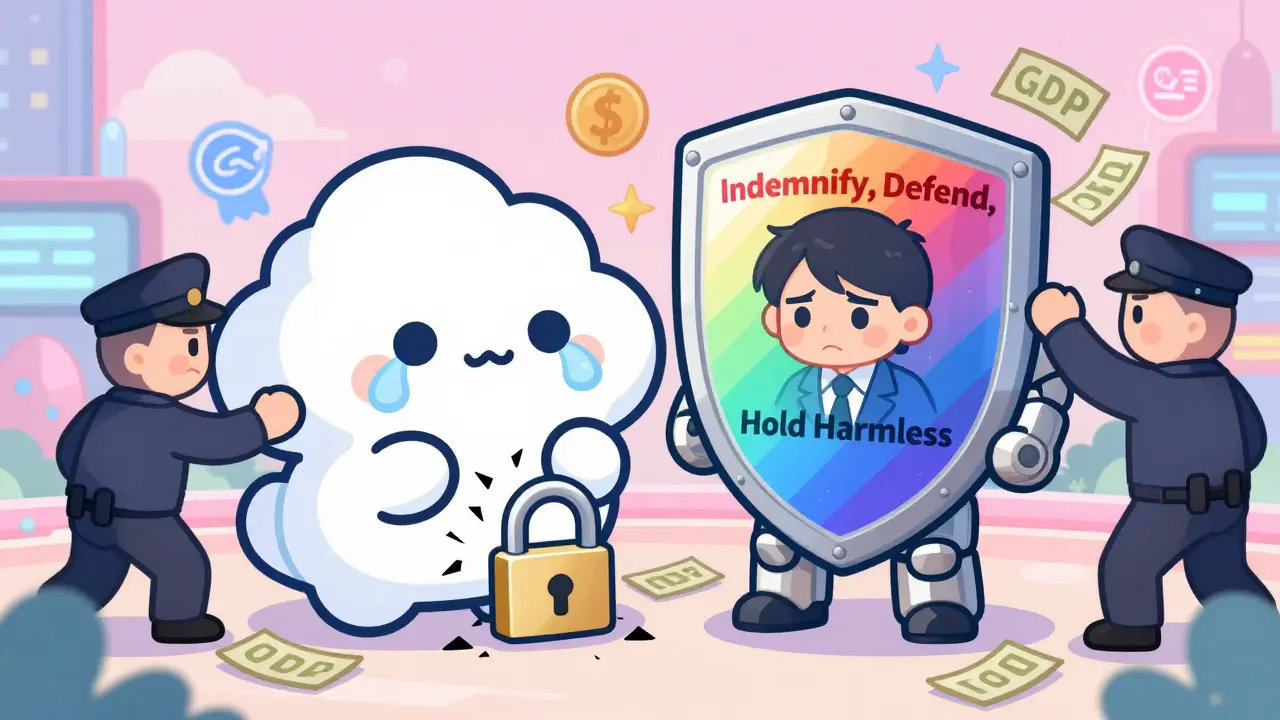
These three terms often show up together. But they mean different things:
- Indemnify = Pay for losses after they happen. If you’re sued and lose $100,000, they reimburse you.
- Defend = Pay for your legal costs upfront. They hire your lawyer, pay court fees, and handle the case - even if you’re not found liable.
- Hold Harmless = You can’t sue them for anything related to this deal. This is often redundant - if they’re indemnifying and defending you, holding you harmless is implied. But in some states, courts treat it as a separate legal doctrine.
Best practice? Use all three together. “Indemnify, defend, and hold harmless” covers every angle. But if you’re the one being asked to indemnify, try to remove “defend” - it gives the other side control over your legal strategy, which can inflate costs.
Why Sellers Always Lose in These Negotiations
Let’s be honest: sellers almost always end up with worse indemnity terms. Buyers want protection. Sellers want to limit exposure. In practice, sellers give in.
Why? Because buyers have more leverage - especially in M&A deals. A buyer will walk away if the seller won’t indemnify for tax liabilities or undisclosed debts. So sellers accept broad clauses, then spend months trying to narrow them.
Smart sellers do three things:
- Cap liability at the purchase price. No one should pay more than they made.
- Set a deductible. The buyer absorbs the first $25,000 of losses.
- Shorten survival periods. If a warranty expires in 12 months, don’t let it live for 5.
Also, fight to exclude consequential damages. If your product fails and the buyer loses a major client, you shouldn’t pay for their lost revenue. That’s not your fault - that’s their business risk.
Real-World Example: A Data Breach
Imagine you buy a cloud storage service. The vendor promises “enterprise-grade security.” Six months later, hackers steal customer data. You get fined $200,000 by regulators. You notify 10,000 customers. You pay for credit monitoring.
If your contract says the vendor will indemnify you for “breaches of security obligations,” you’re covered. They pay the fine, the notification costs, and your legal fees. But if the clause only covers “third-party claims,” you might be stuck - because the fine came from a government agency, not a customer.
That’s why wording matters. Vague = no protection. Specific = real safety.
What Happens If There’s No Indemnification Clause?
If your contract doesn’t have one, you’re relying on the law. And the law is messy.
Without a contract, you might still have a claim under tort law (like negligence) - but that’s harder to prove. You’d need to show the other party acted carelessly, and that their action directly caused your loss. It’s expensive. It’s slow. And you might not win.
Indemnification clauses turn risk into a predictable cost. Without them, it’s a gamble.
What to Do Before Signing
Don’t just skim the indemnity section. Treat it like a bomb defusal manual. Here’s your checklist:
- Does it list every possible triggering event? If not, ask for additions.
- Is there a cap? If not, demand one.
- Is there a deductible? If not, push for it.
- Are insurance requirements stated? If not, demand proof of coverage.
- Is the jurisdiction favorable to you? If not, negotiate a neutral location.
- Is “defend” included? If you’re the indemnifier, try to remove it.
- Are exclusions clear? If you’re the indemnitee, push to remove as many as possible.
And always get legal help. A lawyer won’t make the clause perfect - but they’ll spot the traps you’ll miss.
Bottom Line
Indemnification isn’t about trust. It’s about control. You can’t control whether your vendor’s software has a bug. But you can control whether they pay for the damage it causes.
Every contract carries risk. The difference between a good deal and a disaster is whether that risk is clearly assigned. If you’re signing a contract without understanding the indemnity clause, you’re not negotiating - you’re gambling.
Know what you’re agreeing to. Write it clearly. Enforce it when needed. That’s how smart businesses protect themselves - not by hoping for the best, but by planning for the worst.

Comments
This is why I refuse to sign anything without my lawyer screaming at me first. Last year, I signed a vendor contract that said 'indemnify for any losses'-no specifics. Guess what? When their API crashed and we lost $400K in sales, they said 'that's not covered.' I spent six months in legal hell. Don't be me.
Just to clarify: 'indemnify, defend, and hold harmless' isn't just legalese-it's a triad. If you only get 'indemnify,' you're on the hook for your own legal bills. I've seen startups think they're protected because the clause says 'we'll cover damages'-but when the lawsuit hits, they're left paying $80k in attorney fees because 'defend' wasn't there. Always insist on all three.
There's a deeper philosophical point here: contracts are not about trust. They are about acknowledging that human systems fail. The indemnification clause is society's way of saying, 'We know someone will mess up-so let's agree on who cleans it up before the mess happens.' It's not cynical. It's pragmatic.
YALL. I just signed a contract last week and I didn't even look at the indemnity clause. I thought it was just boilerplate. Then I read this post and I nearly had a heart attack. I'm calling my lawyer TODAY. Like, right now. I need to know if I'm about to be financially ruined by a third-party vendor's typo. HELP.
Always check the survival period. I once worked with a company that agreed to indemnify for five years on a two-year contract. They thought it was standard. It wasn't. We paid out $120k for a tax error that happened in year one-because the clause didn't expire. Shorten it. Always.
THIS. THIS IS WHY YOU DON'T JUST CLICK 'I AGREE'. I used to think contracts were just paperwork. Now I know-they're armor. And if you don't check the indemnity clause, you're walking into battle with no helmet. Don't be that person. Read it. Fight for it. Protect yourself.
so like… indemnification is just… like… if you break something, you pay for it? right? but like, why do they make it sound so complicated?? i think its just… common sense? but then again, i dont work in law so… maybe i'm dumb??
For anyone who thinks this is overkill: imagine your company gets fined $500k because your SaaS vendor didn’t patch a known vulnerability. Now imagine you have to pay that out of your own pocket because the contract didn’t say they’d indemnify you. This isn’t paranoia. This is business hygiene.
In some cultures, contracts are seen as expressions of trust. In others, they're insurance policies. The indemnification clause is where those two worlds collide. In the U.S., it's standard to demand it. In parts of Asia or Europe, it can feel aggressive. Knowing this helps when negotiating cross-border deals.
Indemnity clauses are a subset of risk allocation mechanisms within contractual frameworks. The efficacy of such provisions is contingent upon the specificity of the triggering events, the alignment of insurance coverage thresholds, and the enforceability of governing law provisions under applicable statutory regimes. Absent precise drafting, the indemnitor's obligations may be deemed void for vagueness under the doctrine of unconscionability in certain jurisdictions.