
When a doctor writes a prescription, they don’t just choose a drug-they choose a story. A story about safety, trust, and cost. And for decades, that story has been dominated by brand names. Even when a cheaper, scientifically equivalent generic version sits on the shelf, many doctors still reach for the brand. Why? Because medical education never taught them to think differently.
What Doctors Are Really Taught About Generics
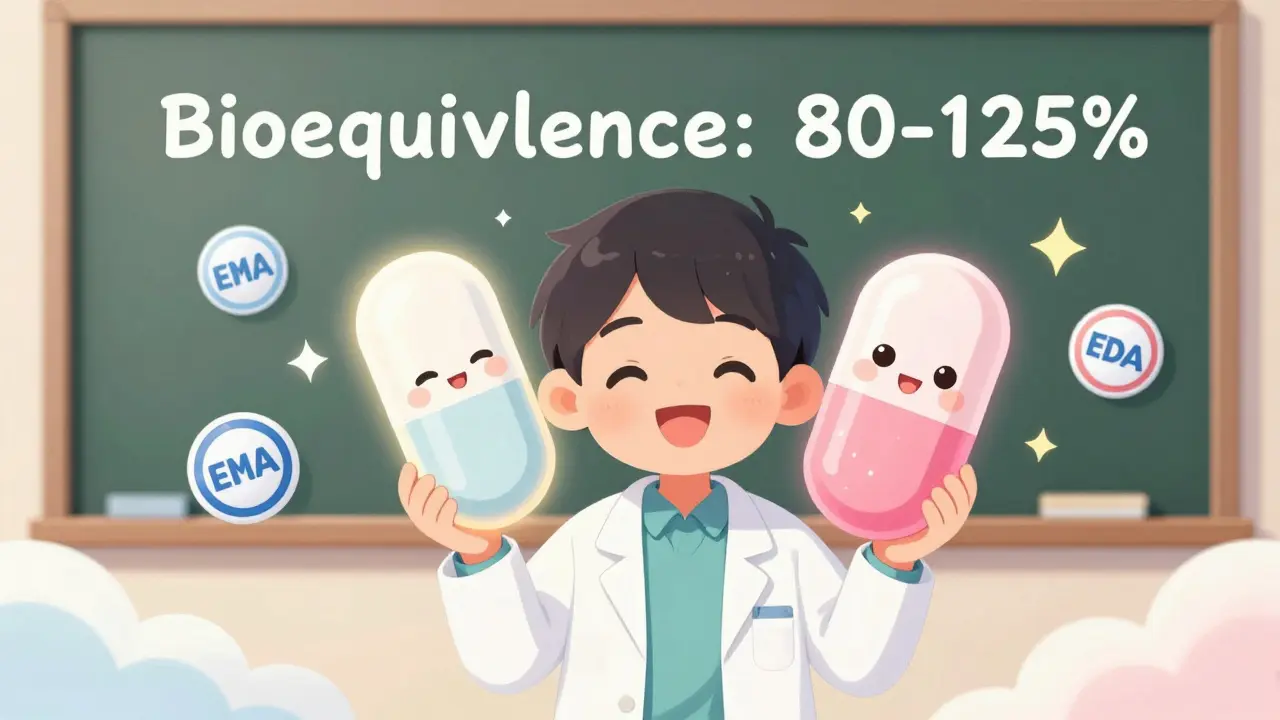
Most medical students spend hours learning the pharmacology of brand-name drugs: how they work, their side effects, their clinical trial data. But when it comes to generics? A 2024 survey of U.S. medical schools found that less than 30 minutes of the entire pharmacology curriculum is dedicated to generic drug equivalence. That’s less time than it takes to explain one brand-name drug’s mechanism of action. The science behind generics is straightforward: a generic drug must prove bioequivalence. That means its active ingredient enters the bloodstream at the same rate and to the same extent as the brand-name version. The FDA and EMA require this to be shown within a 90% confidence interval of 80-125% for two key measures: AUC (total exposure) and Cmax (peak concentration). In plain terms: if the brand drug delivers 100 units of medicine to your body, the generic must deliver between 80 and 125 units. That’s not a guess-it’s a strict, tested standard. But here’s the problem: doctors aren’t taught this. They’re taught to memorize brand names. Case studies in textbooks use brand names. Professors say "Lipitor," not "atorvastatin." Hospitals stock brand-name samples. Even when a generic is available, the default in training is to prescribe the name everyone recognizes.The Knowledge Gap Is Real-And It’s Costing Lives
A 2015 study in Malaysia found that before any education, 100% of doctors surveyed had misconceptions about generics. Some believed generics were less effective. Others thought they were made with inferior ingredients. One doctor even said he wouldn’t prescribe a generic for his own child. These aren’t outliers. They’re the norm. In the U.S., 90% of prescriptions filled are for generics. Yet only 31% of doctors regularly use International Nonproprietary Names (INN)-the generic drug name-in their prescriptions. Why? Because they don’t feel confident explaining it. A 2024 Medscape poll showed that while 89% of doctors agree generics are generally equivalent, only 54% feel completely confident explaining bioequivalence to a patient. The consequences aren’t just financial. When doctors avoid generics out of fear or habit, patients pay more. When they switch patients without proper counseling, they risk non-adherence. A patient who doesn’t understand why they’re now taking a different pill may stop taking it altogether. That’s not just a cost issue-it’s a safety issue.Why Knowledge Doesn’t Always Lead to Change
You’d think that if doctors learned the science, they’d prescribe more generics. But studies show otherwise. In Malaysia, a 45-minute lecture on bioequivalence improved doctors’ knowledge scores by 25 percentage points. But their prescribing habits? Didn’t budge. Why? Because knowledge isn’t the only barrier. Culture is. Junior doctors follow senior doctors. If the attending physician always writes "Concerta," the resident learns to write "Concerta." Hospitals don’t train residents to question the brand-name default. Electronic health records often auto-fill brand names. Pharmacy systems don’t prompt for generics unless forced. And then there’s the ghost of 2016. When the FDA received reports that some generic versions of methylphenidate (the active ingredient in Concerta) weren’t working as well for some patients, it sparked panic. Even though the FDA confirmed all generics met bioequivalence standards, the damage was done. Doctors started avoiding those generics-even the ones that were scientifically identical. One neurologist on Doximity wrote: "I stopped substituting after three patients said the Teva version didn’t work. I didn’t care what the data said-I trusted what my patients told me." That’s the heart of the problem: trust isn’t built in textbooks. It’s built in experience. And if your experience is shaped by anecdote, not evidence, you’ll keep prescribing the brand.
What Actually Works: Education That Changes Behavior
Not all education fails. Some programs do shift prescribing habits. But they don’t rely on lectures. They rely on feedback. A 2023 study in Nature Scientific Reports found that pharmacists who reviewed 100 prescriptions with personalized feedback retained bioequivalence concepts 40% better than those who just read guidelines. The same principle applies to doctors. The most effective interventions include:- Teach-back method: After explaining a generic switch, ask the patient: "Can you tell me why we’re switching?" This forces the doctor to clarify their own understanding-and catches misunderstandings before they become habits.
- INN-only prescribing in medical school: Karolinska Institute in Sweden made INN prescribing mandatory in evaluations. Within five years, graduate prescribing of generics jumped 47%.
- Point-of-care alerts: When a doctor opens a prescription screen, an alert pops up: "Generic available. Bioequivalent. Saves $42." One pilot in a California clinic increased generic prescribing by 32% in six months.
- Prescription audits with feedback: Monthly reports showing each doctor’s generic prescribing rate compared to peers. Competition works. So does accountability.
Specialty Differences: Why Neurologists and Psychiatrists Are Still Hesitant
Not all doctors are the same. Neurologists and psychiatrists are the most resistant to generics. Why? Because they treat drugs with narrow therapeutic indexes-medications where small changes in blood levels can cause big problems. Drugs like levothyroxine (for thyroid), warfarin (for blood thinning), and antiepileptics fall into this category. A 2022 survey found 23.4% of neurologists refused to switch epilepsy patients to generics, even though the FDA says bioequivalence standards apply equally to all drug classes. But here’s the twist: studies show no difference in outcomes when patients are properly monitored. In fact, a 2023 analysis of over 12,000 epilepsy patients found no increase in seizure frequency after switching to generic antiepileptics-when the switch was done carefully and with follow-up. The real issue isn’t science. It’s fear of liability. Doctors worry that if a patient has a seizure after a switch, they’ll be blamed-even if the generic was perfectly equivalent. That fear isn’t irrational. It’s a system failure. There’s no legal protection for doctors who follow evidence-based prescribing. No safety net for doing the right thing.
The Future: Better Tools, Better Training
The FDA launched its "Generic Drug Education for Healthcare Professionals" initiative in September 2023. It’s not a lecture series. It’s 15-minute microlearning modules-short, digestible, and built for busy clinicians. They cover myths, data, and how to talk to patients. In 2024, the Agency for Healthcare Research and Quality released updated prescribing guidelines that push two things: INN prescribing and the teach-back method. And by Q3 2025, bioequivalence data will start appearing directly in electronic health records-showing doctors, in real time, which generics are truly equivalent. The economic impact is massive. The U.S. spends $467 billion on generics each year. If doctors prescribed them more confidently, the system could save $156 billion annually by 2030. But savings won’t come from better marketing. They’ll come from better education.What Needs to Change-Right Now
Here’s what’s needed, in order of urgency:- Medical schools must require INN prescribing in all exams and case simulations. No more "Lipitor"-use "atorvastatin." Always.
- Hospitals must audit prescribing patterns and give feedback. Doctors need to see their own data. Numbers don’t lie.
- Electronic health records must include real-time bioequivalence alerts. If a generic is available and proven equivalent, the system should say so-not hide it.
- Regulators must stop letting anecdotal reports drive policy. One patient says a generic didn’t work? That’s not evidence. It’s a signal to investigate-not to panic.
- Doctors must learn to talk to patients about generics-not just prescribe them. A simple phrase: "This generic is just as safe and effective, and it saves you $40 a month. Would you like to try it?"-makes all the difference.
Generics aren’t second-rate. They’re science made affordable. But if doctors don’t understand that-really understand it-patients will keep paying more, and the system will keep wasting money. The data is clear. The tools exist. What’s missing is the will to teach it properly.
Do generic drugs work as well as brand-name drugs?
Yes. Generic drugs must meet the same strict bioequivalence standards as brand-name drugs. The FDA and EMA require that generics deliver the same amount of active ingredient into the bloodstream at the same rate. Studies show no meaningful difference in effectiveness or safety for the vast majority of drugs. The only exceptions involve very narrow therapeutic index drugs like levothyroxine or warfarin, where close monitoring is recommended-but even then, switching is safe with proper follow-up.
Why do some doctors still prefer brand-name drugs?
Many doctors were trained using brand names exclusively. Textbooks, case studies, and hospital formularies favor brands. They’re also influenced by patient expectations, anecdotal reports (like the 2016 Concerta controversy), and fear of liability. Even when they know generics are equivalent, they may stick with brands out of habit or to avoid patient complaints.
Is it safe to switch from a brand-name drug to a generic?
For most medications, yes. Switching is safe and common. For drugs with a narrow therapeutic index-like thyroid meds, blood thinners, or seizure drugs-doctors may choose to monitor blood levels more closely after the switch. But this isn’t because generics are less effective; it’s because small changes in dose matter more in these cases. The switch itself isn’t the risk-it’s the lack of follow-up that can be.
What’s the difference between INN and brand name?
INN stands for International Nonproprietary Name-the official generic name of a drug. For example, the INN for Lipitor is atorvastatin. Brand names are trademarked names given by pharmaceutical companies. INN prescribing means writing the drug by its generic name, not the brand. This reduces confusion, cuts costs, and improves consistency in prescribing.
How can patients encourage their doctor to prescribe generics?
Ask directly: "Is there a generic version available? Is it safe for me?" Many doctors assume patients want the brand name, so they don’t offer alternatives. If you express openness to generics and ask for cost savings, you’re more likely to get a generic prescription. You can also ask your pharmacist if a generic is available and ask your doctor to consider it.

Comments
Okay but let’s be real - if your doctor prescribes Lipitor because they got free pens from Pfizer in med school, don’t act shocked when your $200 pill is just atorvastatin with a different color capsule. 🤡 I once asked my neurologist why I couldn’t switch to generic Keppra and they said, 'I don’t trust the ones made in India.' I said, 'So you trust the FDA… but not the same factory that makes the brand?' They went silent. I’m still on the generic. Still seizure-free. Still saving $120/month. 🤷♀️
It’s wild how we treat medicine like it’s a religion instead of a science. We memorize brand names like they’re holy texts, but the chemistry? Barely mentioned. I remember my pharmacology professor saying, 'If it works, it works' - then spent 45 minutes on the history of Prozac’s development. Meanwhile, generics got one slide. It’s not that doctors are dumb - it’s that the system trains them to be brand loyalists, not evidence-based practitioners. Time to flip the script.
I’m a pharmacy tech in a rural clinic, and I see this every day. Patients come in confused because their new pill looks different. We don’t just hand them the generic - we sit down, explain bioequivalence, show them the FDA chart, and ask if they have questions. Most are relieved. Some cry because they didn’t know they were overpaying for years. Education isn’t just about doctors - it’s about empowering patients too. Small moments, big impact.
Let me guess - this is another American 'generic is fine' propaganda piece. In the UK, we know better. We’ve had generics for decades, and we still have doctors who won’t prescribe them for heart patients. Why? Because we’ve seen the consequences. The NHS doesn’t push this because they care - they push it because they’re broke. And now you want us to trust a pill that costs 80% less? Please. I’d rather pay more for a brand I know won’t kill me. 🇬🇧
My dad’s on warfarin. We switched him to generic a year ago. His INR stayed stable. No seizures, no clots, no drama. But I get why doctors hesitate - I’ve seen patients panic when their pill changes color. The real problem isn’t the science. It’s the lack of communication. If a doctor says, 'This is the same drug, just cheaper,' and then doesn’t follow up, of course people freak out. It’s not about trust in generics - it’s about trust in the doctor’s ability to explain.
THE 2016 CONCERTA SCANDAL WAS A COVER-UP!! 😱 I’ve got a cousin who went from 100% focused to a zombie after switching to Teva methylphenidate. The FDA? Paid off. The pharmaceutical industry? They love generics because they make more money off the brand name and then sell the generic to the same people later. 💸 It’s a pyramid scheme disguised as healthcare. #GenericGate #WakeUpSheeple
I teach med students. Last semester, I made them write all prescriptions using INNs. At first, they groaned. 'But Professor, no one uses those!' By week four? They were arguing over which generic was best. One even said, 'I didn’t realize atorvastatin was just Lipitor.' That’s the moment you know education works - when the lightbulb goes off. Change starts in the classroom. Let’s stop pretending it’s about money. It’s about pride. And pride is fixable.
My brother’s a neurologist. He still won’t switch epilepsy patients to generics. I asked him why. He said, 'I’ve seen too many patients crash after switching.' I asked for data. He said, 'It’s not about data - it’s about the one who didn’t make it.' That’s the real barrier. Not ignorance. Fear. And until we give doctors emotional safety to make evidence-based calls, we’re just shouting into the void.
So let me get this straight - we spend $467 billion on generics, but doctors don’t know how to prescribe them because they were taught brand names in 1998? And now we’re surprised they’re scared to switch? 🤦♂️ The system is broken, not the science. Fix the EHRs. Fix the training. Fix the feedback loops. Stop blaming doctors for being products of a broken system. They’re not villains - they’re just the last people who haven’t gotten the memo.
One sentence: If your doctor won’t prescribe a generic, ask them to write the INN on the script - then Google it. You’ll probably be shocked. And then you’ll realize you’ve been overpaying your whole life.
My cousin in Lagos switched from brand to generic antiepileptic - and now he’s having seizures every week. 🇳🇬💔 You think this is just about money? No. This is about colonial medicine - you take our bodies, sell us cheap pills made in China, then tell us to be grateful. We don’t need your 'bioequivalence charts.' We need trust. And you broke it. 😤