
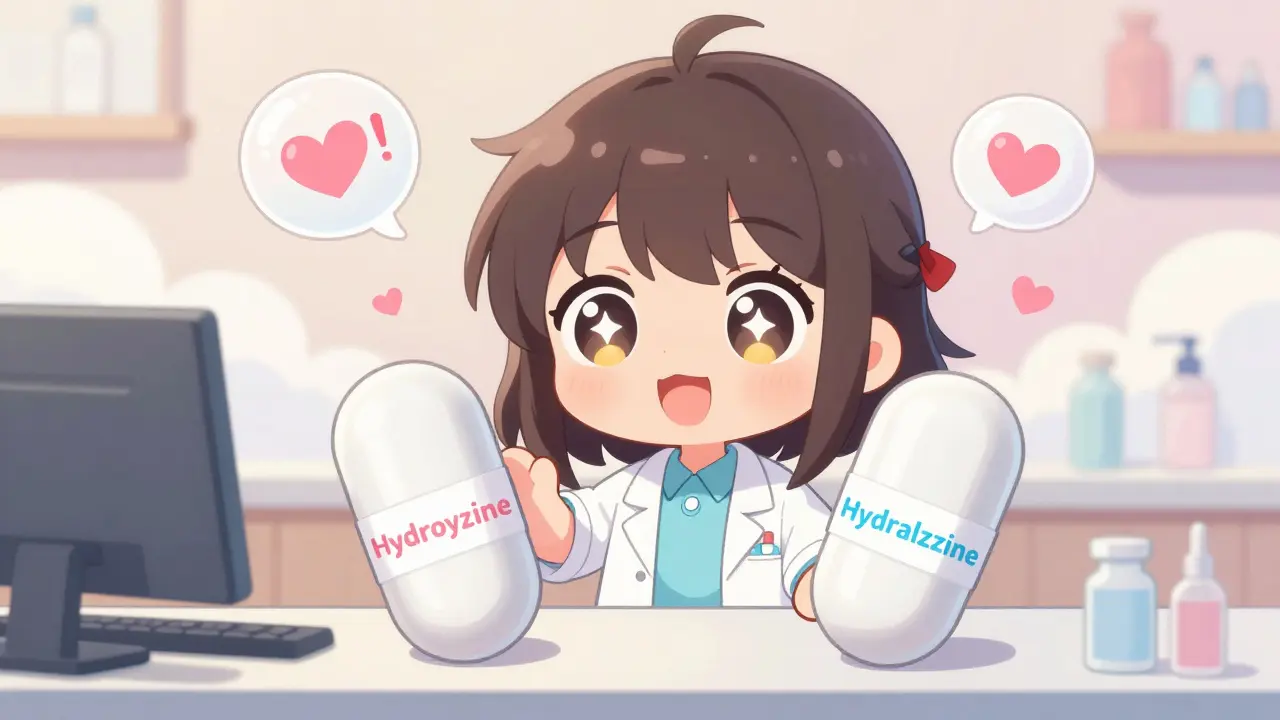
Every year, thousands of people are harmed because a pill looked too much like another - or sounded too similar when a nurse heard it over the phone. These aren’t rare mistakes. They’re common, preventable, and mostly happen with generic drugs. The problem? Look-alike, sound-alike (LASA) names. It’s not about bad pharmacists or careless nurses. It’s about systems that haven’t caught up to how messy drug names have become.
What Exactly Are Look-Alike, Sound-Alike Errors?
Look-alike, sound-alike (LASA) errors happen when two drugs have names that are too similar in how they look on paper or how they sound when spoken. Think of hydroxyzine and hydralazine. One’s for anxiety and allergies. The other’s for high blood pressure. Mix them up, and you could give someone a dangerous drop in blood pressure instead of relief from itching. Or consider Valtrex and Valcyte - both start with ‘val’, both are used in transplant patients, but one treats herpes and the other fights a deadly CMV infection. A simple slip can be deadly.
These aren’t just about names. Packaging makes it worse. Two generics for different conditions might come in identical white capsules with the same size, shape, and font. Pharmacists pull them off the same shelf. Nurses grab them from the same bin. Patients take them without realizing the difference. According to the World Health Organization, LASA errors account for about 25% of all medication mistakes globally. That’s one in four.
Why Generics Make It Worse
Brand-name drugs usually have unique packaging and clear branding. But generics? They’re made by dozens of companies. Each one uses its own label, its own color, its own font. There’s no standard. So you might get a generic version of a drug from Manufacturer A one month, then Manufacturer B the next. Same active ingredient, totally different look. And if both look similar to another drug? You’ve got a perfect storm.
Pharmacists in Australia and the U.S. report encountering LASA errors at least once a month. A 2021 survey found that 78% of pharmacists had seen one in the last 30 days. And 32% had a near-miss - where someone almost got the wrong pill - at least once a week. These aren’t theoretical risks. Real people have died. In 2018, a patient in the UK was given hydralazine instead of hydroxyzine. They went into cardiac arrest. They survived, but only because the nurse caught it right after the dose.
Where These Errors Happen
It’s not just the pharmacy. LASA errors can happen anywhere in the process:
- Prescribing: A doctor types ‘albuterol’ but the computer auto-fills ‘atenolol’ because they’re next to each other on the screen.
- Dispensing: A pharmacist grabs a bottle labeled ‘prednisone’ but it’s actually ‘prednisolone’ - visually identical except for a tiny letter difference.
- Administration: A nurse hears ‘dopamine’ over the phone and administers it instead of ‘dobutamine’ - both are used in ICUs, both are given IV, both sound almost the same.
Merative’s 2023 analysis found that 68% of medication errors happen during administration - the moment a drug is given to the patient. That’s when the confusion becomes real. And in high-pressure settings like emergency rooms or intensive care units, there’s no time to double-check.
What’s Being Done - And Why It’s Not Enough
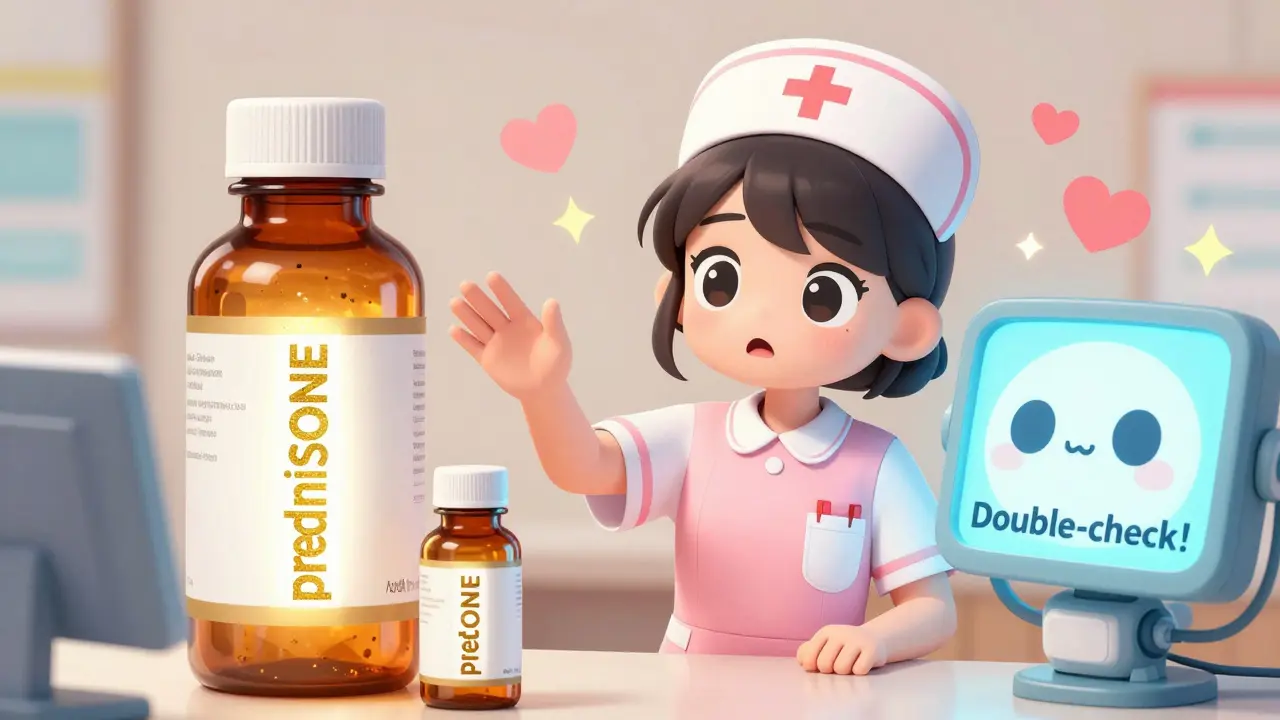
There are known fixes. Tall man lettering - writing drug names with capital letters to highlight differences - helps. For example: predniSONE vs. predniSOLONE. A 2020 study showed this cut LASA errors by 67% across 12 hospitals. Another solution? Separating high-risk drugs physically on shelves. Putting them in different bins, different colors, different zones. Simple. Effective.
Barcode scanning has also helped. When a nurse scans the drug and the patient’s wristband, the system checks if they match. If the drug is a known LASA pair, it flashes a warning. One hospital system cut errors by 45% using this method.
But here’s the problem: not every hospital does this. Not every pharmacy. Not every country. The U.S. FDA rejected 34 drug names in 2021 because they were too similar to existing ones. The European Medicines Agency now requires name similarity checks for every new drug. But generics? They slip through. Once a generic is approved, manufacturers can change packaging anytime. No one enforces visual consistency.
The Tech That’s Actually Working
The biggest breakthrough? Artificial intelligence in electronic health records (EHRs). A 2023 study in the Journal of the American Medical Informatics Association tested AI systems that flagged potential LASA errors before they happened. In a six-month trial across three hospitals, the AI caught 98.7% of risky matches. False alarms? Just 1.3%. That’s better than any human.
These systems don’t just flag names. They look at the patient’s diagnosis, allergies, and current meds. If a doctor tries to prescribe ‘clonazepam’ for a patient already on ‘clonidine’, the system says: ‘Warning - these names sound similar. Clonazepam is for seizures. Clonidine is for high blood pressure. Are you sure?’
And it’s not sci-fi. It’s already in use. Hospitals that adopted this tech saw LASA errors drop by 82%. But adoption is slow. Many clinics still use outdated software. Many doctors don’t trust alerts. Too many false alarms in the past made them ignore them. Now, with smarter AI, that’s changing.
What Patients Can Do
You don’t have to wait for hospitals to fix this. Here’s what you can do:
- Ask: ‘What is this pill for?’ If the answer is vague, dig deeper.
- Check the label. Does it say the generic name? Write it down. Compare it to the last bottle you got.
- Use one pharmacy. If you switch, your meds might look different - and that’s dangerous.
- Ask your pharmacist: ‘Are there any look-alike drugs I should watch out for?’ They’ve seen it all.
One man in Melbourne noticed his ‘blood pressure pill’ looked different. He called his pharmacist. Turns out, the new batch was a different generic - and it was shaped like a heart medication he’d taken years ago. He didn’t take it. He saved himself a trip to the ER.
The Bigger Picture
This isn’t just about pills. It’s about how we design systems. We blame people for mistakes. But if two drugs look identical, and the software doesn’t help, then the system failed - not the person. The WHO’s ‘Medication Without Harm’ campaign aims to cut severe medication errors by 50% by 2025. LASA errors are a big part of that.
Regulators need to enforce visual standards for generics. Hospitals need to invest in AI alerts. Pharmacists need time to double-check. And patients? They need to speak up. Because when a drug name looks too much like another - it’s not an accident waiting to happen. It’s an accident that’s already been designed.
What are the most common look-alike, sound-alike drug pairs?
Some of the most frequently confused pairs include: hydroxyzine/hydralazine, clonazepam/clonidine, prednisone/prednisolone, dopamine/dobutamine, and Valtrex/Valcyte. These are all on the ISMP’s official list of high-risk LASA drugs. Even small differences - like a single letter - can lead to serious harm if the drugs serve completely different purposes.
Why are generic drugs more likely to cause LASA errors than brand-name drugs?
Brand-name drugs have unique packaging, logos, and consistent appearance across batches. Generic drugs, however, are made by multiple manufacturers, each with different label designs, colors, and pill shapes. This lack of standardization means two generics for the same drug can look completely different - and sometimes look too much like a completely different drug. There’s no global rule forcing generics to avoid visual similarities with other medications.
Can tall man lettering really prevent these errors?
Yes. Tall man lettering - capitalizing key letters to highlight differences (e.g., hydralAZINE vs. hydroXYZINE) - has been shown to reduce LASA errors by up to 67% in hospital studies. It’s simple, low-cost, and works across paper prescriptions, labels, and digital systems. The FDA and WHO both recommend it. But not all pharmacies or EHR systems use it consistently, which limits its impact.
Do AI systems in hospitals actually catch these errors before they happen?
Yes - and they’re far more accurate than older alert systems. A 2023 study found AI tools embedded in EHRs caught 98.7% of potential LASA errors while only generating false alerts in 1.3% of cases. These systems analyze not just the drug name, but also the patient’s condition, allergies, and current meds to determine if the match is truly risky. Hospitals using this tech saw a drop of over 80% in LASA incidents.
What should I do if I notice my generic medication looks different?
Don’t assume it’s the same. Check the label for the generic name and manufacturer. Compare it to your last prescription. If anything looks off - different color, shape, size, or markings - call your pharmacist. Ask: ‘Is this the same drug I’ve been taking? Are there any look-alike drugs I should be aware of?’ It’s better to double-check than risk taking the wrong one.

Comments
I've been taking generics for 12 years. Never had an issue. People freak out over font size and capital letters. If you can't read a label, maybe don't take pills. This whole article reads like fearmongering dressed up as public health.
There's a deeper philosophical tension here between standardization and market competition. We allow dozens of manufacturers to produce the same molecule with wildly different visual identities, then wonder why errors occur. It's not negligence-it's structural. The system incentivizes cost-cutting over safety, and we've normalized that trade-off. Perhaps we need to reconsider what 'generic' truly means: identical in effect, yes-but should it not also mean identical in presentation?
I'm a pharmacist in Ohio, and I see this every single day. One week I get a generic metformin from Actavis that's a blue oval, next week it's a white capsule from Teva. Both have the same active ingredient, but one looks exactly like a patient's heart medication. We use tall man lettering, barcode scanners, and double-checks-but we're understaffed, underpaid, and expected to work at warp speed. This isn't about patient care. It's about profit margins. The AI systems work. They're just too expensive for 80% of rural clinics. We need funding, not just awareness.
AI caught 98.7% of errors? Cool. So now we’re outsourcing our attention span to a machine that says ‘Are you sure?’ like a passive-aggressive chatbot. 🤖 Maybe next they’ll send us a reminder to breathe. Just saying.
I love that you mentioned the Melbourne guy. That’s the kind of quiet hero we need more of. My grandma called her pharmacist every time her pills changed color. She didn’t know what clonidine was, but she knew her body. Sometimes the smartest person in the room is the one holding the bottle.
You know who benefits from this chaos? Big Pharma. They push generics to kill competition, then let the manufacturers make pills that look like each other so people keep getting confused. That’s why they lobby against visual standards. It’s not an accident-it’s a business model. And don’t even get me started on how the FDA is bought off by lobbyists. This isn’t about drugs. It’s about control.
Let’s be real: if you can’t distinguish between hydralAZINE and hydroXYZINE after two seconds of looking at a label, you shouldn’t be handling prescriptions. This isn’t a systemic failure-it’s a competency failure. We’ve turned healthcare into a low-stakes game of 'spot the difference' while pretending it’s a public health crisis. The solution? Fire the pharmacists who can’t read. Train the ones who can. Stop blaming the system.
AI caught 98.7%? That’s wild. But here’s the real kicker: the 1.3% false alarms? Those are the ones that train the system. Every time a nurse ignores a warning because 'it’s just another false alarm', the AI learns to be quieter. And then the next time it’s real? It doesn’t scream. It whispers. And someone dies. We’re not fixing systems. We’re training machines to be passive. 😔