
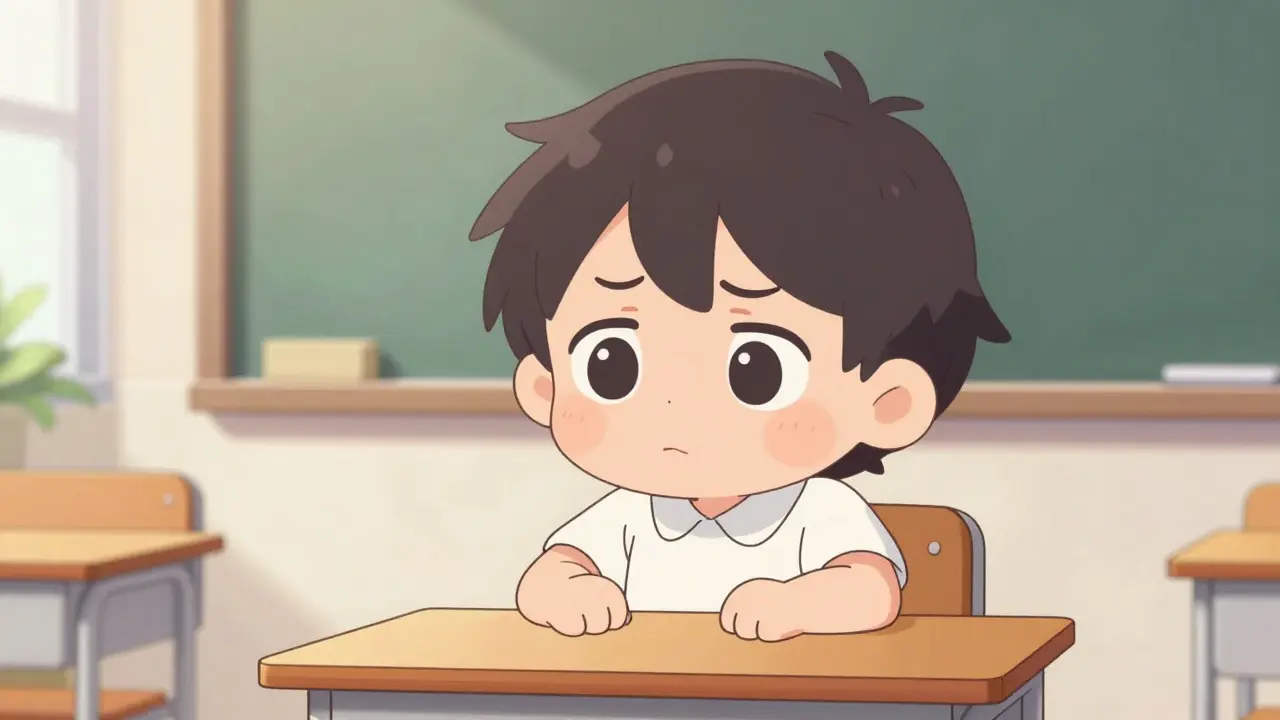
Imagine a child struggling in school, not because they lack the ability to learn, but because they simply cannot see the board. For many kids, vision problems are invisible. They don't complain because they think the blurry image or the double vision they see is normal. This is why pediatric vision screening is a systematic process used to identify children with vision disorders or those at risk of permanent visual impairment so critical. If we catch these issues early, we can often fix them. If we wait, some types of vision loss become permanent.
The stakes are high. There is a biological "window of opportunity" for treatment. The visual system's plasticity-its ability to adapt and change-drops significantly after age 7. This means that treating a condition like a "lazy eye" at age 4 is often highly successful, while trying to fix it at age 9 is a much steeper uphill battle. In fact, the Vision in Preschoolers (VIP) study showed that timely intervention can improve visual acuity in 80-95% of children with amblyopia if detected before age 5. Once they hit age 8, that success rate plummets to between 10% and 50%.
The Main Culprits: What We Are Screening For
When a healthcare provider performs a screen, they aren't just checking if a child can see the letter 'E'. They are looking for specific clinical markers that signal a need for a specialist. The most common targets include:
- Amblyopia is commonly known as "lazy eye," where the brain favors one eye, causing the other to remain underdeveloped . It affects roughly 1.2% to 3.6% of children and is often the primary reason for screening.
- Strabismus is a condition where the eyes are misaligned, pointing in different directions . This affects about 1.9% to 3.4% of the pediatric population.
- Significant refractive errors, such as severe nearsightedness or farsightedness, which can lead to the conditions mentioned above if left untreated.
Screening Methods by Age: From Infants to School-Age
You can't ask a six-month-old to read a chart, so the methods change as the child grows. The approach evolves from simple physical observations to complex digital scans and eventually to traditional eye charts.
For infants from newborn to six months, the primary tool is the red reflex test is a screening method using a direct ophthalmoscope to check for abnormalities in the light reflecting off the retina . A provider shines a light into the eye from a few feet away; if the reflex is absent or white, it's an immediate red flag for cataracts or retinoblastoma.
From six months up until about age three, the focus stays on the red reflex, but adds ocular motility assessments (how the eyes move together) and checks of the eyelids. Once a child is cooperative-usually around age 3-they can start using visual acuity charts. For these, distance is key: 10 feet for distance vision and about 14 to 16 inches for near vision.
As children enter elementary school, the "gold standard" shifts to optotype charts. While many are familiar with the Snellen chart, experts prefer Sloan letters are a set of proportional letters designed to be more accurate for children as young as 6 or 7 years old because the letters are more balanced and easier for young eyes to process without guessing.
| Method | Typical Age | Pros | Cons |
|---|---|---|---|
| Optotype Charts (LEA/Sloan) | 3+ years | Highly accurate for cooperative kids | Requires cognitive effort; high failure rate in 3-year-olds |
| Autorefractors / Photoscreeners | 1+ years | Fast (1-2 mins); no child cooperation needed | Can produce false positives for minor errors |
| Red Reflex Test | Infants | Detects severe pathology early | Limited to detecting major structural issues |
The Rise of Instrument-Based Screening
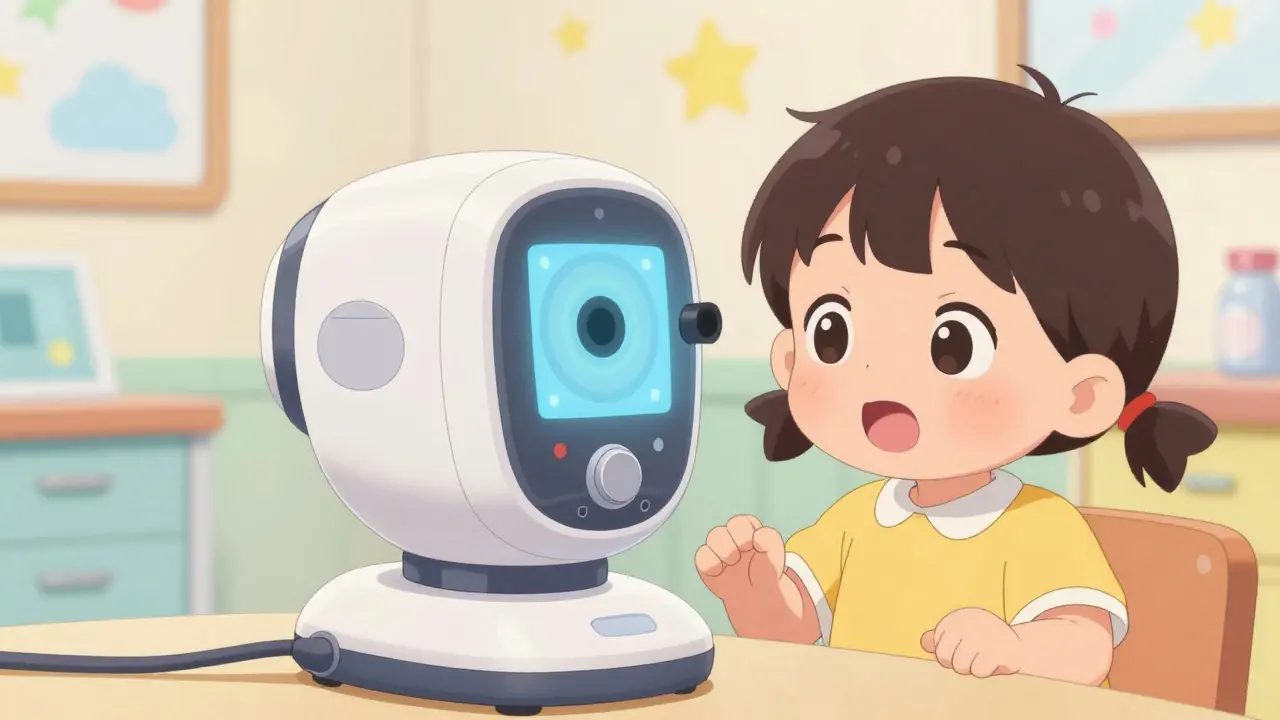
Testing a three-year-old with a chart can be like herding cats. Many children get bored, guess the letters, or simply refuse to participate. This is where instrument-based screening is the use of digital devices like autorefractors and photoscreeners to measure refractive error automatically comes in. These devices don't require the child to identify symbols; they simply take a photo or scan of the eye.
Modern tools like the blinq™ scanner is an AI-powered pediatric vision screener that provides rapid detection of amblyopia and strabismus have changed the game. In some studies, these AI-driven tools showed 100% sensitivity for detecting conditions that required referral in children aged 2 to 8. They are significantly faster-taking only 1 to 2 minutes per child compared to the 3 to 5 minutes needed for traditional charts.
However, these tools aren't perfect. They can occasionally flag a child as needing a referral for a very small refractive error that wouldn't actually impact their vision. This is why most doctors use a combination approach, especially for the "trickier" age group of 3 to 4 years.
When Should Your Child Be Screened?
If you follow the guidelines from the American Academy of Pediatrics is the leading professional organization for pediatricians in the US, setting standards for child health care (AAP), the timeline is quite clear. While some tools can be used as early as age 1, the most critical window is between ages 3 and 5. The U.S. Preventive Services Task Force (USPSTF) gives this a "Grade B" recommendation, meaning it is strongly advised for every child in that age bracket.
Beyond the preschool years, the AAP's "Bright Futures" schedule suggests continuing screenings at ages 8, 10, 12, and 15. This ensures that as the child grows and their eyes change-especially as they start spending more time on tablets and computers-any new refractive errors are caught early.
Common Pitfalls in the Screening Process
Not all screenings are created equal. A poor screening can lead to a false sense of security or an unnecessary trip to the specialist. One of the biggest issues is improper distance. If the chart is placed 8 feet away instead of 10, the results are skewed, leading to a high rate of false positives.
Lighting is another hidden culprit. Poorly illuminated charts make it hard for children to distinguish the optotypes, which often leads to a child failing a test they should have passed. There's also the "human element"-the learning curve for the provider. It usually takes a few hours of specialized training to get the technique right, and without quarterly quality checks, accuracy can drift.

From Screening to Referral: The Next Step
A screening is not a diagnosis. It's a filter. If a child "fails" a screen, they aren't necessarily "vision impaired"; they are now a candidate for a comprehensive eye exam. The goal is to move the child from the primary care office to a Pediatric Ophthalmologist is a medical doctor who specializes in the diagnosis and treatment of eye disorders in children .
The referral process should be immediate. Waiting six months for an appointment can be the difference between a successful treatment for amblyopia and a permanent visual deficit. Parents should be informed that a failed screen is a prompt for more information, not a cause for panic, but one that requires a timely follow-up.
Why can't my child just tell me if they can't see?
Young children often don't have a point of comparison. If they have had a vision problem since birth, they assume everyone sees the world the way they do. They won't complain about blurriness because they don't know what "clear" looks like.
What is the difference between a vision screen and a comprehensive eye exam?
A screening is a quick test designed to identify children who *might* have a problem. A comprehensive exam is a full medical evaluation by an eye doctor involving dilation and specialized equipment to diagnose the exact nature of the issue and prescribe treatment.
Is a "lazy eye" (amblyopia) curable?
Yes, if caught early. Treatment often involves patching the stronger eye to force the brain to use the weaker one, or wearing corrective glasses. The success rate is significantly higher (80-95%) if treated before age 5.
How often should my child have their vision checked?
At minimum, once between ages 3 and 5. After that, following the Bright Futures schedule at ages 8, 10, 12, and 15 is recommended, or more frequently if your child has a family history of vision problems.
Can AI-powered screeners replace traditional eye charts?
They are excellent for initial screening, especially for uncooperative toddlers. However, for older children (6+), optotype charts are still the preferred method for precisely measuring visual acuity.
What to do next
If your child is between 3 and 5 and hasn't had a vision screen, schedule one with your pediatrician. If you notice signs like squinting, tilting the head to see better, or frequent eye rubbing, don't wait for the scheduled checkup-request a screen immediately. If your child fails a screen, ensure you book an appointment with a pediatric ophthalmologist right away to take advantage of that critical window of plasticity.

Comments
This is such a good reminder for parents. Just getting a quick screen can honestly change a kid's whole life trajectory before they even hit kindergarten.
Oh please!!! The "gold standard" for a 6 year old is a chart??? Truly laughable!!!! Everyone knows the AI stuff is already way more consistent because humans are just terrible at measuring 10 feet accurately in a cramped office!!!! It's honestly a joke that we still rely on these archaic methods!!!!
It is worth noting that while the Red Reflex test is a standard first step, the actual interpretation requires significant clinical experience to avoid missing subtle leukocoria. In many regions, the transition from primary care screening to a specialist is where the system fails, and ensuring the referral is processed within two weeks is often the most critical part of the clinical pathway.
Omg I am just so incredibly moved by the idea that we can literally save a child's sight just by being proactive with these screens!! 🌟 It's just so wonderful that science has given us these tools like the blinq scanner to make it easy for those little ones who can't sit still, because let's be real, toddlers are like tiny tornados 🌪️ and trying to make them read a chart is basically impossible!! We really need to spread the word to every single parent group and school board we know so no child is left behind in that critical window of plasticity!! ✨💖
Funny how they push these "AI-powered" scanners. Who knows what's actually in the software or where that data is going? Probably just a way for big tech to get biometric eye scans of kids before they can even talk. Just sounds like another way to over-diagnose kids to make more money for the specialists.
It's interesting to think about how we perceive "normalcy" as children. If a child has never seen clearly, their reality is shaped by that blur. It's a bit of a philosophical trip to realize that we're not just fixing a medical issue, but essentially altering their perception of existence.
Everyone's acting like a screen is some miracle, but honestly, my pediatrician basically just glanced at my kid and said he was fine. These "standardized" screens are usually just a checkbox for the doctor so they can say they did it for insurance purposes. Don't hold your breath waiting for the system to actually catch everything.
The absolute tragedy here is the window of plasticity! Imagine the sheer horror of finding out at age 9 that a child's brain has essentially "given up" on one eye because a simple test wasn't done at age 4! It is an absolute disaster when the system fails and we lose that golden opportunity to rewire the visual cortex! We must demand more rigorous screening in every single daycare center immediately!
Ugh, the struggle of getting a 3-year-old to look at a chart is literally a nightmare! 🙄 Like, why are we still doing this? Just use the AI scanners already! My kid treats the eye chart like a coloring book and it's just so stressful for everyone involved! 😫
I don't care about the fancy AI stuff from overseas, we need to make sure our own US doctors are actually following the AAP guidelines and not just cutting corners to save time in these overworked clinics because it's a disgrace that some kids are still slipping through the cracks in the richest country on earth while we argue about whether a chart is better than a camera.
The correlation between early neurological development and sensory input is a profound subject. One must contemplate how the absence of visual clarity influences the cognitive architecture of a developing mind, potentially hindering the acquisition of literacy and spatial reasoning long before the academic failure becomes evident.
My heart actually breaks thinking about a child not knowing that the world is supposed to be sharp. It is just absolutely devastating that some of these kids suffer in silence for years because they have no point of reference! We really have to be the advocates for them!
I believe it would be most beneficial if schools integrated these screenings into their annual health checks to ensure that no child, regardless of their socioeconomic background, misses that critical window of treatment before age seven. The implementation of the Sloan letters in early grades could provide a much more reliable baseline for longitudinal tracking of visual health across a diverse student population.