

Imagine sitting in a busy classroom, the teacher speaking clearly, but the words just don’t click. You hear the sounds, but the meaning slips away. Or you’re in a meeting at work, everyone talking at once, and you nod along because you’re not sure what was even said. This isn’t inattention. It’s not laziness. For people with auditory processing disorder (APD), the problem isn’t with their ears-it’s with their brain’s ability to make sense of what the ears hear.
What Exactly Is Auditory Processing Disorder?
Auditory Processing Disorder, sometimes called Central Auditory Processing Disorder (CAPD), is a neurological condition where the brain struggles to interpret sounds correctly-even when hearing is perfectly normal. You can pass a standard hearing test with flying colors, but still miss half of what’s said in a noisy room. It’s not a hearing loss. It’s not a language disorder. It’s a glitch in how the brain processes sound signals after they reach the auditory nerve.
First formally recognized in the 1970s, APD affects about 3% to 5% of school-aged children, according to Nemours KidsHealth. That’s roughly one in every 20 kids. It’s also found in adults, though it’s often missed until someone starts struggling at work or in social settings. Boys are diagnosed more often than girls-about twice as often. And it runs in families: if a parent has APD, their child’s risk goes up by 50%.
What makes APD different from hearing loss? Simple: your ears work fine. Your audiogram looks normal. But your brain doesn’t organize the incoming sound properly. Think of it like a bad internet connection: the signal gets through, but the data is garbled. Words blend together. Instructions get mixed up. Background noise drowns out speech.
How APD Shows Up in Daily Life
People with APD don’t have one single symptom. They struggle in specific areas of sound processing. The American Speech-Language-Hearing Association (ASHA) identifies seven core challenges:
- Auditory discrimination: Telling apart similar sounds-like “bat” and “pat”-is hard. This directly affects reading and spelling.
- Sound localization: Knowing where a sound is coming from. Ever wonder why someone with APD turns their head constantly in conversations?
- Auditory memory: Forgetting verbal instructions after just one or two steps. “Go to your room, get your shoes, and bring me the keys.” By the time they reach the stairs, they’ve forgotten the shoes.
- Processing in noise: This is the biggest issue. In a cafeteria, a party, or even a car with the radio on, understanding speech becomes nearly impossible. Studies show 78% of kids with APD struggle here.
- Temporal processing: Catching fast speech, gaps between words, or rhythm. This affects music, poetry, and even understanding sarcasm or tone.
- Pattern recognition: Noticing pitch changes, melody, or stress in speech. This makes it hard to pick up emotional cues.
- Decoding degraded signals: Understanding speech that’s muffled, distant, or slightly distorted-like a phone call with bad reception.
Real-life examples? A 9-year-old writes “write a paragraph” when the teacher said “cite a paragraph.” A college student misses 70% of a lecture because of background chatter. An adult in a team meeting nods along, then later asks, “Wait, what were we supposed to do?”
Why APD Is Often Misdiagnosed
APD doesn’t show up on standard hearing tests. That’s why it’s confused with ADHD, dyslexia, or just “being inattentive.”
Here’s the overlap:
- 30%-40% of children with APD also have ADHD-but the attention issues in APD come from auditory overload, not poor impulse control.
- 25%-35% of kids with APD also have dyslexia, because both affect how the brain handles sounds.
- 45% of kids referred for APD testing turn out to have attention or language disorders instead.
- And 30% of kids diagnosed with ADHD actually meet the criteria for APD.
Doctors and teachers often assume the child isn’t trying hard enough. But research from the Hearing Health Foundation shows these kids aren’t ignoring you-they’re hearing speech like it’s coming through static. One parent put it simply: “My son didn’t have a behavior problem. He had a perception problem.”
That’s why diagnosis requires a specialist. A regular pediatrician or school psychologist can’t spot APD. You need a certified audiologist who uses specialized tests:
- Dichotic Digits Test: Different numbers are played in each ear at the same time. Can the brain combine them?
- Random Gap Detection Test: Measures how well the brain detects tiny silences between sounds.
- Pitch Pattern Sequence Test: Asks the person to repeat rising or falling tones.
Results must be at least two standard deviations below age norms. No single test confirms APD. It’s a pattern of failures across multiple areas.

Types of APD: It’s Not One Condition
APD isn’t a single problem. Experts like Dr. Teri James Bellis break it into four main subtypes:
- Decoding deficit: Trouble with basic sound discrimination. Often linked to left-brain issues. This type affects reading and spelling the most.
- Tolerance-fading memory deficit: Can’t handle noisy or distorted speech. Memory fades quickly. Associated with temporal lobe dysfunction.
- Auditory integration deficit: Struggles to combine information from both ears. Often tied to problems in the corpus callosum, the bridge between brain hemispheres.
- Prosodic deficit: Misses emotional tone, sarcasm, or rhythm in speech. Linked to right-brain processing issues.
Knowing the subtype helps target interventions. A child with a decoding deficit needs different help than one with a prosodic deficit.
How APD Affects School and Work
Classrooms are noisy. Lectures are fast. Group discussions are chaotic. For a child with APD, school isn’t just hard-it’s exhausting.
According to Boston Children’s Hospital, 65% of children with APD have academic struggles, especially in reading, spelling, and following verbal instructions. One parent shared that after implementing preferential seating (front row, away from windows and doors), their child’s reading scores jumped from the 45th to the 89th percentile.
Adults aren’t spared. The Hearing Health Foundation reports 82% of adults with APD face workplace challenges-especially in meetings, phone calls, or open offices. One man described his job as a project manager as “a constant guessing game.” He’d miss deadlines because he misunderstood instructions. He thought he was being careless. He later found out he had APD.
Untreated APD also increases mental health risks. By adolescence, kids with APD are 2.3 times more likely to develop anxiety and 1.8 times more likely to experience depression than their peers. The social isolation-being seen as “slow,” “distracted,” or “rude”-takes a toll.
What Helps: Evidence-Based Support Strategies
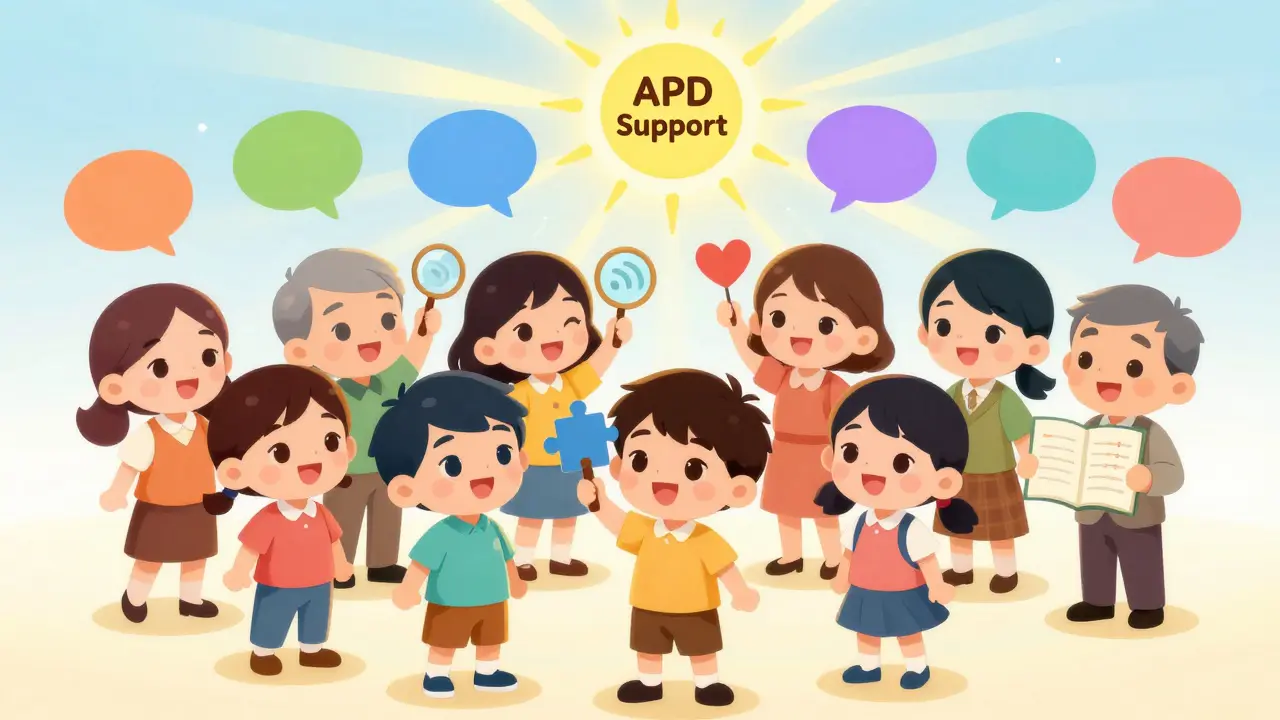
There’s no pill for APD. No surgery. But there are powerful, proven ways to manage it.
Environmental Changes
Small tweaks make a huge difference:
- Preferential seating: Sit within 3-6 feet of the speaker. Avoid areas near air conditioners, doors, or windows.
- Sound-field amplification: A teacher wears a mic, and speakers boost their voice evenly across the room. Reduces background noise by 15-20 dB.
- Noise reduction: Use rugs, curtains, and acoustic panels. Keep background noise low. The American Academy of Audiology recommends a +15 dB signal-to-noise ratio (voice 15 dB louder than background).
Assistive Technology
- FM systems: A wireless mic transmits the speaker’s voice directly to earbuds or headphones. Proven effective in classrooms.
- AI-powered speech apps: Tools like Otter.ai or Microsoft’s Live Transcribe turn speech into real-time text. Useful for lectures or meetings.
Therapy and Training
- Auditory training: Programs like Earobics or Auditory Workout use computer-based games to strengthen sound discrimination. Studies show 40%-60% improvement after 10-12 weeks.
- Speech-language therapy: Focuses on metacognitive strategies-teaching kids to ask for repetition, summarize what they heard, and self-monitor.
- Self-advocacy: Teaching kids to say, “I didn’t catch that. Can you say it again?” or “Can we write that down?”
ASHA’s 2022 meta-analysis found that combining environmental changes with speech therapy leads to 70% improvement in academic outcomes.
Home Strategies
- Speak slowly and clearly. Pause between sentences.
- Use visual cues: write down instructions, use pictures, point to objects.
- Reduce background noise: turn off the TV or radio during conversations.
- Practice listening for 15 minutes a day using apps like Auditory Workout or Sound Therapy.
Legal Rights and Accommodations
In the U.S., children with APD qualify for support under IDEA (Individuals with Disabilities Education Act) or Section 504 of the Rehabilitation Act. This means:
- Preferential seating
- Extended time on verbal tests
- Access to FM systems
- Written copies of oral instructions
- Reduced background noise during exams
Yet, only 35% of children with APD actually receive these accommodations, according to U.S. Department of Education data. Parents often don’t know their rights-or schools don’t recognize APD as a legitimate need.
For adults, the Americans with Disabilities Act (ADA) protects workplace accommodations. Requesting a quiet workspace, noise-canceling headphones, or written meeting summaries isn’t unreasonable-it’s a right.
The Future of APD: Research and Hope
Neuroscience is catching up. fMRI studies from 2023 show reduced activation in the left superior temporal gyrus-the area responsible for processing speech-during listening tasks in people with APD.
New treatments are being tested. Transcranial magnetic stimulation (TMS), which gently stimulates brain areas, showed 35% improvement in temporal processing in a 2023 clinical trial. The NIH has allocated $4.7 million in 2024 to find biological markers for early detection.
Long-term studies from the University of Florida show that with early intervention, 80% of children develop strong coping skills and succeed academically. But 45% still face challenges in noisy workplaces as adults.
One thing’s clear: APD isn’t a life sentence. It’s a neurological difference. With the right support, people with APD don’t just survive-they thrive.
Is auditory processing disorder the same as hearing loss?
No. Hearing loss means the ears have trouble picking up sound-usually due to damage in the ear canal, eardrum, or inner ear. APD means the ears hear fine, but the brain struggles to interpret what the sound means. A person with APD can pass a standard hearing test but still miss words in noisy rooms.
Can APD be cured?
There’s no cure for APD because it’s a neurological processing issue, not a disease. But it can be managed effectively. With the right strategies-like environmental changes, assistive tech, and auditory training-most people learn to compensate and lead successful lives.
How is APD diagnosed?
Only a certified audiologist can diagnose APD. They use specialized tests like the Dichotic Digits Test, Random Gap Detection Test, and Pitch Pattern Sequence Test. These measure how well the brain processes sound under different conditions. Standard hearing tests won’t catch APD.
Does APD affect only children?
No. While symptoms often appear in school-aged children, APD affects adults too. Many adults go undiagnosed for years, thinking they’re just “bad listeners.” Workplace settings with background noise, meetings, and phone calls often reveal the problem later in life.
Can I help someone with APD at home?
Yes. Speak slowly and clearly. Reduce background noise. Use visual aids like notes or pictures. Repeat important information. Encourage them to ask for clarification. Practice listening for 15 minutes a day using apps like Auditory Workout. These small changes make a big difference.
Is APD linked to ADHD or dyslexia?
Yes, but they’re not the same. About 30%-40% of children with APD also have ADHD, and 25%-35% have dyslexia. But the root causes are different. APD is about sound processing. ADHD is about attention and impulse control. Dyslexia is about reading and language. Often, they overlap, which is why proper diagnosis matters.

Comments
I never knew APD was so common. My brother always seemed like he was zoning out in class, but turns out he was just struggling to untangle words from noise. We didn't get it diagnosed till he was 18. Now he uses Otter.ai for lectures and it's changed everything. Seriously, if you think someone's just 'not listening', maybe they're just trying to decode a signal through static.
Also, typo: 'cite a paragraph' not 'write a paragraph'-yeah, that's APD right there.
OMG I KNEW IT 😍👏 This is why I refuse to do Zoom calls. I don't have ADHD. I'm not rude. I just can't process 3 people talking at once in a virtual room. My therapist said I 'overthink everything'-nope. My brain just can't filter out the echo of the guy in the back who's chewing gum. 🤦♀️
Also, if you're not using noise-canceling headphones in an open office, you're literally asking for sensory overload. Basic.
Ah yes, the classic 'he's just not trying hard enough' diagnosis. How quaint. 🙄
Let me guess-your kid got labeled 'inattentive' because they missed the homework assignment spoken at 7:30 a.m. in a classroom with a buzzing fluorescent light? Classic APD. And no, putting them in a quieter room isn't 'coddling'-it's neuroscience. You wouldn't make a diabetic eat more sugar because they 'should try harder.'
Also, FM systems? Please. That's not 'accommodation,' that's basic human engineering. Why are we still arguing about this in 2025?
Interesting. In India, we don't talk much about APD. Teachers say 'be more careful' or 'listen better.' No one tests for it. My cousin, who is now a software engineer, used to fail oral exams because he'd repeat the wrong part. He thought he was dumb. Turns out he had decoding deficit. He started using live captions on YouTube for lectures. Now he's top of his class. Small changes, big impact.
Thank you for this comprehensive overview. The distinction between auditory processing disorder and attention deficit is critically important and often misunderstood in educational settings. Evidence-based interventions such as preferential seating and sound-field amplification are not merely accommodations-they are necessary modifications grounded in neuroplasticity research. Schools that resist implementing these supports are not just failing students; they are neglecting their legal obligations under Section 504 and IDEA. Professional audiologists must be integrated into school evaluation teams.
I'm just saying... what if this isn't a disorder at all? What if it's a side effect of overexposure to digital noise? Maybe our brains are just adapting to a world where everything is filtered, compressed, and corrupted. Maybe APD is evolution. Maybe the real problem is that schools still teach like it's 1998. Just saying.
In Tamil Nadu, we have a saying: 'Hearing is not listening.' My grandmother used to say this when I kept asking her to repeat herself. Turns out, she was right. No one told me APD was a thing. I just learned to write everything down. Now I work as a translator. My brain learned to compensate. You don't need a cure. You need space to adapt.
APD isn't real. It's just lazy kids who don't pay attention.
I appreciate the depth of this post. As a speech-language pathologist, I've seen too many kids mislabeled as 'disruptive' or 'slow' when they just couldn't untangle speech from background noise. The most powerful intervention isn't tech-it's teaching self-advocacy. When a child learns to say, 'Can you say that again?' without shame, their confidence skyrockets. And yes, it's never too late. I had a 42-year-old client last month who cried because she finally understood why she'd always felt so behind in meetings.
This made me cry. My daughter was diagnosed at 10. We spent years thinking she was lazy. Turns out she was drowning in noise every day. We started using written notes, quiet mornings, and Auditory Workout. She just got her first A in English. Not because she's smarter now. Because she finally had a chance to hear.
I never realized APD could be inherited. My mom always said I was 'too sensitive' to noise. Now I know she had it too. She never got tested. I'm getting evaluated this month. If I have it, I'll finally understand why loud rooms make me want to disappear. Thanks for writing this. I feel less alone.