

When a doctor prescribes a generic drug, most patients assume it’s just as safe and effective as the brand-name version. After all, the FDA says so. But behind that simple prescription is a complex, global supply chain that many clinicians are beginning to question - not because they distrust generics, but because they’re seeing patterns that don’t add up.
What’s really in that pill?
Generic drugs aren’t copies. They’re legally required to contain the same active ingredient, in the same strength, and deliver it at the same rate as the brand-name drug. That’s bioequivalence. But what’s not required? Identifying where every single step of the process happens. A single generic pill might have its active ingredient made in a factory in Hyderabad, mixed with fillers in a plant in New Jersey, coated in a facility in Shanghai, and packaged in a warehouse in Mexico. Only one company name appears on the label - the one that holds the marketing rights. The rest? Invisible. Clinicians aren’t just guessing. Data from the FDA’s Adverse Event Reporting System shows something troubling. A 2023 study from Ohio State University found that generic drugs manufactured in India had a 54% higher rate of severe adverse events - including hospitalizations, disabilities, and deaths - compared to identical generics made in the U.S. The researchers controlled for how often the drugs were prescribed. It wasn’t about usage. It was about origin.Why does manufacturing location matter?
The FDA inspects U.S. facilities without warning. Overseas? Not so much. In countries like India and China, inspections are scheduled months in advance. That gives manufacturers time to clean up, fix visible problems, and hide what’s really going on behind the scenes. It’s not about corruption. It’s about systems. Many overseas facilities still use outdated equipment. They lack real-time monitoring. They don’t have the same culture of continuous quality control. And when the pressure to cut costs gets intense - especially for older, low-margin generics - corners get cut. A 2023 report from Duke-Margolis Center found that outdated manufacturing tech is the leading cause of drug shortages. And those shortages? They lead to delays in cancer treatment, rationed medications, and even higher mortality rates. Dr. Robert S. Gray, lead author of the Ohio State study, put it bluntly: “As drugs get cheaper and cheaper and the competition gets more intense to hold down costs, operations and supply chain issues can compromise drug quality.”The quiet crisis: older generics
The problem isn’t new generics. It’s the old ones - the ones that have been on the market for 20 years, the ones that cost pennies. These are the drugs that hospitals and Medicaid programs rely on most. The ones that get prescribed for heart failure, epilepsy, thyroid conditions, and depression. When a drug’s patent expires, dozens of manufacturers jump in. Prices drop. Margins vanish. The only way to stay profitable is to reduce costs - often by outsourcing to the cheapest supplier, regardless of quality. That’s why older generics are the ones showing the worst adverse event rates. One pharmacist in Ohio told me about a patient on a generic version of levothyroxine. The patient was stable for years. Then, after a switch to a new batch made in India, their TSH levels spiked. They had symptoms of hypothyroidism - fatigue, weight gain, brain fog. The pharmacist switched them back to the U.S.-made version. Symptoms disappeared in two weeks. No change in dosage. Just a change in manufacturer. This isn’t rare. It’s happening in clinics across the country.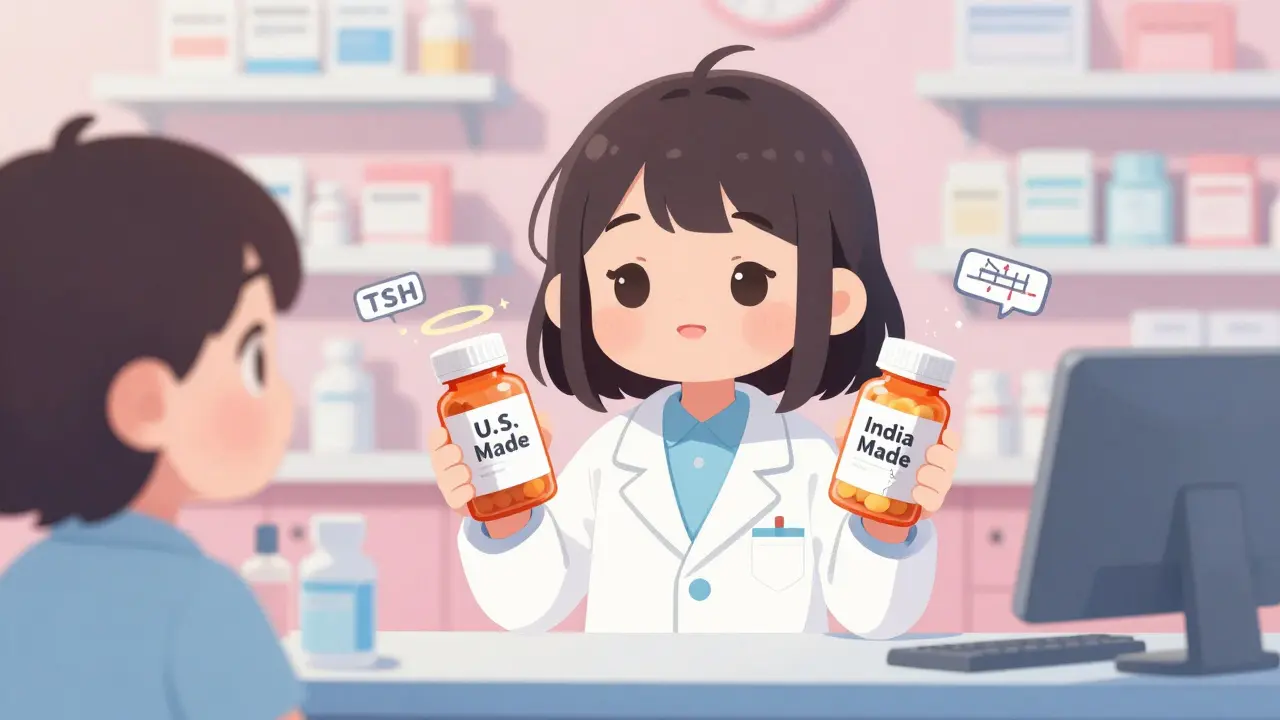
Is the FDA doing enough?
The FDA says the U.S. drug supply is among the safest in the world. They have over 1,300 staff dedicated to drug quality. They inspect thousands of facilities every year. And yes - many overseas plants meet standards. But here’s the gap: inspection frequency and transparency. The FDA doesn’t publicly list where each generic drug is made. Patients don’t know. Prescribers don’t know. Pharmacists often don’t know until they get a batch that doesn’t work the same. Some experts are calling for mandatory labeling: “Manufactured in India” or “Made in the U.S.” on the box. Not to scare people, but to give clinicians and patients real information. If a patient has a bad reaction, they can trace it. If a hospital sees a pattern, they can switch. The University of Wisconsin School of Pharmacy argues that if more manufacturing happened domestically, we’d see fewer quality issues, fewer shortages, and a more stable supply chain. It’s not about nationalism. It’s about control.Advanced manufacturing could fix this - if we invest
There’s a better way: advanced manufacturing technologies (AMTs). Things like continuous manufacturing, real-time sensors that detect impurities during production, and automated quality checks. These aren’t sci-fi. They’re already in use - but 80% of AMT-produced drugs are made in the U.S. The catch? The upfront cost is high. A small generic manufacturer in India can’t afford to install a $50 million continuous manufacturing line. They can’t compete on price if they do. So they stick with batch processing, manual checks, and outdated systems. But here’s the irony: AMTs can actually lower per-unit costs over time. They reduce waste, cut downtime, and improve consistency. The Duke-Margolis Center says these technologies could make domestic production cost-competitive - if we incentivize it.What clinicians are doing now
Some doctors are starting to track which generic brands work best for their patients. They avoid switching unless absolutely necessary. They ask pharmacists: “Is this the same batch we used last month?” Others are pushing for institutional policies. One hospital in Minnesota now requires prescribers to specify the manufacturer on generic prescriptions for critical drugs - like anticoagulants, seizure meds, and insulin. Pharmacists are becoming frontline detectives. One in Chicago told me she keeps a log: “When a patient reports a change in how they feel after a generic switch, I check the lot number. If it’s from a new supplier, I note it. Over time, we’ve seen which ones cause issues.” It’s not about rejecting generics. It’s about demanding accountability.

Comments
This is wild 🤯 I took my grandma's generic levothyroxine last month and she started zoning out at dinner like she was in a coma. We switched back to the old batch and boom-she’s back to yelling at the TV like normal. Who knew pills had personalities?
The data presented here aligns with peer-reviewed pharmacovigilance trends observed in tertiary care centers over the past five years. The variance in pharmacokinetic profiles-particularly with narrow-therapeutic-index drugs-is statistically significant when stratified by manufacturing origin. The absence of mandatory lot-level traceability in the U.S. regulatory framework constitutes a critical vulnerability in patient safety infrastructure. We must institutionalize post-market surveillance protocols that link adverse events to specific manufacturing sites, not just brand names.
Stop pretending this is about safety. It's about profit. The FDA lets Indian manufacturers get away with this because they're too scared to lose cheap drugs. Meanwhile, patients die while bureaucrats sip coffee and wait for their next audit schedule. You think a $50 million machine is too expensive? Try paying for a funeral. The system is corrupt. Fix it or shut up.
I'm a pharmacist in rural Ohio and this hits home. 💊 We keep a little notebook: lot #, patient reaction, switch date. Last month, three patients on the same generic metoprolol had heart palpitations after a batch change. We called the distributor-turns out it was from a new vendor in Telangana. We switched them back to the old one. No drama. No panic. Just better info. We can fix this one pill at a time. 🙏
As someone who has worked in API manufacturing in Hyderabad, I can say with sincerity that the infrastructure challenges are real-but they are not universal. Many facilities operate with global standards, often exceeding those in small U.S. plants. The issue is not geography, but oversight. If the FDA implemented unannounced audits with real-time data streaming from production lines-regardless of location-we could eliminate the worst actors without stigmatizing entire nations. Quality is not a flag; it is a process.
So let me get this straight-we’re mad because the pills are cheap? Lol. In India, we make these pills for 2 cents each. You guys pay $12 for the same thing because you like labels that say 'Made in USA'. I get it. You want to feel safe. But your grandma’s heart med? It’s the same chemistry. Maybe she just needed a nap.
This isn't a pharmacology debate-it's a post-industrial capitalism critique wrapped in pill form. The erosion of domestic manufacturing capacity didn't happen by accident; it was engineered by shareholder value maximization, offshoring incentives, and the commodification of human health. The FDA's inspection regime is a theater of compliance, not a guarantee of safety. The solution isn't just labeling-it's re-nationalizing critical supply chains, investing in continuous manufacturing at scale, and treating pharmaceuticals as public goods, not profit engines. We have the technology. We have the capital. What we lack is the moral imagination to prioritize life over liquidity.