

Living with Borderline Personality Disorder (BPD) often feels like walking through life with raw nerves exposed. One moment you’re fine, the next, you’re overwhelmed by anger, fear of abandonment, or a crushing sense of emptiness. Self-harm, impulsive decisions, and intense relationship conflicts aren’t choices-they’re reactions to emotional storms that don’t seem to have an off switch. But there’s a proven way out: DBT skills and structured crisis planning. This isn’t about fixing your personality. It’s about learning tools that help you survive the storm until it passes.
What DBT Actually Does for BPD
Dialectical Behavior Therapy, or DBT, wasn’t created to cure BPD. It was built to help people with BPD stop dying. Developed by Dr. Marsha Linehan in the 1980s, DBT emerged because traditional therapy wasn’t working for people who were chronically suicidal and emotionally unstable. Standard talk therapy often made them feel worse-like their pain was being dismissed or misunderstood. DBT flipped that. It says: Your feelings are real. Now let’s teach you how to handle them without destroying yourself. It’s not magic. It’s methodical. DBT combines two opposing ideas: acceptance and change. You learn to accept your emotions as valid, even when they’re intense. Then you learn how to change how you respond to them. This balance is what makes DBT different from other therapies. It doesn’t tell you to calm down. It teaches you how to calm down-step by step.The Four Core Skill Modules
DBT breaks down emotional survival into four skill sets. Each one targets a different part of the BPD experience. You don’t need to master all of them at once. Start with one. Build from there.Mindfulness: Ground Yourself in the Now
Mindfulness in DBT isn’t about meditation for relaxation. It’s about stopping the spiral. When you’re in crisis, your brain is stuck on autopilot-racing through memories, imagining disasters, replaying arguments. Mindfulness teaches you to pause. The core skills are simple: observe, describe, participate. You learn to notice what’s happening inside you without judging it. Is your chest tight? Is your heart pounding? Are your thoughts screaming? Just name it. Don’t try to fix it yet. Research shows that after just eight weeks of daily mindfulness practice, people with BPD see a 32% improvement in their ability to regulate emotions. That’s not a small gain. It’s the difference between reacting and responding.Distress Tolerance: Get Through the Night
This is where DBT saves lives. When you’re in the middle of a crisis-when the urge to self-harm is overwhelming, or you’re convinced you can’t go on-distress tolerance gives you tools to survive until the feeling passes. These aren’t coping mechanisms. They’re emergency procedures. The TIPP skill is one of the most powerful. It stands for:- Temperature: Splash ice water on your face. The cold triggers your body’s natural calming reflex.
- Intense exercise: Do 20 jumping jacks or sprint in place. Physical exertion burns off adrenaline.
- Paced breathing: Breathe in for 4 seconds, hold for 4, out for 6. Slow breathing tells your nervous system: you’re safe.
- Paired muscle relaxation: Tense your fists for 5 seconds, then release. Do the same with your shoulders, legs, face. Repeat.
Emotion Regulation: Stop the Rollercoaster
BPD often comes with extreme emotional swings-anger that lasts hours, sadness that feels permanent. Emotion regulation skills help you understand why you feel the way you do, and how to change it without numbing out or exploding. The PLEASE skill is simple but life-changing:- Physical illness: Treat medical issues. Pain and fatigue make emotions worse.
- Level of eating: Eat balanced meals. Blood sugar crashes trigger irritability.
- Evoid mood-altering drugs: Alcohol, weed, stimulants-they make emotional control harder.
- Abalanced sleep: Get 7-8 hours. Sleep deprivation is a trigger for self-harm.
- Exercise: Move your body daily. Even a 15-minute walk lowers stress hormones.
Interpersonal Effectiveness: Say What You Need Without Losing Yourself
Relationships are the biggest source of pain and joy for people with BPD. You crave connection, but fear abandonment. You say things in the heat of the moment, then regret them. DEAR MAN, GIVE, and FAST are scripts for navigating conflict without losing your dignity or your relationships. DEAR MAN helps you ask for what you need:- Describe the situation without blame.
- Express how you feel.
- Assert your request clearly.
- Reinforce the positive outcome.
- Mindful: Stay focused on your goal.
- Appear confident-even if you’re not.
- Negotiate if needed.
Crisis Planning: Your Personal Emergency Kit
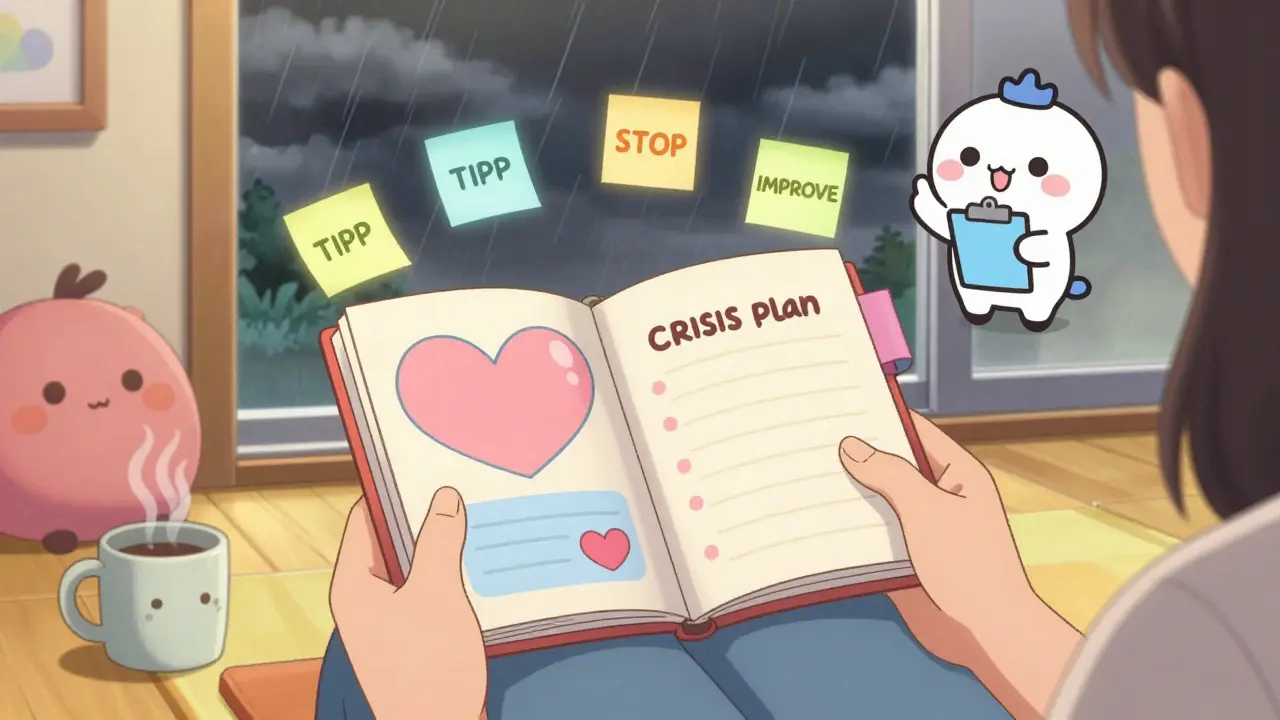
A crisis plan isn’t just a list of phone numbers. It’s a step-by-step guide for when you’re too overwhelmed to think. Write it down when you’re calm. Keep it on your phone, in your wallet, taped to your mirror. Your plan should include:- Triggers: What usually sets off your crisis? (e.g., silence from a friend, being criticized, feeling ignored)
- Early warning signs: What happens in your body before you lose control? (e.g., clenched jaw, racing thoughts, numbness)
- First steps: Which DBT skill do you use first? (TIPP? STOP?)
- Support people: Who can you call? Who won’t judge you? (Include names and numbers)
- Safe places: Where can you go? (A friend’s house, a park, your bedroom with the door locked)
- Professional help: Who’s your therapist? What’s the crisis line number?
How DBT Compares to Other Treatments
There are other therapies for BPD-Mentalization-Based Therapy, Schema Therapy, Transference-Focused Psychotherapy. But DBT stands out because it’s practical. It doesn’t just explore your past. It gives you tools for today. A 2019 meta-analysis of 18 studies found DBT reduced self-harm by 35% compared to standard care. Other therapies saw reductions of 22-28%. DBT also cuts suicide attempts in half over the first year. That’s not just statistically significant. That’s life-saving. But DBT isn’t easy. It’s demanding. You need to commit to weekly individual therapy, a 2-hour skills group, and phone coaching. That’s 3-4 hours a week. Many people drop out because it’s hard. But those who stick with it? They say it changes everything.Real People, Real Results
Reddit communities like r/BPD and r/DBT are full of stories. One user wrote: “I used IMPROVE to get through a night I thought I’d never survive. I imagined a peaceful beach, focused on one thing at a time, and reminded myself I’d made it through worse. I didn’t cut myself. For the first time in 10 years, I woke up without shame.” Another said: “I kept the PLEASE worksheet on my fridge. Every morning, I checked it off. Sleep? Yes. Food? Yes. No alcohol? Yes. It felt stupid at first. But after a month, I noticed I wasn’t exploding as much. My therapist said, ‘You’re not trying to be perfect. You’re trying to be consistent.’ That stuck with me.”
Getting Started
You don’t need to be in a formal DBT program to start using these skills. You can buy the Dialectical Behavior Therapy Skills Workbook. There are free worksheets online. Apps like DBT Coach walk you through each skill. But if you’re struggling with frequent self-harm, suicidal thoughts, or relationships that keep falling apart, formal DBT is the best path. Look for a therapist certified by the Linehan Institute. There are only about 1,800 certified DBT therapists worldwide. Telehealth has made access easier-especially in rural areas.What to Expect
The first month is hard. You’ll feel like the skills don’t work. You’ll forget to use them. You’ll get frustrated. That’s normal. Most people don’t see progress until month 3 or 4. By month 6, if you’re practicing daily, you’ll notice things: fewer panic attacks, less guilt after arguments, more control over your impulses. It’s not about becoming a calm, perfect person. It’s about learning to survive your own mind. And that’s enough.Is DBT Right for You?
DBT works best if you’re willing to practice-even when it feels pointless. It’s not for people who want quick fixes. It’s for people who are tired of hurting themselves and want to try something that actually works. If you’re reading this and thinking, “Maybe I need this,” you already have the first skill: awareness. Now take the next step. Call a therapist. Download a worksheet. Try TIPP the next time you feel like you’re falling apart. You don’t have to do it all at once. Just do one thing. Then another. And another.Can I use DBT skills without therapy?
Yes, you can learn and practice DBT skills on your own using workbooks, apps, or free online resources. Many people start this way. But for those with severe BPD symptoms-like frequent self-harm or suicidal thoughts-working with a certified DBT therapist significantly increases success. Therapy provides accountability, personalized feedback, and crisis support that self-help can’t fully replace.
How long does it take to see results from DBT?
Most people start noticing small changes within 3-4 months of consistent practice. Significant improvements-like fewer self-harm episodes, better relationships, or less emotional overwhelm-usually appear after 6-8 months. Full mastery of all skills can take a year or more. Progress isn’t linear. Some weeks feel like setbacks. That’s normal. The goal isn’t perfection-it’s progress.
Is DBT only for women?
No. While early research focused on women, DBT has been proven effective for men, adolescents, and non-binary individuals. BPD affects about 3.6% of adults in the U.S., and men are just as likely to have it-but they’re often misdiagnosed with depression, PTSD, or antisocial personality disorder. DBT works regardless of gender.
What if I can’t afford DBT therapy?
Many community mental health centers offer sliding-scale fees or DBT groups at reduced costs. Some universities with psychology programs run low-cost clinics staffed by trained graduate students. Online DBT groups and apps like DBT Coach or Mindfulness Coach are affordable alternatives. Insurance in the U.S. often covers 12-20 DBT sessions per year. Don’t assume it’s out of reach-ask for help.
Can DBT help with co-occurring issues like addiction or depression?
Yes. DBT was originally designed for BPD, but its skills are effective for substance use, depression, anxiety, and PTSD. The distress tolerance and emotion regulation modules directly address the emotional pain that drives addiction. Many rehab programs now integrate DBT skills. If you have multiple diagnoses, a skilled DBT therapist can tailor the approach to fit your needs.

Comments
Wow, this is like someone took a textbook and threw it into a poetry slam. DBT? More like Dialectical Bullsh*t Therapy. I’ve been doing ‘mindfulness’ by staring at my ceiling and yelling at my cat. Works better than any worksheet.
Let me tell you something real - DBT isn’t some trendy self-help fad. It’s the only thing that kept me from ending it during my worst spiral. TIPP saved my life three times. Ice water on the face? Sounds ridiculous until you’re shaking, screaming, and the cold snaps you back into your body like a damn reset button. Do it. Even if you think it’s dumb. Do it anyway.
This is one of the most balanced, compassionate, and clinically accurate summaries of DBT I’ve seen outside of academic journals. The distinction between acceptance and change is critical - and often misunderstood. Many people mistake DBT for emotional suppression, when in fact it’s about emotional sovereignty. Well done.
How charming. Another article that treats borderline personality disorder like a DIY project you can fix with a free PDF and a 15-minute walk. Let me guess - you’ve never sat in a hospital room watching someone bleed out because they thought they were worthless? No? Then maybe don’t reduce survival to bullet points.
I read this and thought - who the hell wrote this? Some therapist trying to sell books? DBT is a cult. The groups are full of people who talk about their ‘emotional regulation’ like it’s a yoga class. And don’t get me started on the ‘crisis plan’ - like writing down ‘call mom’ is gonna stop a dissociative episode. Pathetic.
There’s a reason DBT is the gold standard: it’s the only therapy that doesn’t ask you to change who you are - it asks you to change how you survive. The skills are simple, but the practice is brutal. I’ve been doing this for 18 months. Some days I forget to breathe. Other days, I use DEAR MAN and actually get my needs met. It’s not about perfection. It’s about showing up. Even when you’re broken. Especially then.
OMG YES!!! I used TIPP last night after my ex texted ‘hey’ and I felt like I was gonna die!!! I splashed ice water on my face and did 30 jumping jacks in my kitchen and then I cried for 20 mins and it was like… ahhh I’m still here!!! I’m still here!!! I’m still here!!! 🙌💧💪
Interesting. In India, we call this ‘managing the mind’s chaos’ - but we do it with meditation, not ice water. Still, the Western obsession with technique over transcendence is… predictable. You treat symptoms like puzzles. But the soul doesn’t solve. It surrenders. DBT is a bridge, not a home.
Who funded this article? The pharmaceutical industry? The Linehan Institute? Did you know that DBT was developed by a woman who was once diagnosed with BPD herself? Coincidence? Or a carefully constructed narrative to sell therapy packages to vulnerable people? The real cure is systemic change - not breathing exercises.
Why is everyone so obsessed with ‘skills’? Why not just… feel? Why not let it burn? Why do we need to ‘regulate’? Why do we need to ‘stop’? Why not just scream until our throats bleed? Why do we need to survive? Why not just… end it? I’ve tried the skills. They don’t work. They just make you feel worse for failing.
Wow, you really think this stuff works? I’ve been in DBT for 2 years. I’ve done all the worksheets. I’ve called my therapist at 3 a.m. I’ve used TIPP until my face was numb. And I’m still in the same damn hospital. This isn’t a toolkit. It’s a prison with nice handouts.
DBT saved me. I used to cut. Now I write on my arms with red pen. It’s not perfect. But it’s not blood. And I’m still here. Stop overthinking it. Just try one skill. Just one. You don’t need to believe in it. Just do it. Then come back and tell me I’m wrong.
You’re not alone. I’ve been where you are. I thought I’d never feel peace again. But I started with one breath. Then another. Then I used STOP when I felt the panic rising. And now? I’m going to therapy tomorrow. And I’m not scared. You got this. 💖
While DBT is empirically effective, one must acknowledge its cultural limitations. In collectivist societies, the emphasis on individual skill-building can feel isolating. The ‘crisis plan’ assumes autonomy - but what if your family is the trigger? What if your ‘safe place’ is your abusive parent’s house? DBT needs adaptation - not blind adoption.