
When you take a pill for high blood pressure or antibiotics, chances are it was made in China or India. These two countries supply most of the world’s generic drugs and active pharmaceutical ingredients (APIs). But behind the low cost and high volume lies a complex reality: China and India manufacturing aren’t equally safe, and the FDA watches them very differently.
Why FDA Monitoring Matters More Than You Think
The U.S. Food and Drug Administration doesn’t just inspect drug factories in America. It sends teams to China and India regularly - because over 80% of the world’s generic APIs come from these two countries. A single contaminated batch can trigger nationwide recalls. In 2023, the FDA issued import alerts against 37% of Chinese pharmaceutical facilities. For India, that number was just 18%. That gap isn’t random. It’s the result of years of compliance differences. These aren’t just numbers. They’re real risks. In 2018, a batch of contaminated cough syrup from India caused over 70 child deaths in Gambia. The cause? Diethylene glycol - a toxic chemical used in antifreeze. The FDA later found the supplier had falsified test results. Similar issues have surfaced in Chinese plants, where poor documentation and lack of cleanroom controls led to microbial contamination in injectables.India’s Edge: Compliance Over Scale
India has over 100 FDA-approved manufacturing sites. China has 28. That’s not a typo. India leads by a wide margin in facilities that meet U.S. standards. Why? Because Indian pharma companies learned early that compliance was the price of entry into Western markets. Companies like Sun Pharma, Dr. Reddy’s, and Cipla built their businesses around FDA requirements. They invested in digital systems to track every step of production - from raw material intake to final packaging. Their workers are trained in 21 CFR Part 211, the FDA’s quality rules for drug manufacturing. In inspections from 2020 to 2023, Indian plants received 30% fewer Form 483 observations - the FDA’s official list of violations - than Chinese ones. India’s regulatory environment is also more predictable. When a plant fails an inspection, the FDA gives clear guidance on how to fix it. Many Indian firms respond within months. In China, remediation often takes longer - and sometimes never happens. That’s why global pharma companies are shifting production to India under the “China+1” strategy. They’re not abandoning China. They’re diversifying.China’s Strength: Volume and Cost - But at a Price
China dominates API production. It makes about 80% of the world’s raw ingredients for generic drugs. Its factories are massive. They can produce 100 tons of metformin in a single run. That’s cheaper than anywhere else. Labor costs are rising, but China still holds a 40% cost advantage over the U.S. and Europe. But scale doesn’t equal safety. Many Chinese manufacturers are small, family-run operations with minimal oversight. They cut corners to meet price targets. Some use unapproved solvents. Others skip stability testing. The FDA has caught them. In 2023, over a third of Chinese facilities were flagged for violations - from poor sanitation to data falsification. The Chinese government has tried to fix this. Since 2020, it’s pushed manufacturers to adopt WHO-GMP and ISO standards. Some large firms like Sinopharm and CSPC have improved. But the middle and lower tiers? They’re still risky. For a U.S. company making a low-margin drug, the temptation to use cheap Chinese APIs is strong. But the FDA doesn’t care about your profit margin. It cares about patient safety.
The Hidden Problem: India’s Dependence on China
Here’s the irony: India is the FDA’s favorite, but it can’t make its own raw materials. About 72% of India’s bulk drug ingredients - the stuff that goes into pills - come from China. That’s up from 66% in 2022. This creates a dangerous bottleneck. If China cuts off exports - for political, economic, or health reasons - India’s drug supply chain collapses. The U.S. and Europe would feel it too. A senior sourcing executive at a major American pharma company told Bain & Company: “We’re trying to build redundancy, but we’re still 72% dependent on China through India.” India knows this. That’s why it launched the Production Linked Incentive (PLI) scheme in 2020 - pouring nearly $3 billion into domestic API manufacturing. The goal? Cut that 72% down to 40% by 2030. So far, it’s working slowly. New plants are opening, but they’re expensive and take years to ramp up.What the FDA Actually Looks For
The FDA doesn’t just check if a plant is clean. It digs into records. It asks: Do you track every batch? Can you prove the ingredients are what you say they are? Are your employees trained? Are your data systems secure? In India, inspectors find fewer issues because companies are used to the scrutiny. They keep digital logs. They use barcodes. They audit themselves before the FDA shows up. In China, many plants still use paper records. Some even backdate entries. The FDA caught one facility in Shanghai altering chromatography data to hide impurities. That’s not a mistake. That’s fraud. The FDA also looks at supply chain transparency. If a drug is made in India using Chinese APIs, the FDA wants to know where those APIs came from - and who tested them. If the answer is “a third-party lab in Guangdong we’ve never audited,” that’s a red flag.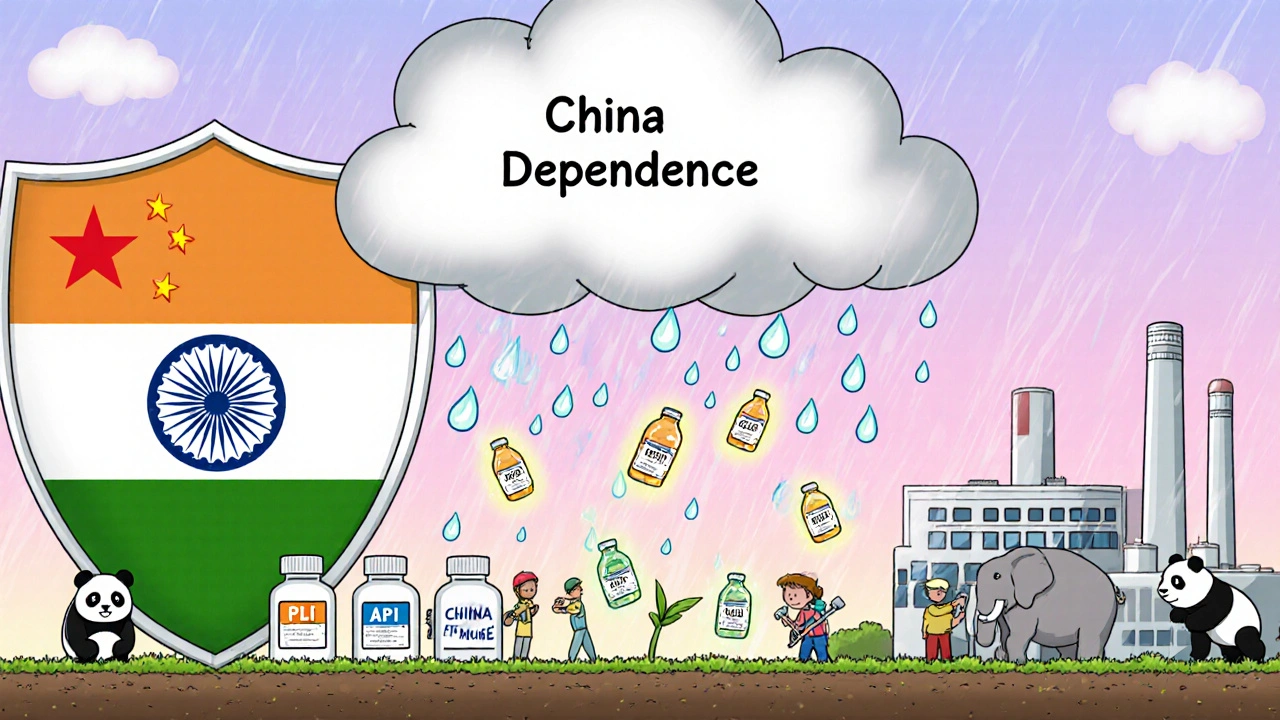
Who Should Use Which Country?
If you’re a U.S. company making a high-volume, low-cost generic - like metformin or lisinopril - you might still use Chinese APIs. But you need a solid supplier audit program. You can’t just take their word for it. If you’re making a specialty drug - like a biosimilar or a complex inhaler - you’re better off with an Indian manufacturer. They’ve built systems for quality control, documentation, and regulatory reporting. They know how to pass an FDA inspection. For new drug developers, the smart move is to avoid China entirely. The risk of delays, recalls, or import blocks is too high. India’s higher compliance costs are worth it in the long run.The Future: A Two-Tier System
By 2030, the global pharma supply chain will split into two tiers. Tier 1: High-quality, FDA-compliant manufacturing - mostly in India, with growing support from the U.S., EU, and Japan. These companies make drugs for North America, Europe, and Australia. They charge more. They deliver reliably. Tier 2: Low-cost, high-volume production - mostly in China. These make bulk APIs and simple generics for markets with weaker regulations: parts of Africa, Southeast Asia, Latin America. Price matters more than paperwork. India is trying to climb into Tier 1 for biologics and cell therapies. China is trying to move up too. But right now, India’s compliance culture gives it the edge. China’s scale gives it staying power.What You Can Do
If you’re a patient: Ask your pharmacist where your generic drug is made. You have a right to know. If it’s made in China, ask if the manufacturer is FDA-approved. If you’re a healthcare provider: Push for transparency in your hospital’s drug sourcing. Don’t just accept the lowest bid. Ask about compliance history. If you’re in pharma: Don’t assume India is perfect. Check your API suppliers. Even Indian companies can source from China. Trace your supply chain. Audit your vendors. Document everything. The bottom line: Quality isn’t about where something is made. It’s about how it’s made. And right now, India’s system is built for it. China’s system is built for volume.That’s why the FDA watches them differently - and why your next pill might depend on that difference.

Comments
Just had my blood pressure script refilled and checked the label - made in India 🙌 I didn’t even know to look before. So glad I did. My grandma’s meds used to cause her stomach issues, and now she’s stable. Small things matter.
Yeah i read this and was shocked. I always assumed all generics were the same. Turns out the country matters way more than the price tag. Learned something today.
China is a rogue state that exports poison disguised as medicine. The FDA should ban all imports from there. This isn’t trade - it’s national security negligence.
Of course India’s ‘compliant’ - they’ve been kissing the FDA’s ring since the 90s. Meanwhile China’s just trying to feed the world on a budget. Who are you to judge? The FDA’s just a corporate puppet anyway.
So we’re supposed to trust India more… but they get 72% of their stuff from China? That’s like trusting a firefighter who uses a lighter from a arsonist. 😅
The cultural and regulatory divergence between the two nations is striking. India’s pharmaceutical ethos evolved alongside Western compliance frameworks, whereas China’s industrial model prioritizes output velocity, often at the expense of traceability. This is not merely a supply chain issue - it is a philosophical one.
Imagine your life-saving pill was made in a factory where someone wrote the quality logs with a crayon. That’s China. Now imagine India’s got spreadsheets, barcodes, and a guy who actually knows what ‘sterile’ means. That’s the difference between living and dying. And we’re still buying the crayon version because it’s cheaper. We’re all just gambling with our meds.
It is imperative to recognize that the structural inefficiencies inherent in China’s pharmaceutical manufacturing ecosystem are not merely operational but systemic, rooted in a governance paradigm that privileges economic output over regulatory fidelity. The FDA’s disparity in inspection outcomes reflects not bias, but the empirical manifestation of divergent institutional norms. India’s adherence to 21 CFR Part 211 is not a virtue - it is a contractual obligation necessary for market access. China, by contrast, continues to operate under a hybrid model wherein compliance is selectively implemented based on export destination, rendering its domestic regulatory framework functionally inert for global markets. The so-called ‘China+1’ strategy is not diversification - it is damage control.
It’s not about blaming countries - it’s about holding systems accountable. India’s making progress, China’s got a long road, and we all need to push for better transparency. Maybe if more of us ask where our meds come from, companies will have to step up. Small actions add up 💪
What does it mean to be ‘safe’ in a world where every pill is a product of global inequality? India’s compliance is impressive, but it’s built on a foundation of Chinese raw materials. China’s scale is undeniable, but it’s a scale built on exploitation - of workers, of environment, of oversight. Are we really choosing between two evils? Or are we being forced to choose because the system was never designed to value health over profit? Maybe the real question isn’t who makes the pills - but why we let them be made this way at all.