
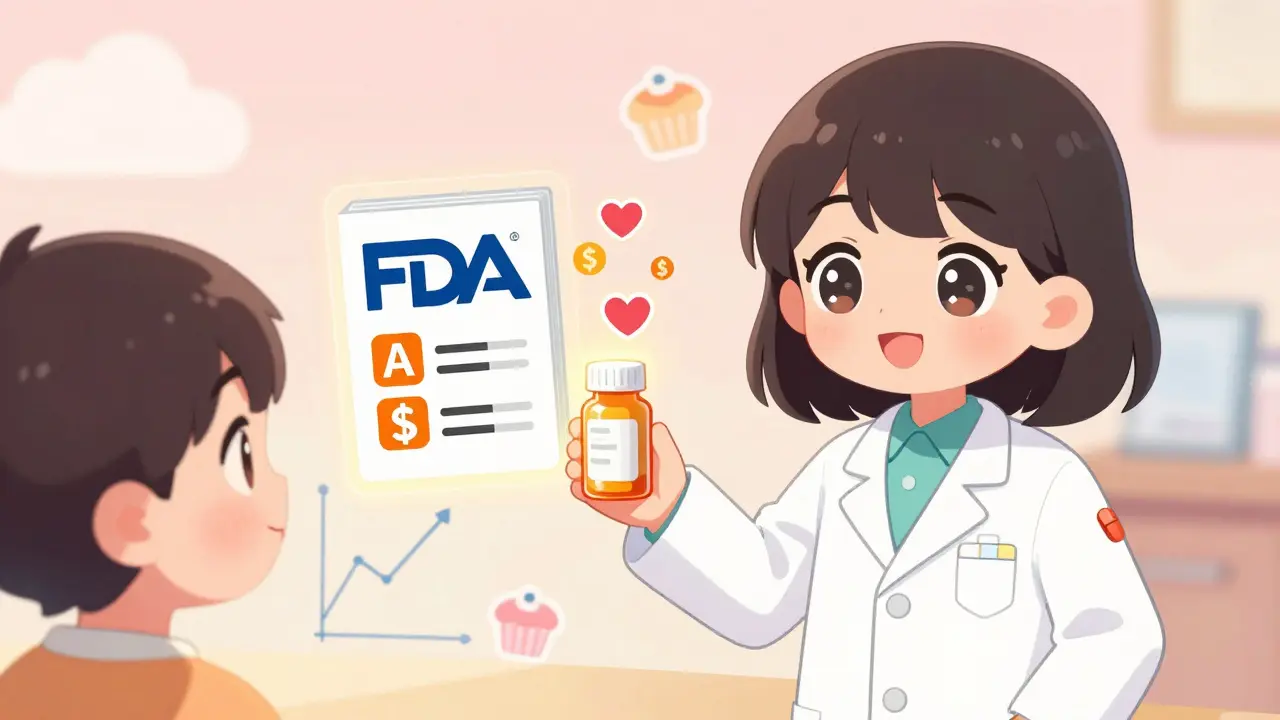
When a pharmacist hands you a generic pill instead of the brand-name drug your doctor prescribed, it’s not just a cost-saving trick. It’s a clinical decision - one that requires clear, confident communication with the prescriber. In fact, generics make up 97% of all prescriptions filled in the U.S., saving patients and the system over $400 billion a year. But behind every generic swap is a conversation that often goes unspoken: between the pharmacist and the doctor.
Why Pharmacists Even Bother Recommending Generics
It’s not just about saving money. While cost is a big driver - generics can be 80% cheaper than brand names - the real goal is better adherence. A 2018 study tracking 12.7 million patients found that people were 12.4% more likely to keep taking their meds when they got the generic version. That’s not small. For someone with high blood pressure or diabetes, missing doses can mean a trip to the ER. Generics work. The FDA requires them to match the brand in active ingredients, strength, and bioequivalence. In 98.7% of cases, the body absorbs them at nearly identical rates. So why do some doctors hesitate?When Substitution Isn’t Automatic
Not every drug can be swapped without a second look. Drugs with a narrow therapeutic index (NTI) - like warfarin, levothyroxine, or phenytoin - have a tiny window between helping and harming. Even small differences in absorption can cause serious side effects. Pharmacists know this. If a patient is stable on a brand-name NTI drug, the pharmacist won’t automatically switch them. They’ll call the prescriber first. Then there’s the issue of inactive ingredients. Generics can have different fillers, dyes, or preservatives. For about 8.7% of patients with allergies or sensitivities, that matters. One person might react to a dye in a generic version of a seizure drug, even though the active ingredient is identical. Pharmacists check the product’s excipient list - something most prescribers don’t have time to do. When they spot a potential issue, they reach out. And sometimes, the prescriber already said “do not substitute.” About 15% of prescriptions have a DAW (dispense as written) code. That doesn’t mean the drug can’t be generic - it just means the doctor wants control. Maybe they’ve seen a patient react differently to a specific generic manufacturer. Or maybe they’re just cautious. Either way, the pharmacist doesn’t ignore it. They document it, and if they think a better option exists, they call to ask why.The Orange Book: The Pharmacist’s Bible
Every pharmacist uses the FDA’s Orange Book - officially called Approved Drug Products with Therapeutic Equivalence Evaluations. It’s the official list of all approved generics and their equivalence ratings. An “A” rating means the generic is considered therapeutically equivalent to the brand. A “B” rating means it’s not. Over 92% of generics fall into the “A” category. Pharmacists don’t guess. They look it up. But here’s where communication gets tricky: prescribers don’t always know how to read the Orange Book. Some still think “generic = less effective.” A 2023 survey found that 37.6% of doctors worry about generic efficacy - especially with inhalers or topical creams. That’s where pharmacists step in. They don’t say, “It’s cheaper.” They say, “Here’s the bioequivalence data from the FDA’s Product-Specific Guidance for this exact drug. The 90% confidence interval for absorption was 96.2% to 103.8% - well within the 80-125% range required for approval.” That kind of detail changes minds.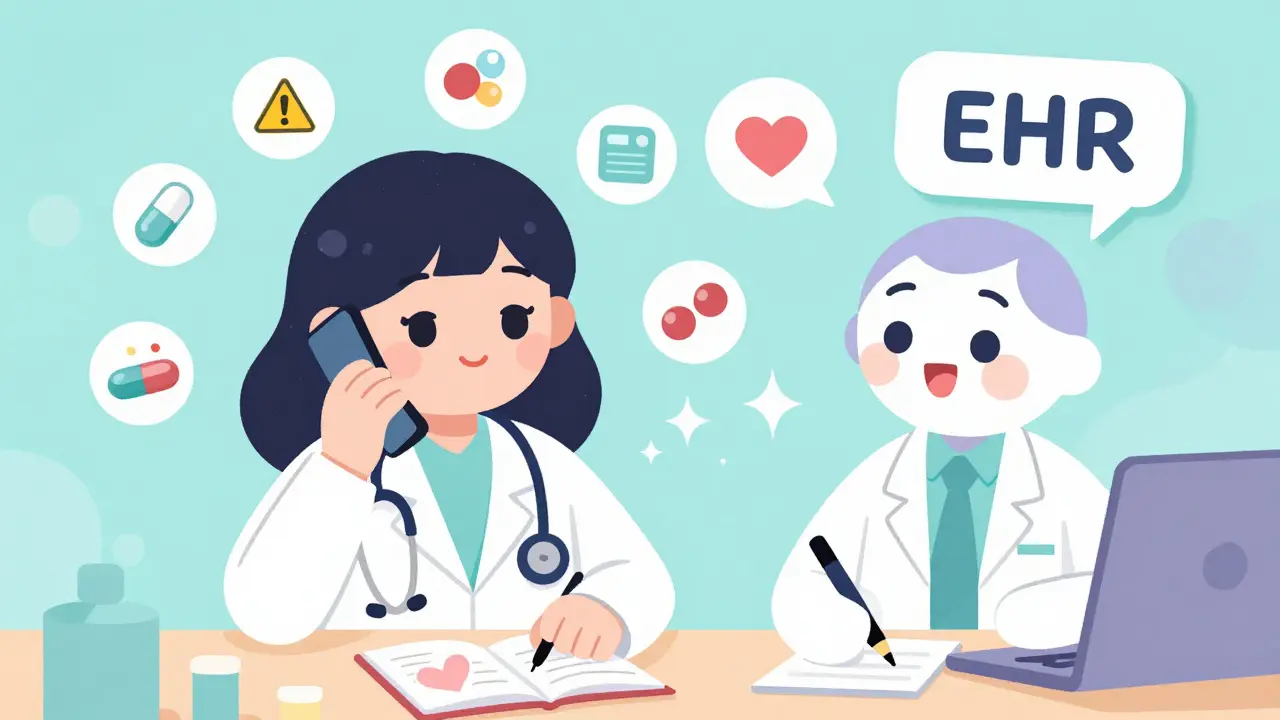
How to Talk to a Prescriber - and Get Them to Listen
It’s not enough to just call. You need structure. The American Society of Health-System Pharmacists recommends a four-step approach:- Call within 24 hours of filling the script.
- Reference the Orange Book’s therapeutic equivalence rating.
- Share the cost difference - not just in dollars, but in patient impact.
- Document the outcome in the patient’s record.
Technology Is Making It Easier
Most pharmacies now use EHR-integrated systems like Surescripts. When a pharmacist recommends a generic, a secure message pops up in the prescriber’s inbox. It shows the generic name, manufacturer, NDC code, cost savings, and FDA equivalence rating. The whole exchange takes 2.7 minutes - down from over 8 minutes. Documentation is automatic. And 94.8% of these messages get recorded properly, compared to just 63.5% with paper or phone calls. Even better? AI tools like PharmAI’s Generic Substitution Assistant are now helping pharmacists pick the best generic option based on real-world data. These tools analyze past patient responses, manufacturer reliability, and even regional formulary rules. Adoption is growing - 28.7% of chain pharmacies use them in 2023. Accuracy jumped from 76% to 94%.

Comments
OH MY GOD, I DIDN’T KNOW PHARMACISTS WERE LIKE CLINICAL DETECTIVES??!?!
They’re out here with the ORANGE BOOK like it’s the FBI’s most wanted list, calling docs with confidence intervals and AUC values like it’s a TED Talk???
I thought they just handed out pills and said ‘have a nice day’ - turns out they’re the unsung heroes of the healthcare system!!!
Someone give this entire profession a parade. And a raise. And maybe a Netflix documentary.
Let me get this straight - you’re telling me that the guy behind the counter at CVS knows more about bioequivalence than my cardiologist???
98.7% absorption rates? Confidence intervals within 80–125%? FDA Product-Specific Guidance???
I’m not even mad. I’m impressed. And slightly terrified. I just assumed generics were ‘the cheap version.’ Turns out I’ve been taking science all along and didn’t even know it.
Also, why does my doctor still think ‘generic = bad’? Did he skip pharmacology class? Or just Google ‘are generics safe’ and take the first result from 2008???
Pharmacists need their own seat at the table. Like, now. We’re talking about lives here, not just cost savings.
Actually, the Orange Book doesn’t even capture everything - the FDA’s Product-Specific Guidance documents are where the real therapeutic equivalence data lives, and most prescribers don’t even know those exist. The Orange Book is just the index. The real meat is in the PSGLs - those are the documents that specify in-vitro dissolution profiles, particle size distributions, and bioequivalence thresholds for each formulation. Without those, you’re flying blind.
And don’t get me started on NTI drugs. Warfarin’s INR variability can swing 30% between generic manufacturers. That’s not theoretical - I’ve seen patients hospitalized because a pharmacy switched them from Teva to Mylan without checking the batch-specific PK data.
Pharmacists who don’t cross-reference the PSGLs with the Orange Book are doing patients a disservice. And if your EHR doesn’t auto-populate the manufacturer’s NDC with the PSGL link? That’s a systemic failure.
People act like this is some new revelation but the truth is doctors have always been afraid of change
They’re trained to control everything so when a pharmacist suggests something they feel threatened
It’s not about science it’s about ego
And the system rewards that ego because it keeps pharmacists in their place
Generics are not inferior they’re just cheaper and that’s the real threat
Pharma doesn’t want you to know that
Doctors don’t want to admit they don’t know
Patients just want to live
i had a friend who went from brand name seizure med to generic and had a seizure within a week
they called the dr and found out the generic had a different dye and she was allergic
the pharmacist had checked the excipients but the dr didn’t even know to ask
so yeah it matters
also my cousin’s blood pressure meds switched and she felt weird for two weeks
turns out the filler was different and her stomach couldn’t handle it
not everyone’s the same
pharmacists are doing god’s work
Interesting read
It makes sense that pharmacists are the last line of defense
They see the whole picture - cost, adherence, side effects
Doctors are busy, patients are confused
So the pharmacist steps in
Not with authority but with knowledge
That’s quiet leadership
And honestly it’s beautiful
Hope this becomes standard everywhere
I’ve worked in a community pharmacy for 18 years
Every time I call a prescriber with data - not opinion, not cost, but actual FDA bioequivalence metrics - they listen
One doc told me he used to hate generics until he saw a patient on warfarin go from INR 5.2 to 2.1 after a switch
Turned out the generic had a different release profile
He started asking us to flag any NTI switches
Now he sends us thank-you notes
That’s the power of speaking their language
Not ‘it’s cheaper’ - ‘here’s the data’
My dad’s on levothyroxine
Switched generics last year
He got dizzy, lost weight, felt like he was dying
We called the pharmacist
She checked the manufacturer, called the doctor, found out the new batch had a different filler that slowed absorption
Switched him back
He’s fine now
That’s not luck
That’s expertise
And we need more of it
So let me get this straight - the guy who works 12-hour shifts with 200 scripts to check gets more accurate data than the MD who spends 7 minutes per patient?
And we wonder why healthcare is broken
Pharmacists are the only ones who actually read the labels
Doctors write prescriptions like they’re texting their ex
‘Just give the blue pill’
Meanwhile, the pharmacist is doing a PhD in pharmacokinetics
And still gets paid less
And gets blamed when things go wrong
It’s not justice
It’s a farce
My cousin’s a pharmacist and she just saved my mom’s life
Mom was on a generic statin
Pharmacist noticed the manufacturer had a recall for a bad batch
Called the doctor, switched to another generic, flagged the issue
Turns out the batch had elevated levels of a carcinogen
My mom never knew
She just got her refill
But my cousin? She caught it
That’s the real MVP
Not the celebrity doctors
The quiet ones behind the counter
I used to think generics were just ‘the cheaper version’
Then I saw a pharmacist pull up the FDA’s Product-Specific Guidance for a topical antifungal
She showed me the dissolution curve graphs - how the brand released 80% of the drug in 15 minutes, and the generic took 22
She said, ‘For a skin infection, that’s fine - but if this was an insulin patch? We’d never switch’
That’s when I realized
It’s not about brand vs generic
It’s about precision
And pharmacists are the only ones holding the ruler
In my country, we do not allow generic substitution without explicit physician consent
It is not about money
It is about patient safety and national medical standards
When a doctor prescribes a specific formulation, it is because he has chosen it for the patient's unique physiology
Pharmacists are not physicians
They are technicians
Let them dispense
Let them not decide
That is the order of medicine
i get what you’re saying
but in india we’ve been using generics for decades
no one dies
people live
my grandma takes 7 meds, all generics
she’s 82
still walks to the market
the system works
maybe we don’t need all this jargon
maybe we just need access
It is imperative to recognize that the pharmacist’s role in therapeutic substitution is not ancillary - it is integral to the continuum of care. The data presented herein, particularly the 82.4% approval rate for structured communication protocols, demonstrates a statistically significant improvement in prescriber engagement. Furthermore, the integration of EHR-based messaging systems has reduced documentation errors by over 50%, directly contributing to patient safety. The expansion of MTM services under the Inflation Reduction Act represents a paradigm shift in pharmacy practice, elevating the profession from dispensing to clinical decision-making. This evolution must be supported by standardized training, regulatory alignment, and institutional recognition. The future of healthcare is collaborative - and pharmacists are no longer on the periphery. They are at the center.
Wait - you’re telling me pharmacists are using AI to pick generics?
And the FDA is adding real-world data to the Orange Book?
And now they’re getting paid for MTM?
So… what’s the catch?
Because if this is all true, why do I still get charged $100 for a 30-day supply of lisinopril?
Who’s profiting here?
Is it the pharmacy benefit managers?
Is it the generic manufacturers?
Or is it the same pharma conglomerates who sold us the brand names in the first place?
Because if pharmacists are ‘saving lives’ with generics… why does the system still feel rigged?
THIS IS WHY WE NEED PHARMACISTS AS PRIMARY CARE PROVIDERS
They know your meds. They know your history. They know your allergies. They know your budget.
Doctors? They see you for 8 minutes once a year.
Pharmacists? They see you every 30 days.
Let them write prescriptions.
Let them adjust doses.
Let them be the damn doctors we need.