

Imagine spending months perfecting a product, only to have it recalled because of a hidden contaminant in your facility. It’s not just a bad day; it’s a potential business-ending event. This is why environmental monitoring is a systematic approach to detecting and controlling contamination in production facilities through regular sampling and testing of surfaces, air, and water. It acts as the early warning system for manufacturing quality, catching issues before they reach consumers.
The cost of failure is staggering. According to USDA Economic Research Service data from 2022, foodborne illness outbreaks alone cost the U.S. economy $77.7 billion annually. Environmental monitoring isn't just about ticking regulatory boxes; it's about protecting public health and your bottom line. Whether you are in pharmaceuticals, food processing, or cosmetics, understanding how to test your facility for contamination is non-negotiable.
Understanding the Zone Classification System
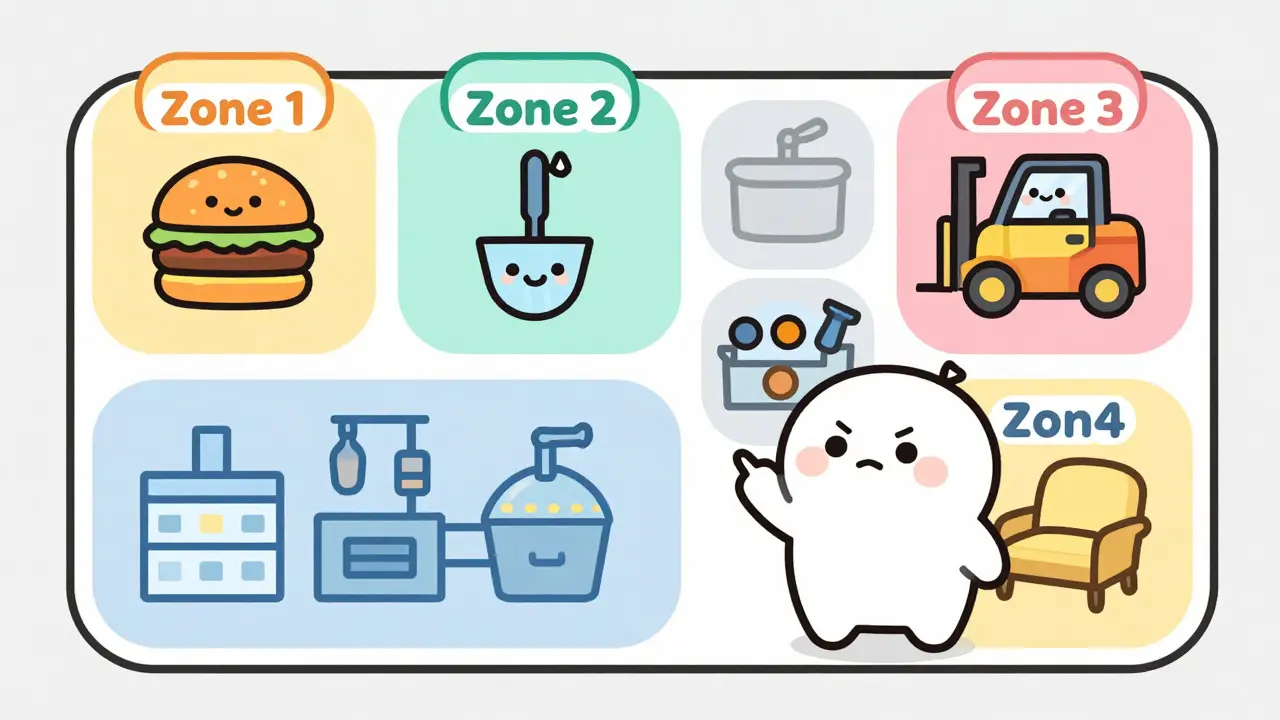
You can’t monitor everything with equal intensity. That would be inefficient and expensive. Instead, successful programs rely on a risk-based zone classification system. This framework divides your facility into four distinct areas based on their proximity to the product and the likelihood of contamination transfer.
| Zone | Description | Examples | Sampling Frequency |
|---|---|---|---|
| Zone 1 | Direct food/product contact surfaces (Highest Risk) | Slicers, mixers, conveyors, utensils | Daily to Weekly |
| Zone 2 | Non-contact surfaces close to the product | Equipment exteriors, refrigeration units near lines | Weekly to Monthly |
| Zone 3 | Remote non-contact surfaces near processing | Forklifts, walls further from the line | Monthly to Quarterly |
| Zone 4 | Non-contact surfaces outside processing areas | Offices, break rooms, exterior walls | Quarterly or As Needed |
A study by PPD Laboratories tracking bioassay labs revealed a surprising insight: laboratory floors were the source of 62% of all alert and action limit events. This highlights that while Zone 1 gets the most attention, Zones 3 and 4 often harbor the reservoirs of contamination that migrate back into critical areas. Don't ignore the "clean" looking corners of your facility.
What Are You Actually Testing For?
Knowing where to sample is half the battle. Knowing what to look for is the other half. The analytes you target depend heavily on your industry, but generally fall into three categories: microbiological, chemical, and physical.
- Microorganisms: This includes general bioburden, specific pathogens like Listeria monocytogenes and Salmonella spp., and molds or yeasts. These are the primary concerns for ready-to-eat (RTE) food facilities and pharmaceutical cleanrooms.
- Chemical Compounds: In pharmaceuticals, this might mean residual solvents or metals detected via Inductively Coupled Plasma (ICP). In food, it could involve allergen residues or cleaning chemical carryover.
- Physical Particulates: Air-borne particles are critical in sterile manufacturing. Results are often expressed as colony-forming units per cubic meter (CFU/m³) or particle counts per ISO class standards.
For water systems, the approach differs significantly between sectors. Pharmaceutical facilities monitor purified water using Total Organic Carbon (TOC) and conductivity measurements to meet USP <645> standards. Food facilities, however, focus more on municipal water safety standards per EPA regulations, ensuring no biological hazards enter the process stream.
Industry Differences: Pharma vs. Food Processing
Not all environmental monitoring programs are created equal. The regulatory landscape shapes how rigorously you must test. Pharmaceutical facilities following EU GMP Annex 1 requirements implement extremely strict air particulate monitoring. They require continuous non-viable particle monitoring at ISO Class 5 (equivalent to EU Grade B) standards. Their goal is sterility assurance.
In contrast, food processing facilities face different pressures. Under the USDA Food Safety and Inspection Service (FSIS) regulations, specifically the "Listeria Rule" (9 CFR part 430), RTE facilities must aggressively test Zones 1-4 for Listeria spp. The FDA explicitly states that environmental monitoring is a key step to verify control of microbial hazards. While pharma focuses on preventing any microbial presence, food safety often focuses on detecting specific high-risk pathogens that cause illness.
Data from PPD Laboratories comparing U.S. and Irish facilities showed that contamination rates varied by location but remained consistently below 0.01% of environmental monitoring events across all sites when standardized approaches were used. This suggests that geography matters less than protocol consistency.
Sampling Methods and Technologies
How you collect samples determines the validity of your results. Using the wrong technique can lead to false negatives, giving you a false sense of security.
Surface Sampling
For surface testing, sterile sponges or swabs are the standard tools. FDA investigators use these to collect samples from both food contact surfaces (like slicers) and non-food contact surfaces (like drains and equipment housing). A common pitfall is improper technique. The CDC notes that many facilities struggle here, emphasizing that the interior of sampling devices must be sterile to avoid inadvertent contamination from the sampler itself.
Air Sampling
Air monitoring requires specialized equipment. Liquid impinger and solid impactor samplers are the most practical options because they can process large volumes of air quickly. Solid impactor units come in "slit" or "sieve" designs and must be sterilized before each use. If you're working in a cleanroom, you'll likely need continuous monitoring systems rather than periodic grab samples.
Rapid vs. Traditional Testing
Traditionally, microbiological tests take 24 to 72 hours to yield results. By then, production might have continued with contaminated product. Adenosine triphosphate (ATP) testing offers a solution for sanitation verification. ATP results are obtained in seconds. Facilities implementing ATP testing report a 32% faster turnaround between production runs according to FDA 2022 benchmarks. However, ATP only tells you if organic matter is present, not what kind of microorganism it is. It’s a hygiene check, not a pathogen detection tool.

Building an Effective Program: Resources and Training
Setting up an environmental monitoring program (EMP) requires significant resource allocation. It’s not just buying test kits. Medium-sized food processing facilities typically dedicate 2-3 full-time employees to these activities. Annual spending on testing supplies and lab services ranges from $15,000 to $25,000, according to a 2021 industry survey by the UGA Cooperative Extension.
Training is perhaps the most overlooked component. The FDA recommends that personnel complete at least 40 hours of hands-on training before conducting official monitoring. Why? Because inconsistent sampling techniques are reported by 68% of facilities as a major challenge. If your team doesn't know how to properly swab a complex machine part, your data is useless.
Dr. Laurel Dunn of the University of Georgia emphasizes that the greatest time and resources should go toward monitoring and cleaning Zone 1 surfaces, followed by Zone 2. However, she also warns against rigid hierarchies. Facility-specific risk assessments might dictate that overhead pipes in a humid environment are treated as Zone 1 due to condensation risks, even if they don't directly touch the product.
Future Trends: AI and Next-Generation Sequencing
The field is evolving rapidly. The global environmental monitoring market reached $7.2 billion in 2022 and is projected to grow to $12.5 billion by 2027. Two trends are driving this growth: technological integration and regulatory harmonization.
Next-generation sequencing (NGS) and metagenomics are changing how we identify microbes. The FDA’s 2023 draft guidance encourages the adoption of these rapid methods, which can reduce pathogen identification time from days to under 24 hours. Imagine knowing exactly which strain of Listeria is in your drain within hours, allowing for targeted remediation.
Artificial Intelligence is also entering the space. MarketsandMarkets forecasts that AI-integrated monitoring systems will grow from 12% market penetration in 2022 to 38% by 2027. AI helps integrate disparate data streams-ATP results, microbiological cultures, and allergen tests-which remains a significant challenge for 37% of facilities today. By correlating data points, AI can predict contamination events before they happen, moving EMPs from reactive to predictive.
How often should I perform environmental monitoring?
Frequency depends on the zone and risk level. Zone 1 surfaces (direct contact) should be tested daily to weekly. Zone 2 surfaces require weekly to monthly testing. Zones 3 and 4, being further from the product, are typically tested monthly to quarterly. Ready-to-Eat (RTE) food facilities must test for Listeria in Zone 1 at least weekly per FDA guidelines.
What is the difference between ATP testing and microbiological testing?
ATP testing detects organic matter (sanitation residue) instantly, making it ideal for verifying cleaning effectiveness between shifts. Microbiological testing identifies specific bacteria, molds, or yeasts but takes 24-72 hours. ATP does not tell you if pathogens are present, only that dirt or organic material remains.
Why are floors considered a high-risk area in environmental monitoring?
Floors are often the reservoir for pathogens like Listeria. Studies show that floors can be the source of over 60% of contamination alerts. Dust and foot traffic can transport these organisms from the floor to higher surfaces, including Zone 1 equipment, making floor monitoring critical despite it being a non-contact surface.
Do small businesses need formal environmental monitoring programs?
Yes, though implementation challenges are higher. Only 48% of small facilities (<50 employees) maintain fully compliant programs. However, regulatory agencies like the FDA and USDA do not exempt small processors from safety standards. A simplified, risk-based EMP is essential for survival and compliance.
What is the role of air sampling in contamination control?
Air sampling detects airborne particulates and microbial spores that can settle on products or surfaces. In pharmaceutical cleanrooms, continuous air monitoring is mandatory to maintain ISO class standards. In food facilities, air sampling helps identify sources of mold or yeast contamination, especially in dry goods or packaging areas.