

When you pick up a generic pill from the pharmacy, you expect it to work the same as the brand-name version-safe, effective, and consistent. But what happens when that pill doesn’t meet those standards? In 2024, nearly 350 drugs were pulled from shelves in the U.S. because they posed real health risks. Most of these were generic medications. And behind every recall is a chain of failures-often hidden in overseas factories, missed inspections, or labeling mistakes that could cost someone their life.
What Actually Causes a Generic Drug to Be Recalled?
Not every recall is the same. The FDA sorts them into three classes based on how dangerous the product is. Class I recalls are the most serious. These happen when a drug could cause serious injury or death. One example from July 2024: a batch of potassium chloride injections was mislabeled. Instead of saying 10 mEq, the label said 20 mEq. That’s a 100% overdose risk. In intensive care units, that kind of error can kill a patient within minutes. Class II recalls are more common. They involve problems that might cause temporary or reversible health issues. In April 2025, Glenmark Pharmaceuticals recalled nearly 40 generic drugs because of contamination and poor manufacturing practices at their Indian plant. The drugs weren’t toxic, but they might not have worked as intended. Some had too little active ingredient; others had particles in them. Patients might not notice right away, but over time, their condition could worsen. Class III recalls are the least urgent. These are about paperwork, not safety. Think wrong expiration dates, minor typos on labels, or packaging that doesn’t match the bottle inside. The medicine itself is fine. But the FDA still requires these to be pulled because the law says so.The Real Culprits Behind Most Recalls
If you look at the data, certain problems keep showing up. Sterility failures are the biggest trigger-accounting for 37% of all recalls between 2012 and 2023. That means bacteria or mold got into sterile drugs like injections or eye drops. A single contaminated vial can infect dozens of patients. Then there’s particulate matter-tiny bits of glass, metal, or plastic in the liquid. That’s 12% of recalls. Labeling errors make up 9%. And active ingredient potency issues-where the drug has too much or too little of the medicine-are behind 7% of cases. These aren’t random accidents. They’re symptoms of deeper problems. The FDA’s own rules, called Current Good Manufacturing Practices (cGMP), spell out exactly how drugs must be made: clean rooms with air filtered to 0.5-micron size, microbial limits of 10 CFU/m³, water with endotoxins under 0.25 EU/mL. But many factories, especially overseas, don’t follow these rules consistently. And when they don’t, the drugs they make are risky-even if they look normal.Why Foreign Factories Are the Biggest Risk
About 80% of the active ingredients in U.S. generic drugs come from just two countries: India and China. That’s not a problem by itself. But here’s the catch: the FDA inspects domestic factories every 1.8 years on average. Foreign factories? Every 4.6 years. That’s more than four years between checks. In some cases, like Glenmark’s Indian plant, inspectors hadn’t been there in over four years before the problems were exposed by journalists. This gap isn’t just bureaucratic-it’s dangerous. A factory in the U.S. can’t hide a contamination issue for long. Inspectors show up unannounced. Equipment logs are checked. Staff are interviewed. In foreign plants, the system relies on self-reporting. Companies submit paperwork. Sometimes, it’s accurate. Sometimes, it’s not. And without regular inspections, problems go unnoticed until someone gets sick. Compare that to the European Union. In the EU, recalls are mandatory. Regulators can force a company to pull a drug. The U.S. system is voluntary. The FDA can ask, recommend, or even pressure a company-but it can’t order a recall unless the manufacturer refuses to act. That delay matters. On average, it takes 42 days from when a problem is first detected to when the public is told. In the EU, it’s 18 days.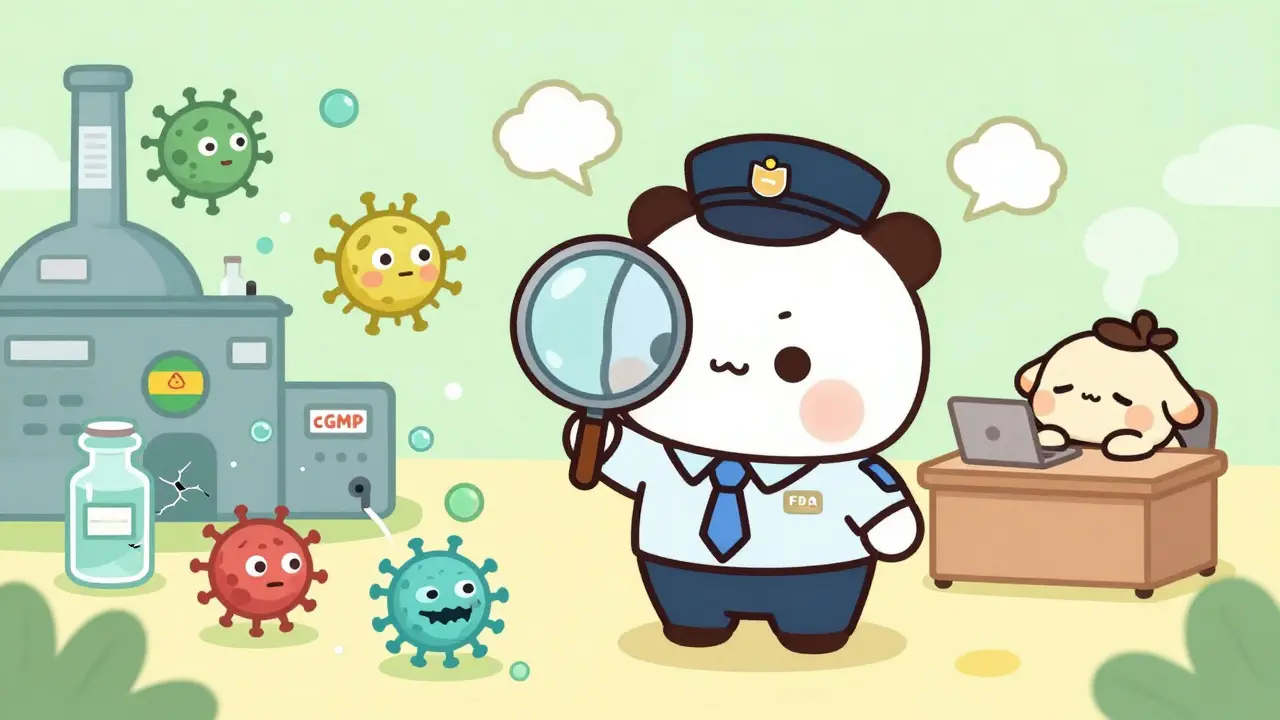
Who Notices the Problems First?
You might think the FDA catches everything. But in reality, many recalls start with someone else. Pharmacists. Nurses. Patients. A nurse in Illinois noticed that her patients on hydroxyzine weren’t responding as expected. She checked the lot numbers. Found a match with a recall notice. That’s how she flagged it. On Reddit, a nurse wrote about contacting 127 patients after the Glenmark recall. Only 38 had symptoms. But 100% were terrified. That’s the emotional toll. People don’t just worry about side effects-they worry they’ve been poisoned by something they trusted. The FDA’s MedWatch system lets patients and doctors report bad reactions. In 2024, they got over 142,000 reports. But only 3.2% of potential reports came from patients. Why? Because most people don’t know how to report. Or they think it won’t matter. Or they’re too busy trying to figure out if their headache is from the drug or just stress.What Happens After a Recall Is Issued?
Once the FDA announces a recall, the real work begins. Pharmacies get the notice. Hospitals update their inventory systems. Pharmacists pull affected lots from shelves. But here’s the problem: most patients never get a direct call. Only 12% reported being contacted personally. The rest have to check the FDA website, read a notice on the pharmacy’s door, or stumble across it online. AARP’s 2025 survey found that 78% of people would stop taking a recalled drug immediately-even if the FDA says to talk to their doctor first. That’s risky. Stopping blood pressure meds or seizure drugs cold turkey can be deadly. But when people hear “recall,” they panic. The communication is too vague. Too technical. Too slow. Hospitals have to track every lot number. That’s hard. A single drug might go through five distributors before it reaches your pharmacy. Eighty-two percent of hospitals say identifying affected lots is a nightmare. That’s why 76% now use automated systems that block recalled drugs from being ordered again. But small clinics? They’re still using spreadsheets.
Is the System Getting Better?
Yes-but not fast enough. The FDA’s 2025 Enhanced Oversight Initiative will now inspect the riskiest foreign factories every year instead of every 4.6 years. That’s a big step. And new laws like the Pharmaceutical Supply Chain Security Act, passed in May 2025, require foreign manufacturers to share real-time quality data. That’s the future: transparency, not guesswork. Technology is helping too. Blockchain is being used by 18% of major drugmakers now-up from just 3% in 2023. That means every step of a drug’s journey-from raw ingredient to pharmacy shelf-is tracked digitally. If something goes wrong, they can trace it in hours, not weeks. The FDA is also testing AI tools to predict which factories are most likely to fail. With $47 million in new funding, they’re training algorithms to spot patterns in past recalls, inspection reports, and supplier histories. The goal? Stop problems before they happen. But here’s the hard truth: the FDA’s budget still covers only 17% of the foreign inspections they need. The Government Accountability Office says it would take $780 million more per year to fix the gap. Without that, the system will keep relying on luck-and patient reports-to catch the next big failure.What You Can Do to Stay Safe
You can’t control what happens in a factory in India. But you can protect yourself:- Check the lot number on your prescription bottle. If you’re unsure, call your pharmacy and ask if it’s been recalled.
- Sign up for FDA recall alerts. You can get emails or text notifications when a drug you take is pulled.
- Don’t stop your medication without talking to your doctor-even if it’s recalled. Sometimes the risk of stopping is worse than the risk of continuing.
- Report any unusual side effects to MedWatch. Even if you think it’s minor, your report could help catch a pattern.
- Use the FDA’s searchable Enforcement Reports database. It’s free, updated daily, and more reliable than random Google searches.
Why This Matters Beyond the Label
Generic drugs save the U.S. healthcare system over $300 billion a year. They’re not second-rate. They’re the backbone of affordable care. But when quality slips, it’s not just one bad batch. It’s a crack in the system that affects millions. A patient on a recalled blood thinner might have a stroke. A child on a contaminated antibiotic might develop a resistant infection. A senior on a mislabeled heart drug might end up in the ER. The system isn’t broken. It’s stretched thin. And until inspections catch up to globalization, until reporting becomes easier, and until patients are truly informed, the next recall is just a manufacturing error away.What’s on your pill bottle matters. But what happened behind the scenes before it got there? That’s the real story.
Comments
This isn't about generics-it's about outsourcing quality control to countries with zero accountability. We let factories run on paper audits while real people get poisoned. The FDA's a paper tiger.
And don't tell me 'it's cheaper.' I'd rather pay $200 for a pill that doesn't kill me.
OMG I JUST CHECKED MY BLOOD PRESSURE MED AND THE LOT NUMBER MATCHES THE GLENMARK RECALL 😭 I THOUGHT MY HEADACHES WERE JUST STRESS 😭
India makes 80 percent of the active ingredients. That's not a coincidence. It's a strategic vulnerability. The system is designed to fail.
Western consumers get the pills. Indian workers get the blame.
Did you know the FDA is owned by Big Pharma? The recalls are staged. They let bad drugs out to scare people into buying expensive brand names. Then they 'fix' it and make it look like heroes.
They're selling fear. I've got receipts.
Let me tell you something nobody else will: this is the endgame of capitalism. We turned medicine into a commodity. Pills are now widgets on a warehouse shelf. The moment you treat life-saving drugs like Amazon Prime inventory, people die.
And we're not just talking about one bad batch. We're talking about an entire philosophy that says 'efficiency over humanity.'
They don't care if your grandma dies from a mislabeled vial. They care if their quarterly earnings hit the target.
And the worst part? We voted for this with every cheap prescription we bought.
Now we're surprised when the system collapses under its own greed?
Wake up. This isn't a glitch. It's the feature.
Everyone's blaming India but no one mentions the U.S. pharmacies that buy the cheapest bid without checking. We're complicit. We demand $4 prescriptions and then cry when they don't work.
Stop pointing fingers. Look in the mirror.
Actually, the real problem is the FDA's voluntary recall system. It's a joke. In the EU, they just order it pulled. Here? They ask nicely. Meanwhile, patients are dying.
And yes, I know the EU has its own issues-but at least they don't pretend they're in charge.
You all ignore the root: Nigerian and Chinese labs have been making API for decades. The U.S. outsourced because it was profitable, not because it was smart. The FDA doesn't lack power-it lacks will. And until Congress stops taking pharma money, nothing changes.
I work in a small clinic. We still use Excel sheets to track recalls. Last month, we almost dispensed a bad batch because the label didn't match the database. No one died. But it was close.
We need help. Not blame.
Think about this: every time you take a generic, you're rolling the dice. The FDA doesn't test every batch. They test one out of every 5,000. That's not oversight. That's Russian roulette with your heart medication.
And the companies? They know it. That's why they keep cutting corners. They're betting you won't notice until it's too late.
Blockchain? AI? Those are PR stunts. The same factories that got caught in 2018 are still producing today. The inspectors? They're overworked, underpaid, and often told to look the other way.
The system isn't broken-it's rigged. And the only reason it hasn't collapsed yet is because most people are too scared to stop taking their meds.
One day, someone's kid is going to die from a contaminated antibiotic. And then the headlines will scream 'TRAGEDY.'
But by then, the company will have moved its factory to Bangladesh and the FDA will issue another 'we're reviewing our processes' press release.
This isn't a public health issue.
This is a moral failure.
And we're all just waiting for the next recall to hit our name.
Class I recall = death. Class II = maybe doesn't work. Class III = typo. So we're okay with lethal errors as long as the label is 'technically' right?
That's not regulation. That's bureaucratic nihilism.
And yes, I know the FDA has a budget problem. But when your job is keeping people alive, you don't get to say 'we're underfunded.' You fix it. Or you get fired.
As someone who has worked in global health policy for over two decades, I can say with certainty: this is not an American problem. It is a global governance failure.
Regulatory harmonization is not a buzzword-it is a lifeline.
We must demand international inspection standards, mandatory transparency, and real-time data sharing-not as ideals, but as non-negotiable human rights.
Our children deserve better than lottery-ticket medicine.
As someone from India, I’m not defending bad practices-but let’s be real. Many of these factories employ thousands of honest workers who just want to do their job. The problem isn’t the country. It’s the pressure from U.S. buyers to cut costs at every step.
We need fair pricing, not finger-pointing.
And yes, I’ve seen inspections. Sometimes they’re thorough. Sometimes they’re a formality. The system’s broken, not the people.
Oh please. You think this is the first time a drug got recalled? Wake up. This has been happening since the 1980s. The only thing that changed? Now we have Reddit to scream about it.
Meanwhile, the same people who are panicking about generics are the ones buying $1,000 supplements on Instagram.
Reality check: if you’re not taking a generic, you’re just paying extra for a logo.
Stop being a hypocrite.