
Every winter, parents scramble to find relief for their sick kids. A runny nose, a cough that won’t quit, sleepless nights-it’s exhausting. So it’s natural to reach for a bottle of Children’s Robitussin or Dimetapp. But here’s the hard truth: OTC cold medicine is not safe for young children, and giving it to them can be dangerous-even deadly.
Why OTC Cold Medicine Doesn’t Work for Kids Under 4
The FDA stopped recommending OTC cough and cold medicines for children under 4 in 2008. Not because they were too weak, but because they didn’t work at all-and they caused real harm. Manufacturers submitted dozens of studies claiming these products eased symptoms. But when scientists reviewed them, they found almost no proof they helped kids breathe better, sleep longer, or recover faster. Meanwhile, poison control centers were flooded with calls about kids who had accidentally swallowed too much. These medicines often contain four active ingredients at once: antihistamines (like diphenhydramine), decongestants (like phenylephrine), cough suppressants (like dextromethorphan), and expectorants (like guaifenesin). That’s a problem because kids don’t need all of them. A stuffy nose doesn’t need a cough suppressant. A dry cough doesn’t need an expectorant. Mixing them increases the chance of overdose, especially when parents use multiple products thinking they’re helping more.The Real Risks: Seizures, Coma, and Death
Between 2004 and 2015, over 1,500 children were hospitalized because of OTC cold medicine. Most were under 2 years old. The symptoms? Fast heart rate, extreme agitation, trouble breathing, seizures, and coma. In rare cases, children died. A 2012 study found that 5.2% of all pediatric drug-related emergency visits were caused by cough and cold products. That’s not a small number-it’s preventable. The biggest danger? Unintentional overdose. Kids get into bottles. Parents misread labels. They use kitchen spoons instead of the dosing cup that came with the medicine. One teaspoon too much can turn a mild cough into a medical emergency. Poison Control reports that over 12,000 calls between 2019 and 2022 involved children under 4. Nearly half of those cases needed hospital care.Age Limits Aren’t Arbitrary-They’re Based on Science
You might hear someone say, “My neighbor gave their 3-year-old cold medicine and they’re fine.” That’s anecdotal. Science doesn’t work that way. The FDA and the American Academy of Pediatrics set age limits based on data, not luck. Children under 4 have smaller bodies, developing livers, and immature nervous systems. Their bodies can’t process these drugs the way adults or even older kids can. A dose that’s safe for a 6-year-old could be toxic for a 2-year-old. Even the “4-year-old rule” is outdated for many experts. The American College of Chest Physicians now says no OTC cough medicine should be used in children under 12. Why? Because the risk-benefit ratio is negative. There’s no proven benefit, but the risk of harm is real and documented.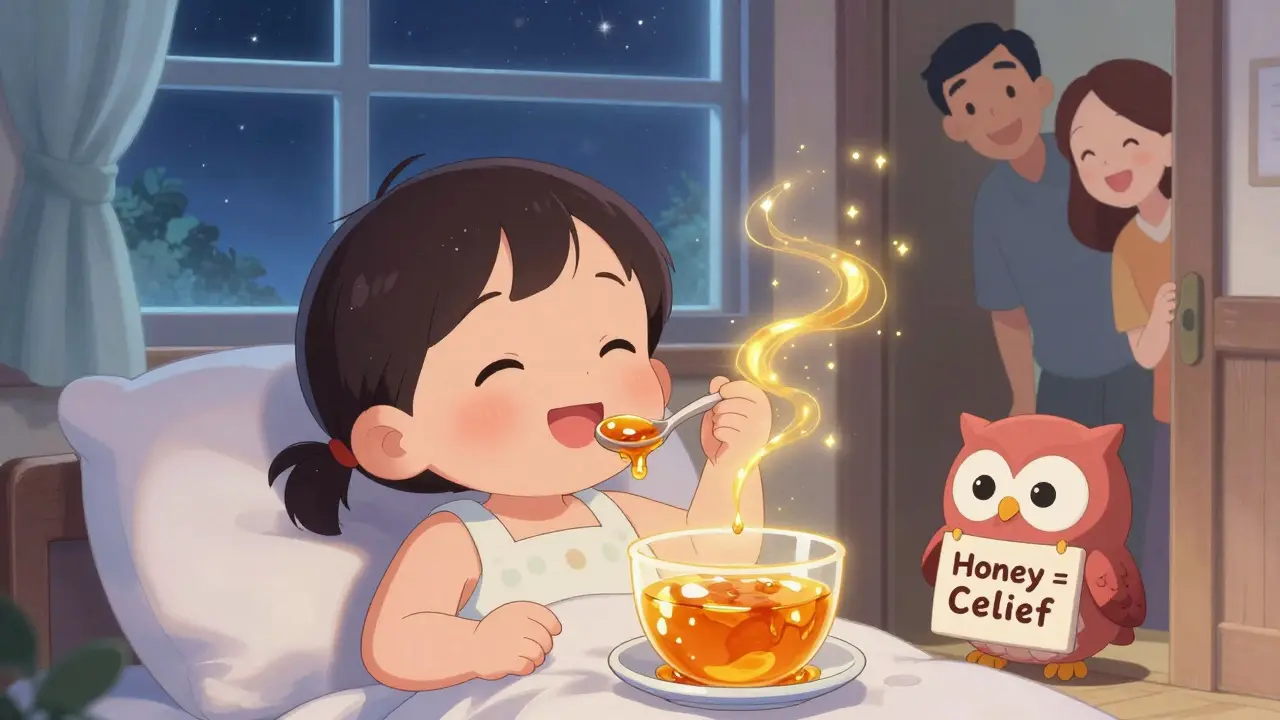
Why Parents Still Give It Anyway
Despite the warnings, a 2021 survey found that 38% of parents still give OTC cold medicine to kids under 4. Why? Many think their doctor told them it’s okay. But when researchers checked medical records, only 17% had actually asked a doctor. Most were following old habits, advice from family, or what they saw online. Parents aren’t stupid. They’re desperate. When their child is coughing all night, they want to fix it. But giving medicine that doesn’t work and could hurt them is the opposite of helping. The emotional pressure is real-but so are the consequences.What Actually Works: Safe, Proven Alternatives
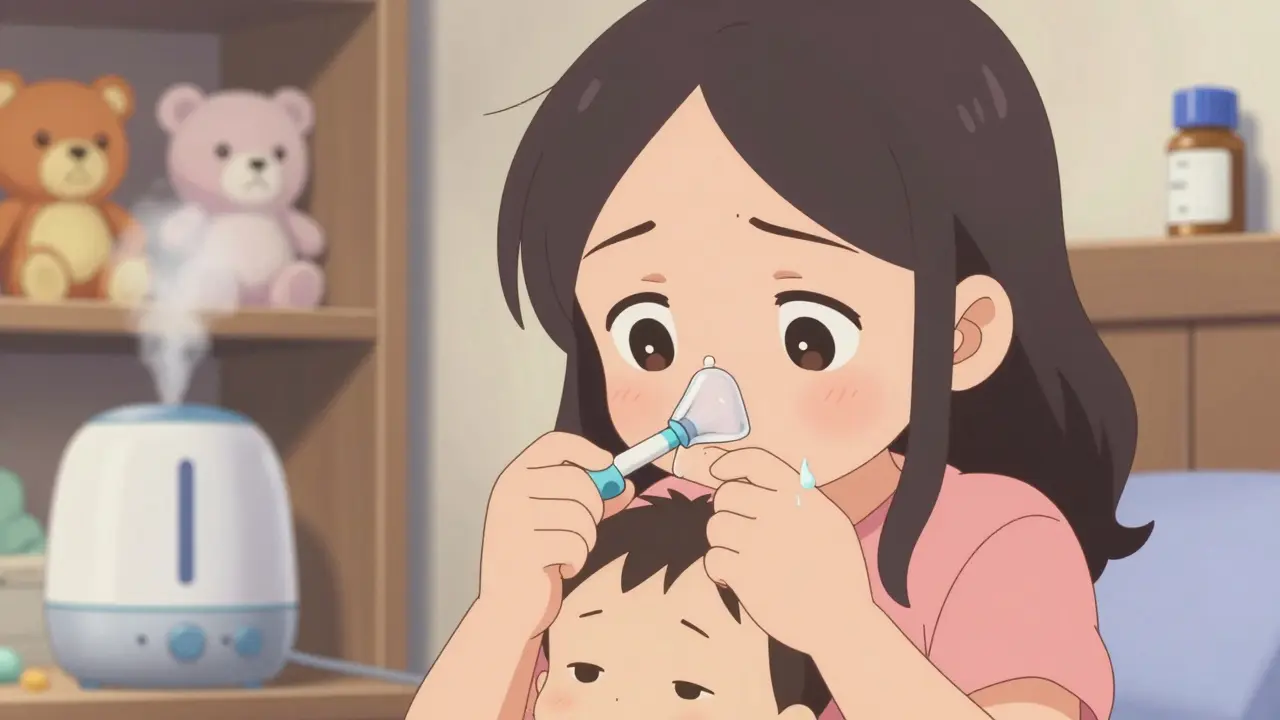
You don’t need medicine to help your child feel better. Here’s what the AAP and CDC recommend instead:- Saline nasal drops - Put 2-3 drops in each nostril, then gently suction with a bulb syringe. Do this before meals and bedtime. It clears mucus without drugs.
- Honey - For kids over 1 year old, give 2.5 mL (half a teaspoon) before bed. A 2018 Cochrane review showed it reduces cough frequency better than placebo and works as well as some OTC cough syrups.
- Hydration - Offer water, breast milk, or formula more often. Kids need about 50 mL per kg of body weight extra each day when sick.
- Humidified air - Run a cool-mist humidifier in the bedroom. Moist air loosens mucus and soothes irritated throats.
- Fever relief - If your child has a fever and is uncomfortable, use acetaminophen (10-15 mg/kg every 4-6 hours) or ibuprofen (5-10 mg/kg every 6-8 hours) for kids over 6 months. Always dose by weight, not age.
What to Do If You’ve Already Given It
If you gave your child OTC cold medicine and they’re under 4, don’t panic-but act. Check the label. Did you give more than the recommended dose? Did they take it without your knowledge? Watch for signs like rapid heartbeat, extreme drowsiness, irritability, trouble breathing, or seizures. Call Poison Control immediately at 1-800-222-1222 (U.S.) or your local emergency number. They’re trained to handle these cases. Don’t wait for symptoms to appear. Don’t try to make your child vomit. Don’t give them anything else unless instructed.
How to Avoid Future Mistakes
- Never use adult medicine for kids. Even half a tablet can be too much. - Always use the dosing tool that comes with the medicine. A kitchen teaspoon holds anywhere from 3-7 mL. The one that comes with the bottle is calibrated for accuracy. Using it cuts dosing errors by nearly half. - Don’t combine products. If your child has a cough and a stuffy nose, don’t give one medicine for each. Most OTC cold products already contain multiple ingredients. You could accidentally double-dose on dextromethorphan or pseudoephedrine. - Store medicine out of reach. Most overdoses happen when kids grab bottles while parents are distracted. - Read the label every time. Manufacturers update warnings. What was okay last year might not be now.What’s Changing? The Future of Pediatric Cold Medicine
The market for pediatric OTC cold medicine has shrunk by over 30% since 2007. Companies have pulled over 37 products off shelves. The ones still sold now carry clear warnings: “Do not use under 4 years.” Some, like Children’s Mucinex and Robitussin, now include flow restrictors on bottles that limit each dose to 5 mL-cutting overdose risk by 82% in studies. The FDA is working on new rules expected by mid-2025 that could extend the age restriction to under 6. The European Union already banned these medicines for kids under 6 in 2009. Switzerland banned dextromethorphan entirely in 2022. Meanwhile, research is exploring lower-dose versions for children 2-4 years old. Early results suggest a 50% reduction in dose might be safe and effective. But until those are approved, stick to the current guidelines.Bottom Line: Don’t Risk It
OTC cold medicine isn’t a quick fix. It’s a gamble with your child’s health. The science is clear: it doesn’t help young kids, and it can hurt them. There are better, safer ways to manage cold symptoms. Use saline drops, honey, hydration, and humidity. If your child is struggling to breathe, has a high fever that won’t break, or seems unusually lethargic-see a doctor. Don’t reach for the medicine cabinet. Reach for the phone and call your pediatrician.Your child doesn’t need a chemical fix. They need rest, comfort, and care. You already know how to give that.
Can I give my 3-year-old children’s cough medicine if I use half the dose?
No. Even half the recommended dose for a 4-year-old can be dangerous for a 3-year-old. These medicines are not tested for safety in children under 4, and their bodies process drugs differently. There is no safe dose for this age group. Stick to non-medication remedies like saline drops and honey.
Is honey really safe for toddlers?
Yes-but only for children over 1 year old. Honey can contain spores of Clostridium botulinum, which can cause infant botulism in babies under 12 months. After age 1, their digestive systems are mature enough to handle it safely. One-half teaspoon before bed can reduce nighttime coughing better than many OTC syrups.
What if my child’s doctor says it’s okay?
Ask them to explain why. Most pediatricians follow AAP guidelines and won’t recommend OTC cold medicine for kids under 4. If your doctor does, ask for the evidence. Many parents believe they were told it’s okay when they weren’t. Check your medical records or call the office to confirm. When in doubt, trust the FDA and AAP: no OTC cold medicine for children under 4.
Are natural or herbal cold remedies safe for kids?
Not necessarily. Many “natural” products aren’t regulated like medicines. Some contain hidden ingredients like antihistamines or stimulants. Others can cause allergic reactions or interact with other medications. Stick to proven, non-pharmaceutical options: saline, honey, fluids, and humidifiers. Avoid unregulated supplements.
What should I do if my child accidentally swallows a whole bottle?
Call Poison Control immediately. Do not wait for symptoms. Do not induce vomiting. Have the medicine bottle ready when you call-they’ll need the exact ingredients and amount. If your child is unconscious, having seizures, or struggling to breathe, call 911 or your local emergency number right away. Time matters.

Comments
I used to give my 3-year-old Robitussin like it was candy. My mom did it, my sister did it, everyone did it. Then one night she woke up screaming, heart racing like a hummingbird on espresso. We rushed to the ER. Turns out, she’d swallowed half a capful of something labeled 'for ages 4+'. No one told us it was a death sentence in a plastic bottle. I don't touch OTC meds for kids anymore. Saline drops and honey? That’s my new gospel.
Just want to add: honey works shockingly well. My daughter had a cough that kept her up for 5 nights straight. We tried everything-humidifier, steam, saline, even a warm bath before bed. Nothing. Then I gave her half a teaspoon of raw honey before bed. She slept 7 hours straight. No coughing. No crying. No panic. And it’s not just anecdotal-Cochrane review backs it up. It’s literally safer than most meds on the shelf.
It is imperative to note that the pharmacokinetic profile of dextromethorphan and phenylephrine in pediatric populations under the age of four demonstrates significantly reduced hepatic metabolism and renal clearance, resulting in elevated plasma concentrations even at subtherapeutic doses. The FDA's 2008 advisory was not arbitrary; it was grounded in peer-reviewed pharmacodynamic studies demonstrating a clear correlation between OTC cough/cold formulations and QT prolongation, central nervous system excitation, and respiratory depression in this demographic. Further, the absence of placebo-controlled trials demonstrating efficacy in children under six renders the risk-benefit ratio unequivocally negative.
We’re not raising kids. We’re running a pharmaceutical trial with our own flesh and blood.
As a physician practicing in the United States, I can confirm that the overwhelming majority of pediatricians adhere strictly to AAP guidelines. However, the persistence of OTC use among parents is largely due to cultural normalization and misinformation propagated through social media. It is not a matter of ignorance, but rather a systemic failure in public health communication. We must do better.
I come from India, where we’ve always used home remedies-turmeric milk, steam with eucalyptus, ginger tea for coughs. We never gave our children OTC cold medicines, even when they were sick for weeks. It’s not about being 'traditional'; it’s about trusting the body’s natural healing. The science here aligns with ancient wisdom: rest, warmth, hydration, and patience. Why do we need chemicals when nature gives us everything we need?
bro i gave my 2yo a whole spoon of that pink stuff last winter… she went full zombie mode 😵💫 i thought she was just sleepy… turns out she was almost in a coma?? 😳 i still feel guilty. now i just hug her and read her books. she sleeps better anyway. 🤍
Half the dose? Still dangerous. You're not being careful-you're being delusional. The dose isn't scaled linearly. A 3-year-old isn't a 4-year-old with a smaller body. Their liver doesn't work the same. You're not saving time-you're gambling with a life. Stop pretending you're being cautious when you're just lazy.
Let me get this straight: we’ve got a whole industry built on selling snake oil to exhausted parents, and we call it ‘medicine.’ The FDA knew this was garbage in 2008, but the companies kept selling it because ‘parents want something to do.’ So now we have toddlers in ICU because someone thought ‘a little more won’t hurt.’ Meanwhile, the real solution? A humidifier and a bedtime story. The system didn’t fail us. It *designed* us to fail.
My son had a cough for three weeks. I was so scared. I didn’t give him anything but honey and water. He got better. I still don’t know if it was the honey or just time. But I know I didn’t poison him. That’s enough for me.
Oh wow, the FDA says don’t do it? How dare they. Next they’ll tell us not to breathe oxygen or drink water. Meanwhile, my cousin’s kid took a whole bottle and went to Disney World the next day. Science is a cult. Trust your gut, not some bureaucrat with a clipboard.
you’re not alone. i felt so guilty after i gave my daughter that syrup. but then i found out about the honey trick and now i feel like a better mom. it’s okay to not fix everything with a pill. sometimes love and rest are the medicine. you’re doing great.
They banned it because they want you to buy their vaccines. I’ve seen the charts. The same companies that sell the cold meds also make the flu shots. It’s all connected. They’re making you scared so you’ll take more pills. Don’t fall for it. Let the body heal. Natural immunity is stronger.
Parents who give OTC meds to toddlers are the reason we have a broken healthcare system. You think you’re helping but you’re just lazy. You’d rather hand your kid a chemical than sit with them through the night. You don’t need a cure. You need to be a parent. And if you can’t handle that, maybe you shouldn’t have kids.