
At the heart of this operation is the Traceability Lot Code is an alphanumeric descriptor used to uniquely identify a specific batch of food as it moves through the supply chain. Commonly known as a TLC, this isn't just a random number on a box. It is a digital breadcrumb that links a product to its origin and every hand it touched along the way. Under the Food Safety Modernization Act (FSMA), specifically Section 204, this system is now mandatory for high-risk foods, aiming to cut outbreak response times from weeks to hours.
The Foods Under the Microscope
The FDA doesn't track every single cracker or candy bar with this level of intensity. Instead, they focus on the Food Traceability List (FTL), which is a curated list of high-risk foods that are more likely to cause foodborne illnesses. These foods represent about 15% of the U.S. food supply by volume.
- Fresh Produce: Leafy greens, tomatoes, onions, and fresh-cut fruits or vegetables.
- Dairy and Proteins: Certain cheeses, eggs, and specific seafood products.
- Pantry Staples: Nut butters.
By targeting these specific categories, the FDA can deploy resources where the risk of contamination is highest without overwhelming the entire food industry with paperwork.
When and How a Lot Code is Born
A Traceability Lot Code isn't just slapped on a package at the end of the line. To prevent gaps in the data, the FDA requires the code to be assigned at three very specific "critical points." If a company misses one of these, the entire chain of custody is broken.
- Initial Packing: When raw agricultural commodities (like spinach or carrots) are first packed, unless they are seafood coming off a boat.
- First Land-Based Receiving: For seafood, the clock starts the moment the catch hits the dock and is processed on land.
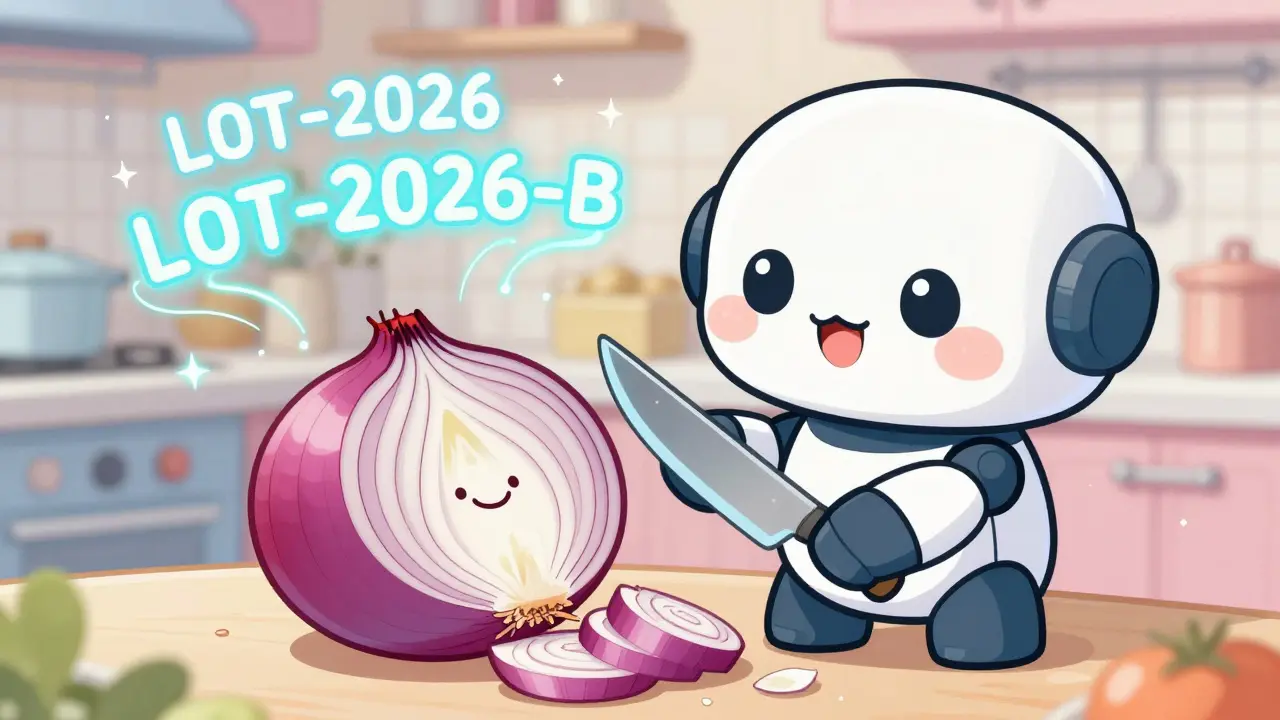
- Transformation: This happens when the food changes its physical state or packaging. For example, if a whole onion is chopped into a pre-cut mix, the original lot code is retired, and a new one is created. Crucially, the new code must be linked to the old one so the FDA can still trace it back to the original farm.
Companies have some flexibility in how they make these codes. Some use a "Julian date plus product code," while others use randomized strings. The only hard rule is that the code must be unique and provided to the FDA within 24 hours if an investigation begins.
Connecting the Dots: Key Data Elements
A lot code by itself is just a number. To make it useful, the FDA pairs the TLC with seven other Key Data Elements (KDEs), which are specific pieces of information that provide context to a traceability event. When an investigator looks at a problem batch, they aren't just looking for a number; they are looking for a story.
| Data Element | What it tells the FDA | Example Value |
|---|---|---|
| Traceability Lot Code | The unique ID of the batch | LOT-2026-0416-A |
| TLC Source | Where the code was assigned | Farm X, Salinas Valley, CA |
| Product Description | Exactly what the item is | Organic Baby Spinach, 5oz bag |
| Quantity | How much was moved | 500 Cases |
| Unit of Measure | How quantity is measured | Cases/Pallets |
| Transaction Info | Who sent it and who got it | Distributor A to Grocery Store B |
| Event Date/Time | When the movement happened | 2026-04-10 08:00 AM |
How This Beats Old Systems
You might wonder why this is different from the barcodes we've used for decades. Most old systems were internal. A warehouse had its own code, and the retailer had another. When the FDA stepped in, they had to manually translate these different languages, which is where the weeks of delay came from.
The TLC system creates a common language. Unlike the Drug Supply Chain Security Act (DSCSA), which tracks every single bottle of medicine via individual serial numbers, the FDA's food system tracks lots. Tracking every single apple would be impossible and too expensive, but tracking a lot of 5,000 apples is a manageable balance between safety and cost.
Compared to the voluntary Produce Traceability Initiative (PTI), the TLC system has teeth. It is mandatory for FTL foods. While companies like Walmart have gone further by using Blockchain, a decentralized digital ledger, to track leafy greens, the FDA's TLC requirement ensures a baseline level of safety for all players, regardless of whether they use fancy tech or simple CSV files.
Real-World Hurdles and the Path Ahead
Moving 15,000 food facilities to a new system isn't easy. Many companies struggle with "legacy systems"-old software that doesn't talk to new databases. Some businesses have even worried about "tandem coding," where they feel they have to keep their own internal codes and the FDA's TLCs. The FDA has clarified that if an internal code meets the requirements, it can serve as the TLC.
The transition has been slow enough that the FDA proposed moving the full compliance deadline to July 20, 2028. This gives smaller farms more time to get their records in order without going bankrupt from the implementation costs, which can average around $42,500 per company for mid-sized operations.
Looking forward, the FDA is eyeing the addition of melons and other ready-to-eat foods to the list. We are also seeing a push toward international harmony. The European Union is developing a Digital Product Passport, and the FDA is working with EU regulators to make sure that if a contaminated batch of produce crosses the ocean, the tracking doesn't stop at the border.
What happens if a company doesn't have the TLC data ready?
Under FSMA 204, firms must provide all Key Data Elements (KDEs) to the FDA within 24 hours of a request. Failure to do so can lead to enforcement actions, including the suspension of food facility registration, which effectively shuts down their ability to sell food in the U.S.
Can I use my existing internal lot numbers as TLCs?
Yes. The FDA has stated that any lot code a firm currently uses can serve as the Traceability Lot Code, provided it is passed along the supply chain and uniquely identifies the lot within the food system.
How does a TLC change when food is processed?
When food is "transformed" (e.g., whole carrots become sliced carrots), the new entity must assign a new TLC. However, they must maintain a digital or paper link to the previous lot code so the FDA can trace the product back to its original source.
Does the FDA require blockchain for this tracking?
No. While blockchain is a popular tool for some large retailers, the FDA does not mandate any specific technology. Electronic records are encouraged, but as long as they are sortable and exportable (like in a CSV file), they are compliant.
Which foods are currently on the Food Traceability List?
The list includes high-risk items such as leafy greens, tomatoes, onions, fresh-cut fruits and vegetables, nut butters, eggs, certain cheeses, and specific seafood products.

Comments
It is absolutely marvelous to see such a comprehensive leap forward in the way our society handles the fundamental necessity of food safety, and while some might find the alphanumeric codes tedious, I believe the sheer drama of a potential outbreak is far more pressing than the administrative burden of a few CSV files! I recall a time when a simple recall meant throwing out every single head of lettuce in the tri-state area, which was an utter tragedy for the farmers and the consumers alike, but now we have this elegant, digital breadcrumb trail that allows us to surgicaly remove only the offending batches from the shelves, which is a victory for efficiency and human health across the board!
Sure, they call it "safety," but anyone with a brain knows this is just more surveillance of the supply chain. The FDA wants to know every single hand that touches your food before it hits your plate. It sounds great on paper, but the real question is who is auditing the auditors? They say it's about E. coli, but once you have a centralized digital ledger of every movement, it's a short hop to total control over what's allowed to be produced and sold. Just follow the money and the power, people.
It's so interesting to think about how these small codes actually protect us... it's almost like a little invisible shield for our dinner plates!!! I really appreciate that they're giving the smaller farms more time to adapt, because the heart of our food system is in those family-owned fields, and we wouldn't want them to go bust just for a software update... right??
The 24-hour deadline for data submission is the most critical part of this whole thing. If you can't get the data out in a day, the damage is already done. Companies need to step up and prioritize their record-keeping now, not wait until 2028. Efficiency isn't a luxury here, it's a requirement for public health.
Omg can you even imagine the stress of a mid-sized company trying to find 42k for this 😱 like literally my anxiety is spiking just thinking about some poor office manager staring at a legacy system from 1998 and realizing they have to link a whole onion to a chopped mix 😭 it's just so overwhelming and the thought of a registration suspension is basically a death sentence for a business and I just can't even deal with that level of pressure right now!! ✨
Actually a pretty chill way to handle it. Just keep the logs clean and everyone wins.
It is indicative of the typical American approach to mandate such systems only after significant failures have occurred. In India, we have our own complex agricultural networks, yet the focus here is solely on Western standards. The FDA's insistence on specific "critical points" reflects a rigid bureaucracy that may not translate well to global markets where food processing is more decentralized.
USA all the way!! 🇺🇸 keep the bad stuff outta our food!! who cares if the paperwork is a mess just get it done lol 🥗💪
The idea of a "digital breadcrumb" is actually such a cute way to put it (⌒▽⌒) It makes the whole scary process of food recalls feel like a little scavenger hunt for the bad guys.
Why is everyone acting like this is some big miracle? We've had lot numbers for years! The only thing that changed is that now the government can breathe down the neck of the producers every five seconds. It's about time we put American safety over corporate profits, period.
It's honestly just a common-sense move. If you're cutting up an onion, you can't just pretend the original lot code still applies to the mix. You've got to create a new trail or the whole thing falls apart. It's basically like a family tree for your vegetables, keeping everything organized so we don't end up in the ER over a bag of spinach.