
Imagine walking into a local pharmacy, handing over your prescription, and trusting that the person behind the counter is fully qualified. Now imagine they aren’t. This isn’t just a hypothetical nightmare; it’s a real risk in an industry where credential fraud can lead to life-threatening errors, including the distribution of counterfeit drugs. In the United States, the safety net preventing this chaos is a network of 56 state pharmacy boards. These regulatory bodies are the gatekeepers of public health, ensuring that every pharmacist and technician you interact with meets strict standards of competence and ethics.
If you are a healthcare employer, a patient concerned about medication safety, or a pharmacist looking to practice across state lines, understanding how these verification systems work is critical. With approximately 350,000 pharmacists and 300,000 technicians regulated nationwide, the stakes are high. This guide breaks down exactly how to verify licenses, why state boards matter more than third-party badges, and how new technologies are closing the gaps that fraudsters exploit.
The Role of State Pharmacy Boards in Public Safety
To understand license verification, you first need to know who holds the keys. State pharmacy boards are independent regulatory agencies established by state legislation. The first board was created in Massachusetts back in 1878, setting a precedent for professional oversight that continues today. Currently, there are 56 active boards covering all 50 states, plus the District of Columbia, Puerto Rico, Guam, and the U.S. Virgin Islands.
These boards don’t just issue licenses; they enforce them. Their primary mandate is protecting public health. They do this by setting educational requirements, administering exams, monitoring continuing education, and investigating complaints. When a pharmacist acts unethically or practices without a valid license, the state board has the legal authority to suspend or revoke their credentials. According to the National Association of Boards of Pharmacy (NABP), these boards collectively manage the careers of hundreds of thousands of practitioners. Without this centralized authority, verifying a pharmacist’s status would be like trying to check a driver’s license without a Department of Motor Vehicles-chaotic and unreliable.
The core value here is trust. When you see a pharmacist’s name on a bottle, the state board has already done the heavy lifting to ensure they are who they say they are. However, this system only works if the information is accessible and accurate, which brings us to the verification process itself.
How to Verify a Pharmacy License Step-by-Step
Verifying a license used to involve sending letters and waiting weeks for a response. Today, most states have moved online, but the interfaces vary wildly. Here is how to navigate the most common systems effectively.
1. Identify the Correct Jurisdiction
A pharmacist might be licensed in multiple states. You must verify their license in the specific state where they are practicing at that moment. A license active in New York does not automatically grant permission to practice in California unless they are part of the Interstate Pharmacy Licensure Compact (more on that later).
2. Access the Official Board Website
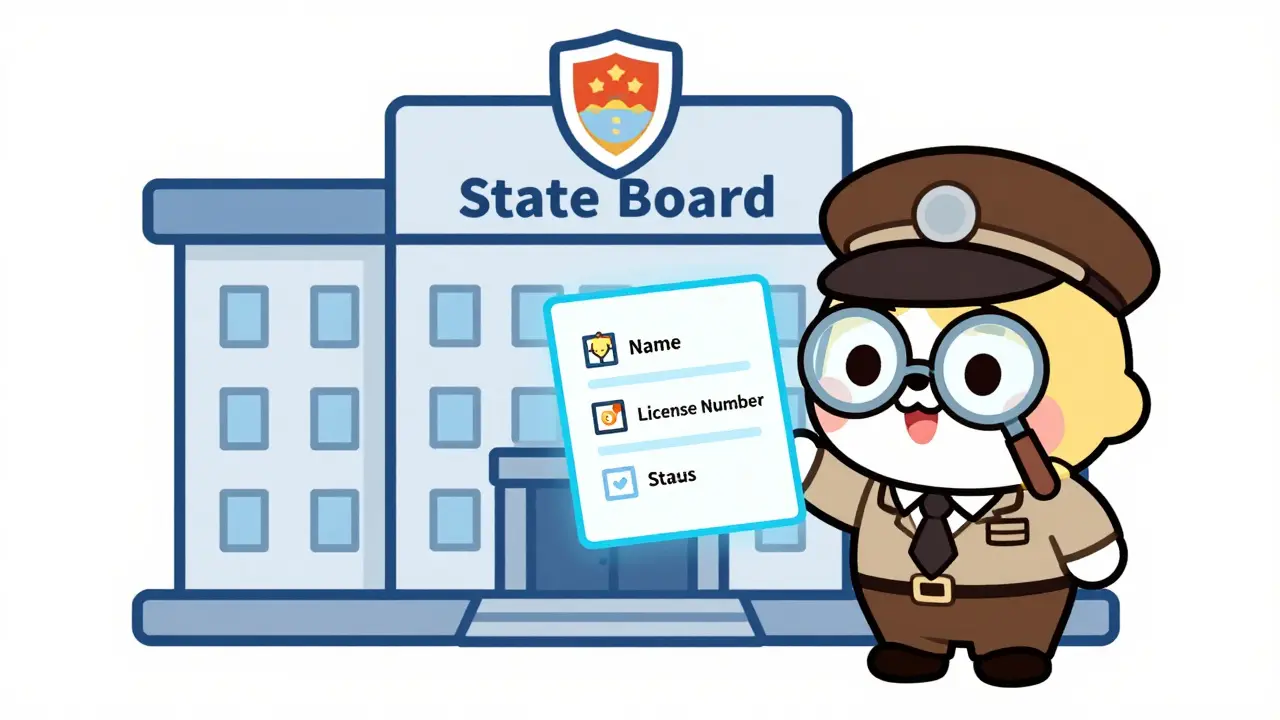
Always go directly to the state’s official government website. Look for URLs ending in .gov. Avoid third-party directories that claim to offer “instant verification” unless they are explicitly linked from the state board’s site. For example, the Maryland Board of Pharmacy offers a robust Web Lookup/Verification system that processes thousands of queries monthly.
3. Enter Search Criteria Carefully
Most systems require at least two pieces of information. Common fields include:
- Last Name
- First Name
- License Number
- Profession Type (Pharmacist, Technician, Intern)
A pro tip from users: less is often more. Entering too many partial details can sometimes confuse the search algorithm. If you have the license number, use that-it is unique and eliminates ambiguity caused by common names or maiden name changes.
4. Interpret the Status Codes
This is where things get tricky. A license doesn’t just exist; it has a status. Maryland’s system, for instance, recognizes 15 distinct statuses. Here is what they typically mean:
- Active: The practitioner is cleared to work.
- Suspended: Temporarily barred due to investigation or penalty.
- Revoked: Permanently stripped of license rights.
- Probation: Allowed to work under strict conditions.
- Expired/Inactive: Not currently authorized to practice.
Pay close attention to expiration dates. A license might show as “Active” but expire next week. Always check the validity period.
State Boards vs. NABP Verify: Which Should You Trust?
You’ve probably heard of NABP Verify. Launched in 2020, this service offers a digital badge and ongoing license monitoring for $59 annually. It sounds convenient, so why not just rely on it? Because of legal authority.
| Feature | State Board Direct Lookup | NABP Verify |
|---|---|---|
| Legal Authority | Official source of truth | Third-party aggregator |
| Cost | Free | $59/year (for the licensee) |
| Update Speed | Varies (7-14 days lag common) | Dependent on state board updates |
| Multi-State Coverage | One state per lookup | Centralized dashboard |
| Best For | Employers, Legal Compliance | Practitioners managing multiple licenses |
The American Pharmacists Association (APhA) explicitly recommends that employers verify licenses directly through the state board website before employment. Why? Because state boards are the only entities with the legal power to discipline practitioners. NABP Verify is a fantastic tool for pharmacists to showcase their compliance easily, but it is not a substitute for primary source verification. Think of NABP Verify as a resume highlight, and the state board record as the background check.
Furthermore, NABP Verify currently focuses on pharmacists. As of late 2023, expansion to pharmacy technicians was scheduled, meaning techs still need to rely on individual state lookups for now. If you are hiring a technician, you cannot skip the state board step.
The Hidden Risks: Delays, Gaps, and Fraud
Even with online systems, verification isn’t perfect. Dr. Susan Cornell, a pharmacy law expert, has pointed out that state board systems often lack real-time updates. There is a dangerous gap between when a disciplinary action occurs and when it appears in the database. On average, pharmacy boards take 14.3 days to update disciplinary records, compared to 12.4 days for medical boards. That two-day difference might seem small, but in cases of acute misconduct, it’s enough time for harm to occur.
User experiences highlight this frustration. On Reddit’s r/pharmacy community, practitioners frequently complain about delays. One user reported waiting three weeks for Maryland to update their status after passing exams. During that window, an employer might assume the license is inactive or, worse, fail to see a suspension if the system lags.
This latency creates opportunities for bad actors. Individuals with revoked licenses might exploit the delay to apply for jobs in other states before the information propagates. This is particularly concerning given the rise in counterfeit drug schemes, where unqualified individuals may attempt to infiltrate supply chains. Verifying licenses is the first line of defense against such infiltration.

New Frontiers: Compacts and Real-Time Updates
The landscape is changing fast. The biggest shift is the Interstate Pharmacy Licensure Compact (IPLC). Operational since 2017, the IPLC allows pharmacists licensed in one member state to practice in others without obtaining a full new license. As of October 2023, 23 states participate. This streamlines mobility but complicates verification. Employers must now check both the home state license and the compact privileges.
Technology is also catching up. Maryland launched an updated verification system in early 2023, handling over 150,000 verifications in six months with improved mobile responsiveness. The NABP Horizon Report predicts that by 2025, 90% of state boards will implement real-time verification updates, aiming to eliminate the current 7-14 day lag. Additionally, the License Verification Exchange (LVE) connects 68% of regulatory boards, creating a more unified data ecosystem.
However, cybersecurity remains a threat. Attacks on state health agency databases increased by 22% in 2022. Protecting this sensitive data is crucial, as any breach could compromise the integrity of the entire verification system.
Practical Tips for Employers and Patients
Whether you are hiring staff or checking your own pharmacist, follow these best practices:
- Don’t Rely Solely on Badges: Treat digital badges as a convenience, not proof. Always cross-reference with the state board.
- Check Multiple States: If a candidate has worked in several states, verify each license individually. Disciplinary actions in one state may not immediately appear in another.
- Look for ‘Probation’ Status: An active license on probation may come with restrictions (e.g., no controlled substances). Ensure these align with the job role.
- Document Your Verification: Take screenshots or save PDFs of the verification results. This protects you legally if issues arise later.
- Use Professional Resources: The APhA maintains a state-by-state verification guide updated quarterly. Use it to find direct links to official portals.
For patients, if you suspect a pharmacist is acting unprofessionally or you have doubts about their credentials, you have the right to ask for their license number and verify it yourself. Most state boards provide free complaint filing forms as well. Your vigilance helps keep the entire system honest.
Is it free to verify a pharmacy license?
Yes, accessing the official state board verification websites is almost always free for the public. While some states charge nominal fees for official printed verification letters sent to other jurisdictions, the online lookup tools provided by all 56 state boards do not cost anything to use.
What is the difference between NABP Verify and state board lookup?
NABP Verify is a paid subscription service ($59/year) for pharmacists that aggregates their license data into a shareable digital badge. State board lookup is the official, legal source of licensure information. Employers should use state board lookups for final verification, while NABP Verify serves as a convenient preliminary check for multi-state practitioners.
How long does it take for a license status to update after renewal or discipline?
Update times vary by state. Generally, there is a lag of 7 to 14 days for disciplinary actions to appear in public databases. Renewals may take longer to process during peak periods. Some states, like Maryland, warn that renewals might not show immediately. Always allow for this buffer period when conducting urgent checks.
Can I verify a pharmacy technician's license?
Yes, but you must use the state board website. As of late 2023, NABP Verify had not yet fully expanded to include pharmacy technicians in all capacities. Therefore, state-specific web lookups remain the primary and most reliable method for verifying technician credentials.
What is the Interstate Pharmacy Licensure Compact (IPLC)?
The IPLC is an agreement among 23 participating states that allows pharmacists licensed in one member state to practice in others without obtaining a separate full license. It simplifies multi-state practice but requires employers to verify both the home state license and the compact privilege status.

Comments
Oh my gosh, this is such a critical topic!! 😱 I’ve been in the pharma regulatory space for years and seeing the lag times mentioned here just makes my blood boil. The fact that NABP Verify isn’t fully integrated for technicians yet is a massive compliance gap 🚫 We need real-time API integration with state boards ASAP! 💻
The article assumes state boards are infallible gatekeepers, which is naive at best. Most of these .gov sites are digital wastelands from the early 2000s. Relying on them as the 'source of truth' is absurd when they’re down for maintenance half the time.
While Mr. Cruz’s frustration is understandable; the legal reality remains that only the state board holds disciplinary authority. It is crucial to note that third-party aggregators like NABP Verify are merely convenience tools. They do not possess the statutory power to revoke or suspend licenses. Therefore; employers must always cross-reference with the primary source. This ensures compliance with federal and state regulations.
You guys are missing the point entirely. In India, we deal with similar issues but our system is even more fragmented. If you think US pharmacy verification is chaotic, try navigating the State Pharmacy Councils there. No centralized database, no real-time updates, just pure chaos. The IPLC compact is a step forward, but it’s baby steps compared to what’s needed globally. Stop complaining about 14-day lags and start demanding blockchain solutions.
I totally get where everyone is coming from. It’s a bit overwhelming with all the different systems. But honestly, checking the license number directly on the state site is the safest bet. I did this recently for a job change and it took me less than five minutes. Just go to the .gov site and type in the name. Simple as that!
This is an incredibly valuable resource! :) I am so glad someone highlighted the importance of checking for 'Probation' status. Many people overlook this detail, but it can have significant implications for patient safety and employer liability. Let’s all stay vigilant and keep each other informed! :)
Your analysis lacks depth. The 14.3-day lag cited is anecdotal and statistically insignificant without raw data sources. Furthermore, suggesting blockchain as a solution ignores the immense infrastructure costs and privacy concerns associated with immutable health records. You are proposing technology for technology's sake.
we trust systems because we fear chaos. but the system is just a mirror of our own negligence. why do we expect perfection from bureaucrats who are underpaid and overworked? the real issue is not the lag. it is our collective denial of human error. we build walls of data to hide from the truth that anyone can slip through.
hey folks, just wanted to say thanks for sharing this info. i know its easy to get frustrated with the red tape but doing your due diligence really does matter. take screenshots if u can. saves headaches later. good luck everyone!
I’ve always felt uneasy asking pharmacists for their license numbers, feeling like it might come across as accusatory. Reading this gives me more confidence to do it, knowing it’s a standard part of ensuring safety. It’s scary to think about how easily counterfeit drugs could enter the supply chain if we aren’t careful.