
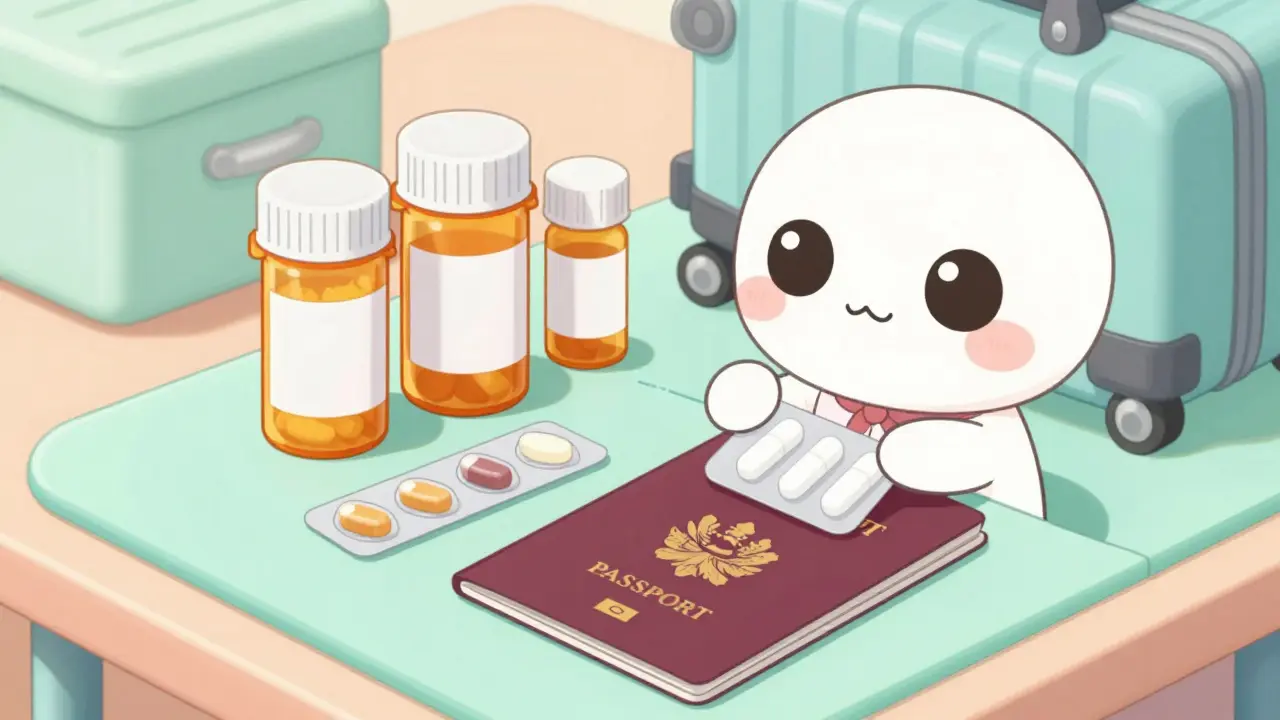
The Golden Rule: Stick to Original Packaging
It is tempting to save space by using those handy weekly pill organizers, but this is a major mistake when flying. The TSA (Transportation Security Administration) generally requires medications to stay in their original pharmacy containers. Why? Because the label provides an instant audit trail: your name, the drug name, the dosage, and the prescribing doctor. Without this, security agents have no way to verify what the substance is.
Beyond security, there is a scientific reason for this. Pharmaceutical experts, including Dr. Marcia Wyman from the Cleveland Clinic, point out that transferring meds to generic containers can expose them to light, moisture, and contamination. This can actually degrade the potency of some drugs by up to 30% in just three days. If you absolutely must use a secondary container for convenience during the flight, carry the original bottle alongside it to avoid any issues at the checkpoint.
Navigating the Liquid Limit
We all know the "3.4-ounce rule" for liquids, but here is the good news: medically necessary liquids are exempt. If your medication exceeds 100 mL, you can still bring it in your carry-on. You just need to declare it to the officer at the security screening point. There isn't a strict "upper limit" for these liquids, though the FAA (Federal Aviation Administration) suggests a ceiling of 2,000 mL for carry-ons unless you have special prior approval.
To make this process painless, don't hide your liquid meds at the bottom of your bag. Place them in a separate, easy-to-reach pouch. When you reach the bin, tell the agent, "I have medically necessary liquid medication." Having your prescription label clearly visible on the bottle usually settles the matter quickly.
Handling Temperature-Sensitive Meds
If you travel with biologics or insulin, the cargo hold is your enemy. Temperatures in a plane's cargo area can plummet to -40°C (-40°F), which can cause irreversible crystallization in protein-based medications, effectively ruining them. Always keep these in your carry-on.
To keep meds between the required 2-8°C (36-46°F), use a TSA-compliant insulated cooler bag. Use frozen gel packs or ice packs, but here is a pro tip: ensure they are fully frozen when you hit the security line. If they've partially melted, they can sometimes trigger a secondary manual search. According to experts from the International Society of Travel Medicine, biologic medications can lose about 5% of their potency every hour they spend above 25°C (77°F). If you're flying a modern aircraft like the Boeing 787 Dreamliner on certain airlines, check if they offer in-flight refrigeration units to keep your meds stable during long hauls.
| Item Type | Packing Method | TSA Requirement | Critical Risk |
|---|---|---|---|
| Pills/Tablets | Original Pharmacy Bottle | Valid Prescription Label | Potency loss in organizers |
| Liquids (>3.4oz) | Separate Pouch/Declared | Medical Necessity Proof | Security delays |
| Biologics/Insulin | Insulated Cooler Bag | Frozen Gel Packs | Freezing in cargo hold |
| Injectables | With associated needles | Sharps container for disposal | Accidental needle sticks |
Documentation That Saves Time
A prescription label is the bare minimum. If you want to move through security without a hitch, especially when traveling internationally, prepare a "Medical Travel Kit" of documents. This should include:
- A Physician's Letter: A signed note on official letterhead explaining your condition and why specific medications (and supplies like syringes or pumps) are medically necessary.
- Translated Labels: If you're heading to a country with strict laws (like Japan or the UAE), have your documents translated. Some countries require prior authorization for drugs containing pseudoephedrine.
- Digital Backups: Keep a photo of your prescriptions on your phone or use a digital medication passport if available.
Managing Your Schedule Across Time Zones
Jet lag isn't just about feeling tired; it can mess with your medication timing. If you're crossing five or more time zones, don't just guess when to take your next dose. The American Academy of Sleep Medicine recommends a gradual shift. Start adjusting your dose time by 15 to 30 minutes every day for three to five days before you leave. This helps your body and your medication levels stay stable as you transition to the new local time.
Final Checklist for a Stress-Free Trip
Before you head to the airport, run through this quick list to ensure you haven't missed anything critical:
- Check Quantities: Ensure you have enough for the trip plus an extra 3-5 days in case of flight delays.
- Verify Labels: Confirm every bottle has a legible name and dosage.
- Prep Cooling: Freeze your gel packs for at least 24 hours before departure.
- Pack Strategically: Place all meds in your carry-on, never in checked luggage.
- Timing: Arrive at the airport 2-3 hours early to account for any potential medical screening questions.
Can I bring liquid medication in my carry-on if it's over 3.4 ounces?
Yes. Medically necessary liquids are exempt from the 3.4-ounce (100 mL) limit. You must declare the medication to the TSA officer at the security checkpoint. It is highly recommended to keep the medication in its original container with the prescription label attached.
Should I put my medication in checked luggage to save space?
No. You should always keep medications in your carry-on. Checked bags can be lost or delayed, and more importantly, cargo holds can reach extreme temperatures (as low as -40°F) that can freeze and destroy biologic medications like insulin.
Do I need a doctor's note for my medications?
While a prescription label is often enough for domestic flights, a signed physician's letter on official letterhead is strongly recommended. This is especially critical for international travel, for passengers carrying syringes/needles, or for those using high-volume liquid medications.
How do I keep my insulin cold during a long flight?
Use an insulated medical cooling pouch with frozen gel packs. Ensure the packs are fully frozen before security. These specialized coolers typically maintain the required 2-8°C (36-46°F) range for 12-18 hours. Some airlines also provide in-flight refrigeration on specific aircraft models.
What happens if I'm traveling to a country with strict drug laws?
Some countries, such as Japan or South Korea, have very strict regulations on specific ingredients (like pseudoephedrine). You may need prior authorization or an import permit. Check the U.S. Department of State's Travel Advisories and carry translated documentation of your prescriptions.

Comments
It's wild how much of our autonomy we surrender the moment we step into an airport. We're basically treating our own health as a security threat that needs a permit to exist in a cabin.
The lack of basic organizational skills in the general public is truly staggering. It is simply a matter of following a set of clearly defined instructions to avoid unnecessary delays.
Western rules are too rigid. Pure chaos.
This is a great breakdown of the requirements. I've found that keeping a digital copy of the prescription on a cloud drive is a lifesaver if you accidentally leave a physical copy at home.
While I appreciate the intent to keep everyone safe, the sheer aggression of some security personnel when they see a needle is absolutely heartbreaking and frankly inhumane, although I do believe that we must find a middle ground where the cultural understanding of medical necessity is woven into the very fabric of international aviation law so that no one, regardless of their country of origin or the severity of their condition, has to feel like a criminal for simply trying to stay alive during a ten-hour flight across the Pacific.
I always just keep mine in a small bag at the top of my carry-on. It's just easier that way, even if the rules are a bit weird sometimes. Hope everyone has a safe trip.
Toting around a whole pharmacy in original bottles is a real trip, but hey, better than gettin' grilled by a TSA agent who's havin' a bad Monday, right? Just keep it all in one spot and you're golden.
Thank you for the reminder about the cargo hold temperatures. I had no idea it could get that cold.
I wonder what kind of medications specifically the author uses for their own travel routine since they seem so concerned with the details. It would be interesting to know if they have a chronic illness or if this is just a general research piece for the public.