
How Patents Keep New Drugs Coming - And Why Generics Can’t Show Up Too Soon
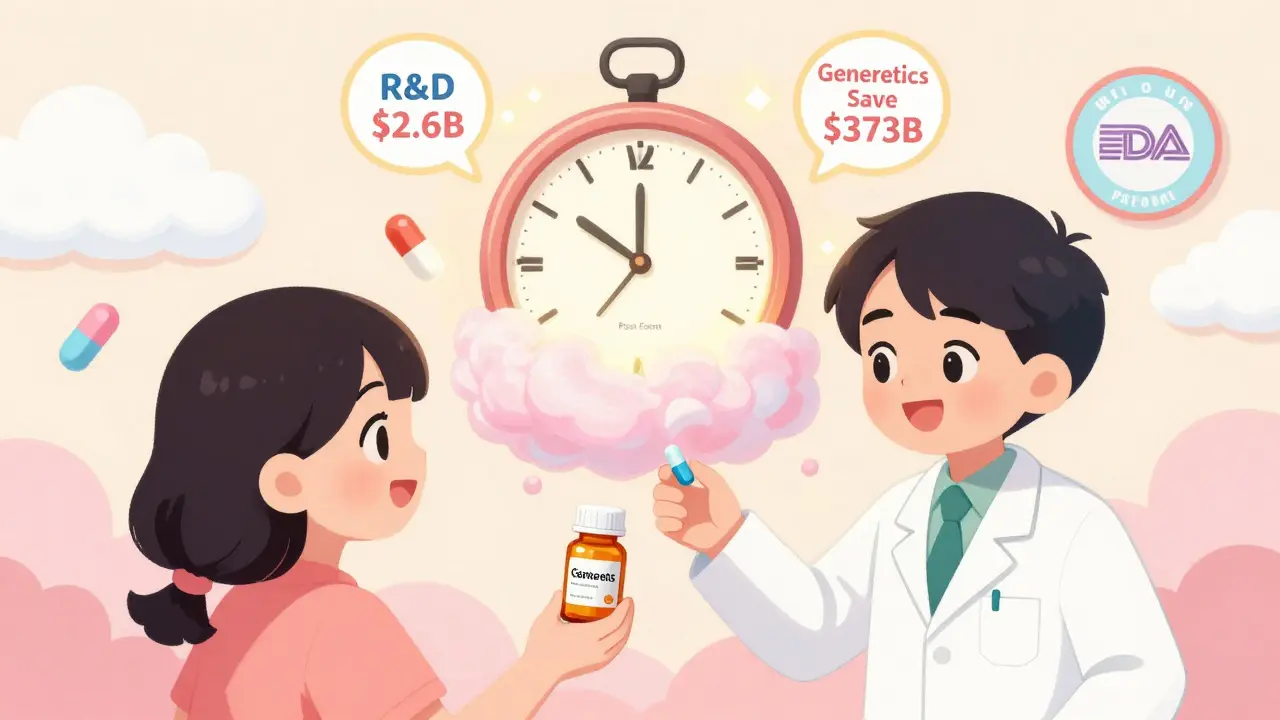
If you’ve ever picked up a bottle of ibuprofen at the pharmacy and noticed it costs $5 instead of $50, you’re seeing the result of a 40-year-old legal balancing act. At its core, patent law in pharmaceuticals isn’t about locking away medicine. It’s about making sure companies have a reason to spend $2.6 billion and 10-15 years developing a single new drug - and then letting generics step in once that investment is paid back.
The system was designed by Congress in 1984 with the Hatch-Waxman Act. Before that, brand-name drug makers could delay generic entry indefinitely by suing any company that even tried to copy their medicine. Generic manufacturers had no legal path to enter the market until after the patent expired - and even then, they had to start from scratch with clinical trials. That meant patients waited years longer for affordable options. Hatch-Waxman changed all that.
The Two-Track Exclusivity System
Pharmaceuticals don’t just have patents. They have two kinds of protection: patent exclusivity and regulatory exclusivity. One comes from the U.S. Patent and Trademark Office. The other comes from the FDA.
A patent gives the inventor a 20-year monopoly from the day they file it. But here’s the catch: drug development takes years. By the time a new drug gets FDA approval, five or six of those 20 years are already gone. That’s why Hatch-Waxman lets companies apply for patent term restoration - adding back up to five years of exclusivity to make up for time lost during testing and review.
On the FDA side, regulatory exclusivity kicks in automatically. For a brand-new chemical compound, the FDA grants five years of market exclusivity - meaning no generic can even apply for approval during that time. For drugs that treat rare diseases or pediatric conditions, that period can stretch to seven or 12 years. This isn’t a patent. It’s a regulatory pause.
Together, these two layers mean a drug might have 12 to 14 years of real market control - enough to recoup massive R&D costs. After that, generics can enter.
The Paragraph IV Gamble: How Generics Break the Lock
Here’s where it gets strategic. Generic companies don’t wait for patents to expire. They look at the FDA’s Orange Book - a public list of every patent tied to a branded drug. If they believe a patent is weak, invalid, or doesn’t actually cover their version of the drug, they can file what’s called a Paragraph IV certification.
This is a legal challenge. It says: “We’re going to make this drug, and we think your patent doesn’t block us.” When they do, the brand-name company has 45 days to sue for infringement. And if they do? The FDA can’t approve the generic for up to 30 months - even if the patent is clearly invalid.
That 30-month clock is the biggest leverage tool in the system. It gives innovators a guaranteed delay. It’s not a win on the merits - it’s a win on timing. And because lawsuits are expensive, many generics walk away. But for the ones that push through? The reward is huge.
The 180-Day Gold Rush
The first generic company to successfully challenge a patent gets 180 days of exclusive market access. No other generics can enter during that time. That’s not just a bonus - it’s a fortune.
Why? Because in most states, pharmacists are legally required to substitute a generic for a brand-name drug if it’s approved as therapeutically equivalent. That means when the first generic hits, it gets nearly all the sales. One study showed that the first generic challenger often captures over 90% of the market during those six months.
That’s why companies like Teva, Mylan, and Sandoz spend hundreds of millions on patent litigation. The payoff can be billions. In 2015, Teva’s challenge to AbbVie’s Humira patents triggered a $2.2 billion settlement - not because they won, but because they forced a deal to enter the market early.
What Happens When Generics Arrive?
Once the exclusivity ends and generics flood in, prices collapse. The first generic usually cuts the price by 70% within six months. By the time five or six generics are selling, prices drop by 90% or more.
Take Prozac. When Eli Lilly’s patent expired in 2001, the brand lost 70% of its U.S. market share in a year. Annual sales dropped by $2.4 billion. But patients paid a fraction of what they did before.
Today, generics make up 91% of all prescriptions filled in the U.S. - but they cost only 24% of what brand-name drugs do. In 2022 alone, they saved the healthcare system $373 billion.
That’s the whole point. Patents fund innovation. Generics make it affordable.
When the System Gets Stuck: Evergreening and Patent Thickets
But it’s not perfect.
Some companies use tactics called “evergreening” - filing new patents on tiny changes: a new pill shape, a slightly different dosage schedule, or a new manufacturing method. These aren’t new drugs. They’re tweaks. But they still trigger new 30-month delays.
Humira, AbbVie’s top-selling drug, had 241 patents across 70 patent families. That’s not innovation - it’s a legal wall. The first biosimilar didn’t enter the U.S. until 2023, even though Europe had generics since 2018.
Another problem: “product hopping.” A brand changes its drug slightly - say, from a pill to a tablet - and pushes patients to the new version. Then it lets the old version’s patent expire, but the new version is still protected. It’s not illegal, but it delays generic access.
In 2022, Congress passed the CREATES Act to stop companies from refusing to sell samples of their drug to generics - a tactic used to block testing. But enforcement is still patchy.
The Pay-for-Delay Problem
Here’s the most controversial part: sometimes, brand companies pay generics not to enter the market.
It sounds crazy. Why pay someone to stay out? Because it’s cheaper than losing $1 billion a year in sales. These “pay-for-delay” deals happen behind closed doors. The FTC estimates they cost consumers $3.5 billion every year.
Congress has tried to ban them. The Preserve Access to Affordable Generics Act has been introduced multiple times. So far, it hasn’t passed. But courts are starting to crack down. In 2013, the Supreme Court ruled these deals can violate antitrust laws - a big shift.
What’s Next? Biologics, IPRs, and the Future of Access
Biologics - complex drugs made from living cells - are the next frontier. They’re not pills. They’re proteins, antibodies, vaccines. They cost more than $100,000 a year. And they’re harder to copy.
The Biologics Price Competition and Innovation Act (BPCIA) was meant to create a path for biosimilars - the biologic version of generics. But in 2017, a court decision in Amgen v. Sandoz threw the whole process into chaos. The “patent dance,” a step-by-step negotiation between brand and generic, became optional. Now, lawsuits are messier, longer, and more unpredictable.
Meanwhile, generics are using a tool called inter partes review (IPR) - a faster, cheaper way to challenge patents at the Patent Office instead of in court. But the constitutionality of IPRs is being challenged. If they’re struck down, generic entry could slow again.
The Bottom Line: Innovation Isn’t the Enemy - Stagnation Is
Patents aren’t meant to lock medicine away forever. They’re meant to give companies a fair shot to earn back their investment - and then get out of the way.
The Hatch-Waxman Act created a system that works, most of the time. It’s why we have 32,000 approved generics. It’s why a month’s supply of metformin costs $4 instead of $400. It’s why new cancer drugs and rare disease treatments keep coming.
But when companies stretch patents to 20 years of effective exclusivity - or pay rivals to stay quiet - the system breaks. Patients pay more. Innovation slows.
The real question isn’t whether patents protect innovation. It’s whether we’re letting them protect profit at the cost of access. The answer will shape the next decade of medicine - and whether the next breakthrough drug is a miracle… or a luxury.
How long do pharmaceutical patents last?
Pharmaceutical patents last 20 years from the filing date. But because drug development takes 10-15 years, the actual time a company has exclusive market rights is usually only 12-14 years. The Hatch-Waxman Act allows companies to extend this by up to five years to make up for time lost during FDA review.
What is the Orange Book and why does it matter?
The Orange Book is a public list published by the FDA that includes every patent associated with an approved brand-name drug. Generic manufacturers use it to identify which patents they might challenge before launching their version. If a patent isn’t listed, it can’t be enforced against generics - making accurate listing critical for brand companies.
Why do generics cost so much less than brand-name drugs?
Generics don’t need to repeat expensive clinical trials. They only need to prove they’re bioequivalent - meaning they work the same way in the body. Since they skip the $2.6 billion R&D cost, they can sell for 80-85% less. The savings come from competition, not lower quality.
What is a Paragraph IV certification?
A Paragraph IV certification is a legal statement by a generic manufacturer claiming that a brand-name drug’s patent is invalid, unenforceable, or won’t be infringed. This triggers a 45-day window for the brand to sue - and if they do, FDA approval is automatically delayed for up to 30 months, even if the patent is weak.
Do generics have the same effectiveness as brand-name drugs?
Yes. The FDA requires generics to be bioequivalent - meaning they deliver the same amount of active ingredient into the bloodstream at the same rate as the brand. Studies show they work the same way in 99% of cases. Differences in inactive ingredients (like fillers) rarely affect outcomes.
What’s the difference between a generic and a biosimilar?
Generics are exact copies of small-molecule drugs - like pills made from chemical compounds. Biosimilars are copies of complex biologic drugs made from living cells, like antibodies. They’re not identical - but they’re highly similar and just as safe and effective. Because they’re harder to replicate, biosimilars cost less than biologics but not as much as traditional generics.
What are pay-for-delay deals?
Pay-for-delay deals happen when a brand-name drug company pays a generic manufacturer to delay launching its cheaper version. The brand avoids lost sales; the generic gets paid. These agreements are controversial and often illegal under antitrust law, but they still occur. The FTC estimates they cost U.S. consumers $3.5 billion each year.

Comments
Wow, this is actually one of the clearest explanations I've ever read about how generics work. I always thought patents were just about locking stuff up, but the Hatch-Waxman thing? Mind blown.
Also, the 180-day gold rush is wild-like a legal heist where the reward is cheaper ibuprofen.
so basically pharma companies are just playing chess with the FDA and the courts while people are still paying $100 for a pill that could be $5?
and we wonder why healthcare is broke lmao
The structural incentives embedded within the Hatch-Waxman framework represent a carefully calibrated equilibrium between innovation and accessibility. The Paragraph IV certification mechanism introduces a non-trivial litigation risk that, while economically rational for generics, imposes significant temporal and financial burdens on market entry. Regulatory exclusivity, distinct from patent protection, operates as a statutory barrier independent of intellectual property law.
I just wanna say… 🤯 this whole system is like a sci-fi movie where the villain is a patent lawyer and the hero is a generic company with a spreadsheet and a dream.
And the people? We’re just the ones holding the cash and the empty pill bottles. 💔💊
This is why America is weak. In South Africa, we don’t wait 15 years for a drug to be affordable. We make it. We copy it. We don’t bow to Big Pharma. Your patents are a colonial relic. We need access, not corporate theatre.
this is so cool actually, i never knew generics could get that 180 day window, like a legit reward for being brave enough to sue big pharma.
hope more companies do it, even if they mess up the spelling sometimes lol
so the system works until it doesnt and then everyone just yells at each other while the price of insulin goes up again. classic.
Patents are for losers who cant innovate. Real companies make money by outsmarting the system not waiting 20 years. India does it better. Why are you still paying for brand names?
The 30-month delay is just a tax on common sense.
You think Humira’s 241 patents are bad? Wait till you see the ones on insulin. They’ve got patents on the color of the pen. The shape of the cap. The *sound* the button makes when you click it. This isn’t innovation. This is a legal prison.
so if generics can challenge patents why dont they do it more often is it just too expensive or are they scared
People still act like this is fair? You’re letting corporations decide who lives and who dies based on profit margins. And you call this a system? This is a moral failure wrapped in legalese. 🤢
The real hero here is the inter partes review process. It’s not perfect, but it gives smaller generics a fighting chance without bankrupting them. We need more tools like this-not fewer. Innovation shouldn’t be a monopoly game.
I’m from Canada and we don’t have this mess. We negotiate drug prices as a country. No 180-day gold rush. No pay-for-delay. Just… cheaper medicine. You guys have the tech. You just need the will.