
It’s 2026, and you walk into your pharmacy to refill your blood pressure pill. The pharmacist hands you a small white bottle with a plain label. "It’s the same medicine," they say. "Just cheaper." But you hesitate. You’ve been taking the brand name for years. You know how it feels. You trust it. So you ask for the brand anyway-even though it costs nearly double.
This isn’t rare. In fact, it’s normal.
Even though generic drugs make up 90% of all prescriptions filled in the U.S., they only account for 22% of total drug spending. Why? Because people keep choosing the brand. And it’s not just about money-it’s about feeling safe.
Same active ingredient, different feeling
Let’s be clear: generic drugs are not knockoffs. They contain the exact same active ingredient as the brand name. The FDA requires them to be bioequivalent-meaning they work the same way in your body. The same dose. The same effect. The same safety profile.
So why do some patients swear their brand-name version works better?
It’s not science. It’s psychology.
When you’ve taken a pill for years-say, your antidepressant or your epilepsy medication-you form a mental link between the brand name and relief. The color, the shape, the logo on the pill. That’s your comfort. When you switch to a generic, even if it’s chemically identical, your brain notices the difference. And for some, that’s enough to trigger anxiety-or even physical symptoms.
A 2023 survey of 200 YouTube videos about medication experiences found that 58% of people expressed a clear preference for brand-name drugs. The top reasons? "I trust what I know" (32%) and "My doctor said the brand works better for me" (27%).
Here’s the catch: doctors don’t always say that. But they sometimes imply it. A 2023 GlobalData survey showed that 40% of physicians would prescribe brand-name drugs if cost wasn’t a factor. In Japan, that number jumps to 57%. In Spain and Italy, it’s over 45%. Even when they know generics are just as effective, many doctors default to brands-especially for chronic conditions.
Who’s most likely to stick with brands?
It’s not random. Certain groups are far more likely to prefer brand-name drugs.
Gen Z is one. Despite being the most cost-conscious generation in many ways, 35% of young adults in a 2022 Fortune survey said they’d choose a brand-name medication-even if it was 79% more expensive. Why? They don’t see it as wasteful spending. They see it as insurance. "I’m not risking my health for $20," one 22-year-old told researchers.
Then there’s the lower-income, lower-education group. A 2023 PMC study found that people with less formal education were 1.54 times more likely to stick with brand-name drugs, even when prices rose. It sounds counterintuitive-why spend more when you can’t afford it? But the logic goes like this: "If it’s cheaper, maybe it’s worse." They associate price with quality. And in medicine, that belief is powerful.
Older adults, too, often cling to brands. Many grew up in an era where generics were rare or poorly made. Even today, they remember stories of generics causing side effects. Those stories stick.
And then there are the patients with mental health conditions. Psychiatric meds-antidepressants, antipsychotics, mood stabilizers-have some of the highest brand loyalty rates. Why? Because the stakes feel higher. A slight change in how a pill works can mean the difference between feeling stable and crashing. Patients report that even tiny differences in inactive ingredients-like fillers or dyes-can trigger anxiety, nausea, or sleep issues. And while science says those differences shouldn’t matter, the lived experience says otherwise.
What’s really in the pill?
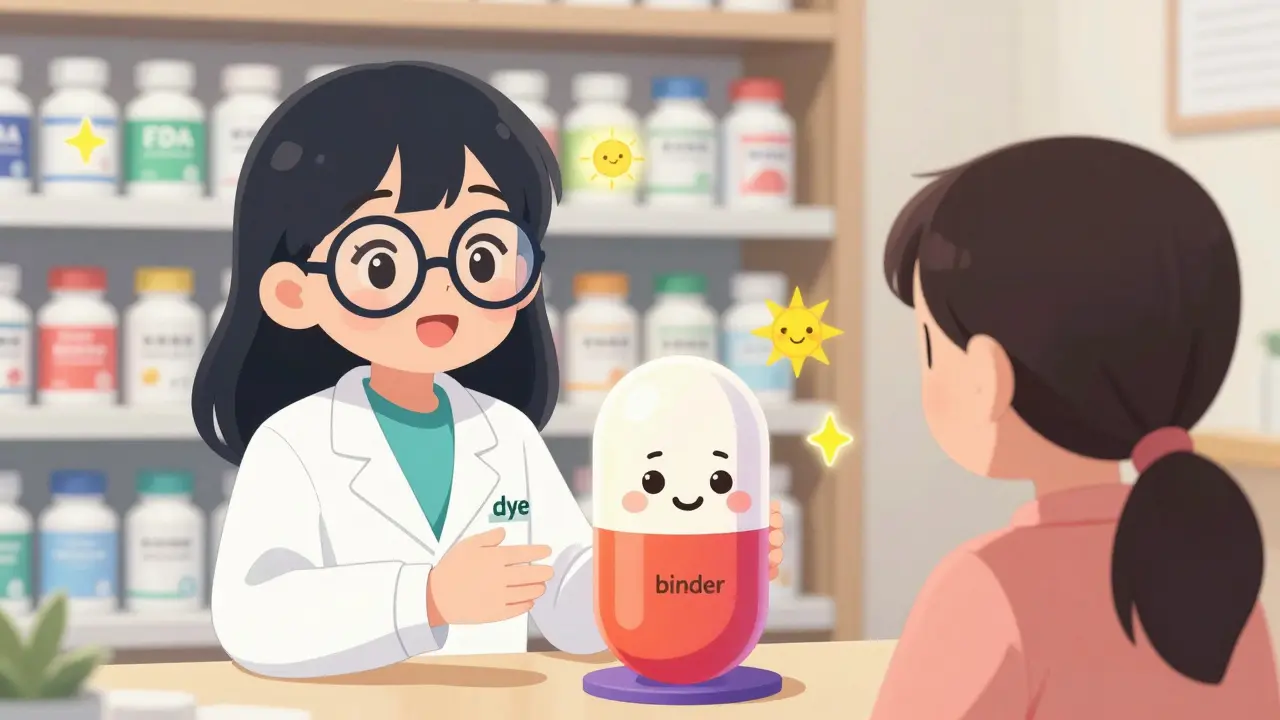
Here’s something most people don’t know: generics can have different inactive ingredients. That’s the stuff that’s not the medicine itself-like the dye, the binder, the coating. These don’t affect how the drug works. But they can affect how your body reacts.
Some people are sensitive to certain dyes. Others have mild allergies to lactose or cornstarch, which are common fillers. One Reddit user, u/AnxiousPatient99, wrote: "I’ve tried three different generics of my antidepressant. Only the brand name works consistently." They got over 1,200 upvotes. That’s not just one person. That’s thousands who feel the same.
Pharmacists know this. In fact, a 2022 American Pharmacists Association study found that 67% of patients accepted generics after a pharmacist sat down and explained exactly what was in the pill-and why it was safe. But that kind of conversation doesn’t happen often. The average counseling session lasts just 7.2 minutes. Most of that time is spent on dosage instructions, not reassurance.
And when a patient does have a bad experience with a generic, it sticks. Trustpilot reviews of pharmacy chains show that 27% of negative comments mention "different inactive ingredients causing allergic reactions." Even if the FDA says those reactions are rare, the perception is real. And perception drives behavior.
The cost of sticking with brands
Let’s talk numbers. In 2022, brand-name drugs cost, on average, 79% more than their generic equivalents. For someone taking a monthly prescription, that’s hundreds of dollars a year. For chronic conditions-diabetes, high blood pressure, thyroid meds-that adds up to thousands.
One user on r/personalfinance wrote: "I’ve used generics for 10 years with no issues. Saved $4,200." That post got 872 upvotes. But it’s not the norm. Most people don’t track their savings. They just feel the pinch at the counter.
Employers are starting to push back. In 2023, 68% of large companies implemented tiered formularies-meaning if a generic exists, you pay more for the brand. Some plans charge $50 for a brand-name statin versus $5 for the generic. That’s a strong nudge. But it doesn’t always work. Patients with chronic illnesses often fight back. They call their doctors. They appeal. They pay out of pocket.
And it’s not just about money. It’s about control. When you’re managing a long-term illness, the pill you take becomes part of your identity. Switching feels like losing something you’ve earned.
Will this change?
The FDA is trying. Their new GDUFA III plan (2023-2027) aims to speed up generic approvals and increase competition. They’re also cracking down on brand-name companies that delay generics with legal tricks.
Biosimilars-generic versions of complex biologic drugs-are another frontier. But so far, only 32% of patients switch to them, even when they’re 30-50% cheaper. Why? Because biologics are made from living cells. They’re harder to copy. And patients fear even the smallest difference.
Deloitte predicts generic use will rise to 95% of prescriptions by 2030. But McKinsey says something else: premium brand-name drugs with strong patient support programs will still hold 35-40% of the market in key areas like mental health, autoimmune diseases, and cancer.
That’s because brand loyalty isn’t just about the pill. It’s about the promise.
It’s the reassurance that comes from a name you’ve seen on TV. It’s the trust in a company that’s been around for decades. It’s the belief that if it’s expensive, it must be better.
And in medicine, where fear and uncertainty are constant, that promise matters more than data.
What you can do
If you’re considering switching from a brand-name drug to a generic:
- Ask your pharmacist to explain the difference in inactive ingredients.
- Check the FDA’s Orange Book to confirm the generic is rated "A"-meaning fully equivalent.
- Give it a fair trial. Don’t assume it won’t work after one bad day.
- Track your symptoms. If you notice real changes, talk to your doctor. Don’t just assume it’s the generic.
- Know your rights. In some states, pharmacists can’t substitute without your consent.
If you’re a patient who’s always chosen the brand:
- You’re not wrong to feel safe with what you know.
- But ask yourself: Is it the pill-or the label-that’s giving you peace of mind?
- Could you save money without risking your health? Maybe. But only if you’re informed.
There’s no right answer. Only the one that works for you.
Are generic drugs really as effective as brand-name drugs?
Yes. By law, generic drugs must contain the same active ingredient, strength, dosage form, and route of administration as the brand name. The FDA requires them to be bioequivalent-meaning they work the same way in your body. Studies show no meaningful difference in effectiveness for the vast majority of patients. But some people report feeling different after switching, often due to changes in inactive ingredients or psychological factors.
Why do some people feel worse on generic medications?
Some people report side effects or reduced effectiveness after switching to generics, especially with psychiatric, epilepsy, or heart medications. While the active ingredient is identical, generics can use different fillers, dyes, or coatings. A small percentage of people are sensitive to these inactive ingredients. Also, psychological factors play a big role-people may expect to feel worse, which can trigger real symptoms. This is called the nocebo effect. It’s not imaginary-it’s real, but not caused by the drug’s chemistry.
Can pharmacists substitute a brand-name drug with a generic without asking me?
It depends on your state and the prescription. In most U.S. states, pharmacists can substitute a generic unless the doctor writes "dispense as written" or "no substitution." But they must tell you if they’re making the switch. You always have the right to refuse and ask for the brand name. Some states require explicit patient consent for substitution, especially for high-risk medications.
Why do doctors prescribe brand-name drugs if generics are cheaper?
Many doctors prescribe brands out of habit, familiarity, or concern about patient outcomes-especially for complex conditions like depression, epilepsy, or autoimmune diseases. Some believe (incorrectly) that generics are less reliable. Others are influenced by pharmaceutical marketing. A 2023 survey found 40% of physicians would choose brand-name drugs if cost weren’t a factor. It’s not always about medical necessity-it’s about comfort and perception.
Is brand loyalty in medications getting stronger or weaker?
It’s mixed. Brand loyalty is weakening in simple, high-volume drugs like statins and antibiotics, where price drives decisions. But it’s holding strong-or even growing-in specialty areas like mental health, biologics, and chronic conditions. Younger patients are more likely to choose brands, while older patients are more open to generics. Insurance plans and employer policies are pushing people toward generics, but patient trust and fear of change are powerful counterforces.
Final thought
Medicine isn’t just chemistry. It’s trust. It’s routine. It’s the quiet certainty that comes from knowing what’s in the bottle. Generics are safe. Generics work. But for many, the brand name is more than a label-it’s a promise. And in healthcare, promises matter as much as pills.

Comments
Bro, I switched to generic Adderall and my brain felt like it was wrapped in cotton. I went back to the brand. No regrets. 🤷♂️
The phenomenon under discussion constitutes a profound epistemological dissonance between pharmacological equivalence and phenomenological experience. The bioequivalence paradigm, while scientifically rigorous, fails to account for the hermeneutic dimension of therapeutic trust.
i get it. i used to be scared to switch too. then i tried one. nothing changed. now i save $80 a month and don't think about it. peace of mind isn't always in the label
In India, generics are the norm and people trust them because they've seen them work for decades. Maybe the fear comes from over-marketing and lack of education. We need more pharmacists talking to patients, not just handing out pills. 🙏
The mind doesn't distinguish between chemical equivalence and symbolic continuity. The pill is an artifact of identity. When that artifact changes, the self experiences dislocation. This isn't irrational. It's existential
It's fascinating how the neoliberal medical-industrial complex weaponizes placebo effects to extract surplus value from vulnerable populations. The brand-name pharmaceutical oligarchy has engineered a psychological dependency matrix that transcends pharmacokinetics and taps into late-capitalist anxiety. The fact that patients pay 80% more for inert packaging is a triumph of semiotic hegemony over evidence-based practice.
The nocebo effect is underappreciated in clinical discourse. When you condition patients to expect variability in generics, you create the very instability you fear. It's not the filler-it's the narrative. And narratives have pharmacodynamic properties.
I had a panic attack after switching to generic Zoloft. My hands shook. I couldn't sleep. I went back to the brand. My doctor said it was all in my head. Well guess what? My head was the only thing keeping me alive. So yeah, I'll pay extra. And if you don't get that, maybe you've never been truly afraid.
This whole thread is pathetic. People are crying over $20 a month while they buy $1000 phones and $15 lattes. If you can't handle a generic pill, maybe you shouldn't be taking medicine at all. Grow up.
I'm a pharmacist. I've seen people panic over color changes. I sit with them. I show them the FDA equivalency chart. I tell them about the fillers. Most of them calm down. It's not about the pill. It's about being heard.
In Nigeria, we don't have the luxury of choosing brands. We take what works. But I've seen people cry because their medicine looked different. It's not about money. It's about fear. We need more compassion, not more judgment. We are all just trying to survive.