
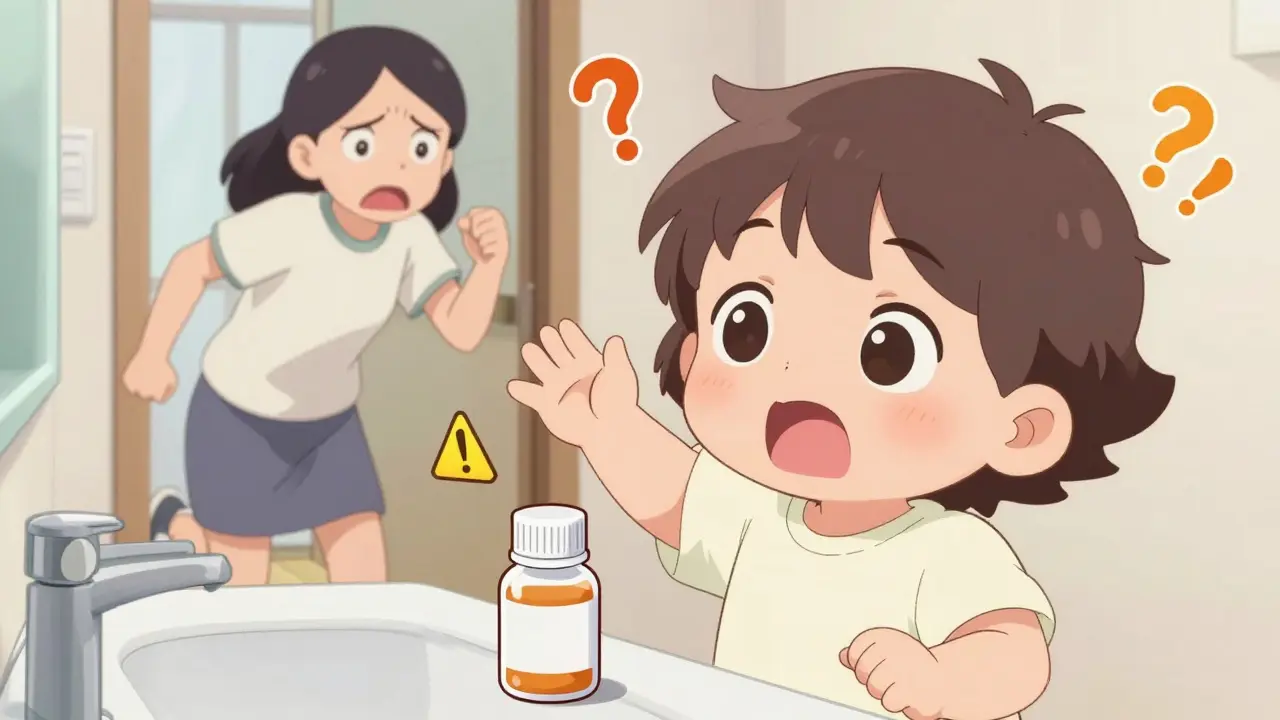
Every year, around 60,000 children under five end up in emergency rooms because they accidentally swallowed medicine they shouldn’t have. That’s not a rare accident-it’s a daily reality. One child every 90 seconds. And most of these incidents happen not because parents are careless, but because they think their child “would never reach it.”
Why Child-Resistant Caps Aren’t Enough
You’ve seen them-the plastic bottles with the twist-and-push caps. They’re called child-resistant, not child-proof. And that’s the problem. A 2023 study by Express Scripts found that half of all kids under five can open those caps in less than a minute. Some do it in seconds. Children as young as two can figure out cabinet latches. They watch. They copy. They experiment. A bottle of children’s Tylenol might look like candy. Aspirin? Looks like Skittles. Chewable Tums? They’re practically Sweetarts. One mother in Ohio told her story on Reddit: her 21-month-old found a bottle of ibuprofen in her purse, opened it, and ate six pills before she came back from the bathroom. It took 40 minutes to get to the hospital. She didn’t leave the bottle out on purpose. She just thought she’d be gone for two minutes.The Two-Minute Rule: Never Leave Medicine Unattended
The CDC’s “Two-Minute Rule” isn’t a suggestion-it’s a survival tactic. If you’re giving your child medicine, don’t put the bottle down, even for a second. Don’t set it on the counter while you answer the door. Don’t leave it on the bathroom sink while you get a towel. Don’t put it in your pocket and forget about it. Research shows kids can open a cabinet in 90 seconds. That’s less than two minutes. If you’re distracted-even for a moment-your child might already have the bottle in their hands. Always hold the medicine until the dose is given. Then lock it up immediately. No exceptions.Where to Store Medicine: Height, Locks, and Visibility
Storing medicine “up high” isn’t enough. You need to store it out of sight and out of reach. That means:- High cabinets-above counter height (at least 36 inches), not on the top shelf of the bathroom cabinet
- Locked cabinets or drawers-preferably with a childproof lock
- Never in purses, coat pockets, or nightstands
Lockboxes: The Most Effective Solution
Medication lockboxes aren’t just for drug addicts or elderly parents. They’re for every home with a child under six. A simple steel or hardened plastic box with a key or combination lock costs between $25 and $60. You can find them at pharmacies, online, or even at big-box stores. Parents who use them report 92% effectiveness. One mother in Texas bought a Med-Tek lockbox after her nephew nearly died from swallowing her blood pressure pills. She kept it on her bedroom dresser. Her 18-month-old granddaughter visited every weekend. The lockbox never opened. The child never touched the medicine. Biometric safes with fingerprint locks exist too-they’re pricier ($80-$120), but they’re fast. Still, don’t use them for emergency meds like EpiPens or inhalers. Those need to be reachable in under 3 seconds. Keep those in a separate, clearly marked location that every adult in the house knows.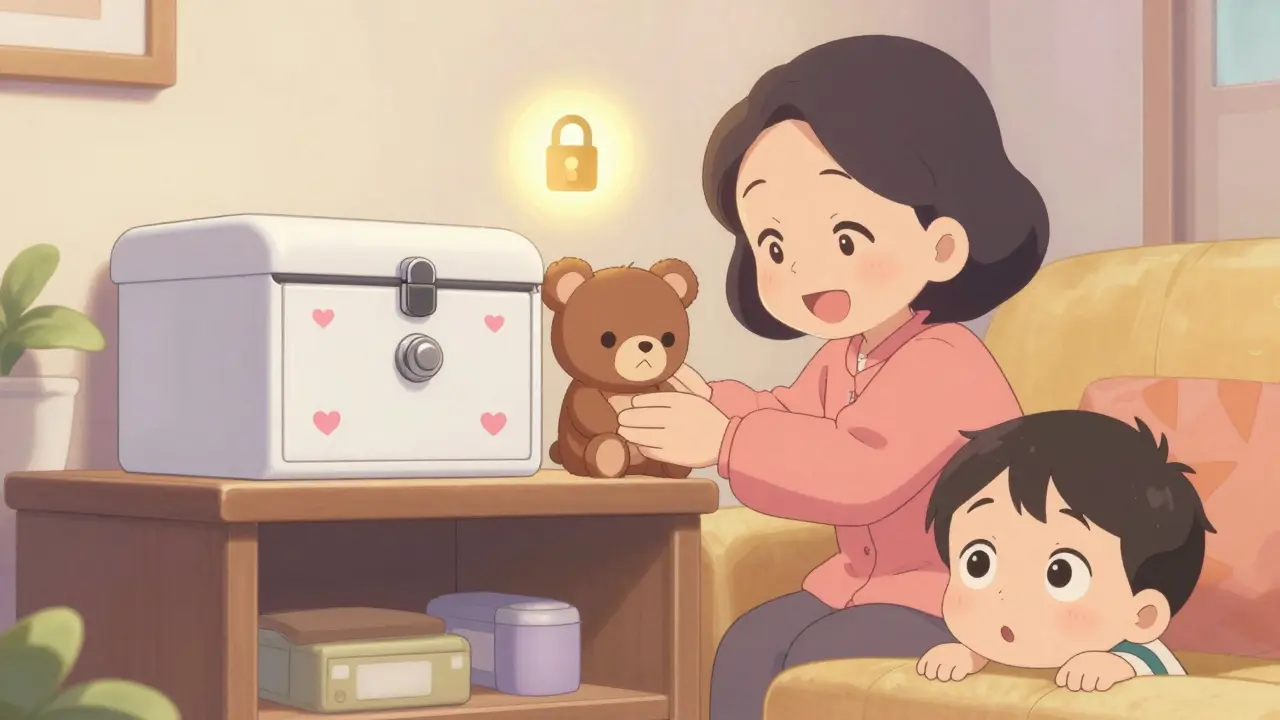
What About Travel and Grandparents’ Houses?
Most accidental poisonings happen when kids visit other homes. A 2023 Safe Kids Worldwide survey found that 76% of grandparents don’t lock up their meds when grandchildren visit. Why? They think, “My grandchild knows better.” Or, “I only have a few pills left.” That’s dangerous thinking. One grandmother in Florida didn’t realize her 3-year-old had opened her diabetes pills. The child ate four tablets. She ended up in the ER with a dangerously low blood sugar level. Always bring your own lockbox when visiting. The CDC now sells “Travel Safety Kits”-small, portable lockboxes that fit in a suitcase or hotel safe. If you’re staying with family, ask them to lock up their meds before you arrive. Don’t assume they’ve done it.Refrigerated Medicines: Just as Dangerous
Insulin, some antibiotics, and liquid medications need to be kept cold. But that doesn’t mean they’re safe in the fridge. Kids open fridges. They climb on chairs. They pull out drawers. Store refrigerated meds in a locked container inside the fridge. Or, better yet, use a small lockbox that fits inside the fridge door. The same rules apply: out of sight, out of reach, locked. Don’t rely on the fridge being “too high.” A 2-year-old can reach the bottom shelf.Medications and Candy: A Deadly Association
Never, ever say, “This tastes like candy.” Don’t joke about medicine being sweet. Don’t use dessert as a reward for taking pills. Children don’t understand metaphor. They learn by association. If medicine = candy, they’ll seek it out. Children’s Mercy Hospital found a 17% spike in accidental ingestions of chewable medications that look like candy. The same goes for pills that are brightly colored or shaped like animals. Even if they’re not meant for kids, they’re still a target.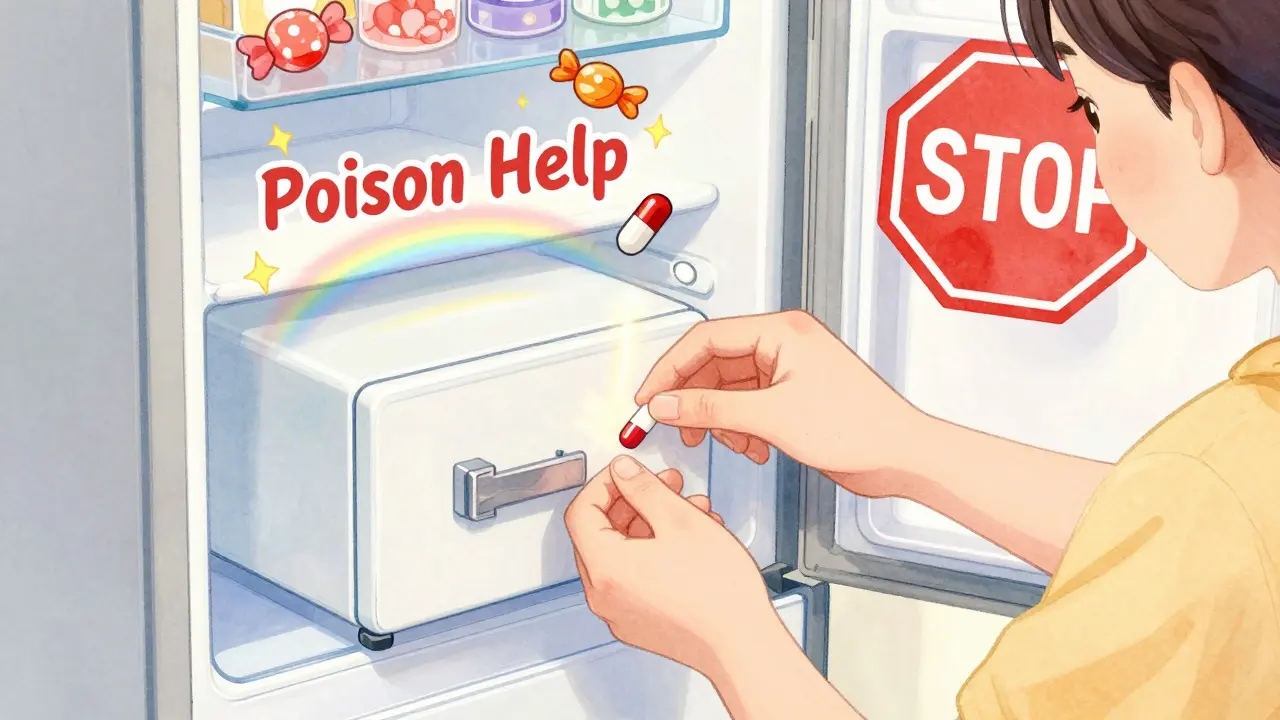
What About Teenagers?
Teenagers don’t accidentally ingest medicine-they take it on purpose. Prescription misuse among teens is rising. A 2023 guideline from the National Association of Pediatric Nurse Practitioners found that families who use a “monitored medication system” reduce misuse by 67%. How? Write down every pill taken. Have the teen sign it. Have an adult verify it. Keep all meds locked up. Even if your teen seems responsible, they’re still developing impulse control. Don’t wait for a crisis to act.Disposing of Old Medicine
Don’t flush pills. Don’t throw them in the trash. Don’t leave them in a drawer “just in case.” The FDA recommends mixing old or expired meds with coffee grounds or kitty litter in a sealed plastic bag. Then throw it in the garbage. Many pharmacies now have permanent drop-off bins for safe disposal. Check with your local pharmacy-they’re free and easy to use.Emergency Preparedness
Keep the Poison Help number (1-800-222-1222) saved in your phone. Post it on the fridge. Know the signs of poisoning: vomiting, drowsiness, difficulty breathing, burns around the mouth. If you suspect your child swallowed something, don’t wait. Call immediately. If your child has a rescue inhaler or EpiPen, keep it in a location you can reach in under 3 seconds-but still locked away from curious hands. A wall-mounted lockbox with a quick-release key works well.Why This Matters More Than You Think
Accidental poisonings cost the U.S. system over $67 billion a year. That’s billions in hospital bills, lost workdays, and emotional trauma. But the real cost? A child’s life. You don’t need to be perfect. You just need to be consistent. Lock it up. Every time. Even if you’re tired. Even if you’re in a hurry. Even if you think no one’s watching. It only takes one second for a child to reach for something they shouldn’t. But it takes a lifetime to live with the consequences.Can child-resistant caps really be opened by kids?
Yes. While designed to slow kids down, child-resistant caps can be opened by half of children under five within one minute. Some open them in seconds. They learn by watching adults and experimenting. Never rely on these caps alone.
Where’s the safest place to store medicine at home?
In a locked cabinet or drawer, at least 36 inches high, and out of sight. Bathroom cabinets are common but risky-kids climb and open them easily. A kitchen cabinet with a lock or a dedicated medication lockbox is far safer.
Should I lock up medicine even if I don’t have young kids?
Yes. Grandchildren, nieces, nephews, or visiting friends might come over. Even teens can accidentally or intentionally access medicine. Locking up is a universal safety step-not just for toddlers.
Is it safe to keep medicine in the fridge?
Only if it’s in a locked container inside the fridge. Kids can open fridge doors and reach low shelves. Never assume refrigeration makes medicine safe. Always use a lockbox, even for insulin or liquid antibiotics.
What should I do if my child swallows medicine?
Call Poison Help at 1-800-222-1222 immediately. Don’t wait for symptoms. Don’t try to make them vomit. Keep the medicine bottle handy to tell the poison control specialist what was taken, how much, and when. Time matters.
Are smart lockboxes worth the extra cost?
They’re convenient but not essential. Bluetooth-enabled safes can alert you when opened, but they’re only 43% reliable according to testing. A simple key or combination lockbox is just as effective and costs less. Prioritize reliability over tech.
How often should I check my medicine storage?
Every time you give a dose. Make locking it up part of your routine-like washing hands. Do a monthly check: remove expired meds, refill lockboxes if needed, and make sure the lock still works. Consistency saves lives.

Comments
Every time I see a post like this, I think about my cousin’s kid who swallowed a whole bottle of melatonin because it looked like gummy bears. He was fine, but the ER visit cost $8,000 and his mom hasn’t slept through the night since. Lock it up. Not ‘maybe’-literally every single time. No exceptions.
Look, I get the fear-mongering, but let’s be real-kids are going to get into stuff. You think locking up medicine is the solution? What about cleaning supplies? Batteries? Sharp objects? We’ve turned parenting into a security theater where every shelf needs a biometric scan. Kids aren’t bombs. They’re curious. And curiosity isn’t a crime. Let them learn by consequence-within reason, of course. But this ‘lock everything or your child dies’ narrative is exhausting.
My sister keeps her meds on the counter. Her 3-year-old hasn’t touched them. Why? Because she talks to him. She says, ‘This isn’t candy, this is medicine.’ And he listens. Not because of a lockbox. Because she taught him. That’s parenting. Not paranoia.
And don’t get me started on the ‘travel kits’-you’re telling me I need to carry a steel box in my suitcase just because some grandparent forgot to lock their aspirin? That’s not safety. That’s performance.
Yes, accidents happen. But we’re creating a generation of kids who think every bottle is a forbidden artifact. We’re teaching them fear, not responsibility. Maybe the real problem isn’t the medicine-it’s the panic.
Of course you’re going to say ‘lock it up’-because you’ve never had a 2-year-old who climbs on the counter, pulls open the cabinet, and finds the bottle because you left it there for ‘two minutes’ while you answered the door. I did. And I didn’t even know it was gone until I heard the dry heaving. You think you’re safe? You’re not. Not unless you’ve got a vault and a guard dog. And even then, your kid will figure out how to open the fridge with a chair and a butter knife.
And don’t even get me started on ‘child-resistant caps.’ My nephew opened one in 12 seconds. With his teeth. He’s two. He doesn’t have opposable thumbs yet, but he’s got determination. That’s the problem. Kids aren’t dumb. They’re adaptive. And we’re the ones who keep underestimating them.
So yes. Lock it. Hide it. Pretend it’s plutonium. Because if you don’t, you’re gambling with their life. And I’m not going to sit here and pretend that’s okay.
My mom used to keep her pills in a drawer next to her bed. Said she needed them ‘for emergencies.’ One day, my 4-year-old cousin came over, climbed up, opened it, and ate three pills. She was fine. But my mom cried for three days. She never left them out again.
Now she has a lockbox on her nightstand. It’s ugly. It’s loud when you open it. But it works. And my cousin? He’s 14 now. He still calls it ‘the scary box.’
It’s not about being dramatic. It’s about being smart. And sometimes, smart looks ridiculous.
My brother’s a nurse. He says the worst cases aren’t from parents forgetting-they’re from grandparents who say, ‘Oh, I only have a few left.’ That’s the lie that kills. Lock it. Always. Even if it’s just one pill.
Did you know the government is using this to push for mandatory smart lockboxes? It’s not about safety-it’s about control. They want to track every pill you take. Your meds, your insulin, your vitamins-they’re all being tagged. Next thing you know, they’ll shut off your lockbox if you take too many. And don’t think they won’t. They’ve already got the tech. It’s in the bill. Look up HR-4712. They’re calling it ‘MedSafe 2.0.’ It’s not paranoia. It’s policy.
LOCK. IT. UP. I don’t care if your kid’s ‘good.’ I don’t care if you’re ‘only gone for a second.’ I don’t care if you ‘trust’ your sister-in-law. I’ve seen the ER logs. I’ve seen the photos. I’ve seen the tiny hands holding a bottle of ibuprofen like it’s a toy. And I’ve seen the parents sobbing in the hallway. You think you’re being careful? You’re not. You’re just lucky. And luck runs out. Always. So lock it. Like your child’s life depends on it. Because it does.
There’s a deeper truth here that no one wants to admit: we’re not raising children. We’re raising consumers. We give them candy-shaped pills, colorful packaging, sweet flavors-then we’re shocked when they treat medicine like a snack. We’ve commodified everything-even healing. We turned a cure into a toy. And now we’re surprised when the toy gets eaten.
The real issue isn’t the lockbox. It’s the culture that teaches children to associate medicine with pleasure. We say, ‘This will make you feel better,’ and they hear, ‘This is good.’ We say, ‘Take your medicine,’ and they hear, ‘This is something you want.’
Until we stop marketing medicine like dessert, we’re just putting band-aids on a hemorrhage.
This is the kind of post that makes me want to be a better parent. Not because I’m scared-but because I care. I used to leave my daughter’s syrup on the counter. Now it’s in a lockbox on the top shelf of the closet. It’s a hassle. But it’s worth it. One less worry. One less what-if. You’re not being paranoid-you’re being present. And that’s everything.
Let’s be honest-this isn’t about medicine. It’s about control. You think locking up pills stops accidents? No. It just moves the danger to the next thing. The bleach. The batteries. The razor. The phone charger. The list never ends. We’re not teaching safety-we’re teaching avoidance. And avoidance breeds ignorance.
Instead of locking everything away, teach kids what things are. Let them see. Let them ask. Let them understand. A child who knows medicine is dangerous isn’t a threat. A child who’s never been told, and just finds a bottle, is the real risk.
And while you’re at it-stop treating kids like little robots who need programming. They’re humans. And humans learn by touching, tasting, exploring. Your job isn’t to lock the world away. It’s to help them understand it.
But hey, if you want to sleep better, lock it up. I won’t stop you. I just won’t pretend it’s the answer.