
When your child starts a new medication, it’s natural to worry. What if they get sick from it? What if the side effect is worse than the illness? The truth is, pediatric medication side effects are common - and most are mild. But knowing how to handle them at home can mean the difference between a calm evening and an emergency room trip.
What Side Effects Are Normal - and What’s an Emergency?
Not every reaction means something’s wrong. Many medications cause temporary, harmless side effects. Up to 42% of kids on antibiotics or pain relievers get an upset stomach. About 19% feel drowsy. A rash shows up in 1 in 5 children. These aren’t always allergies. They’re often just the body adjusting. But some reactions need immediate action. Call 911 or go to the ER if your child has:- Swelling of the face, lips, or tongue
- Difficulty breathing or wheezing
- High fever over 102°F (38.9°C) that doesn’t drop with medicine
- More than 3 episodes of vomiting in 2 hours
- Unresponsiveness or extreme lethargy
Common Side Effects and What to Do at Home
Most reactions can be managed safely at home - if you know how.Gastrointestinal Issues: Upset Stomach, Diarrhea, Vomiting
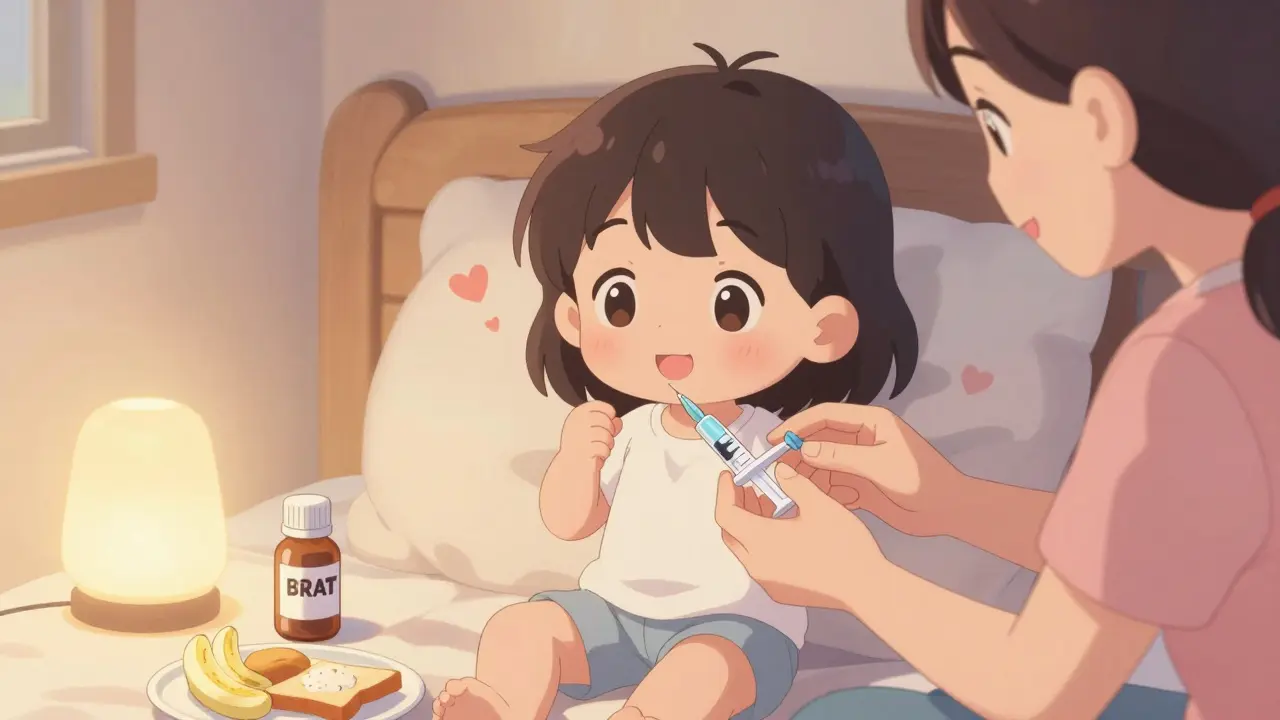
Diarrhea happens in 28% of kids on antibiotics. Upset stomach? That’s even more common. The key is hydration - not stopping the medicine. For vomiting, wait 30 to 60 minutes after the last episode. Then start small: 5 to 10 mL of oral rehydration solution (like Pedialyte) every 5 minutes. Don’t give juice, soda, or milk yet. Those can make it worse. If they keep it down after an hour, slowly increase the amount. After 4 hours, try bland foods: bananas, rice, applesauce, toast. That’s the BRAT diet - simple, gentle, proven. For diarrhea, keep offering fluids. Avoid dairy and sugary snacks. Let their gut heal. Most cases clear up in 2-3 days. If it lasts longer, or they show signs of dehydration (dry mouth, no tears, fewer wet diapers), call your pediatrician.Drowsiness or Hyperactivity
Drowsiness is normal with antihistamines, sleep aids, or some antibiotics. Let them rest. Don’t force play or school. But if your child suddenly becomes hyperactive, agitated, or can’t sit still - that’s unusual. Diphenhydramine (Benadryl) causes this in 15% of kids. That’s way more than in adults. Write down what you see: “Ran around the house for 45 minutes without stopping,” or “Screamed for 20 minutes with no reason.” Bring that to the doctor. It helps them decide if the medicine is the problem.Rashes and Skin Reactions
A mild, pink, flat rash that doesn’t itch? Probably not an allergy. It could be a viral reaction or a drug effect that fades on its own. But if the rash is bumpy, itchy, spreading fast, or covers more than 10% of the body - especially with swelling or breathing trouble - treat it like an emergency. Use epinephrine if prescribed. Call 911.How to Avoid Dosing Mistakes (The #1 Cause of Problems)
Most home medication errors aren’t about bad intent. They’re about confusion. One study found 78% of parents misread dosing instructions. The biggest mistake? Confusing a teaspoon (5 mL) with a tablespoon (15 mL). That’s a 300% overdose. That’s dangerous. Use only the tool that came with the medicine - usually a 1 mL oral syringe with 0.1 mL marks. Never use kitchen spoons. Never guess. Always measure. Also, take a photo of the label before giving the medicine. It sounds silly - until you’re tired at 2 a.m. and grab the wrong bottle. Photos help you double-check: “Is this the amoxicillin or the ibuprofen?”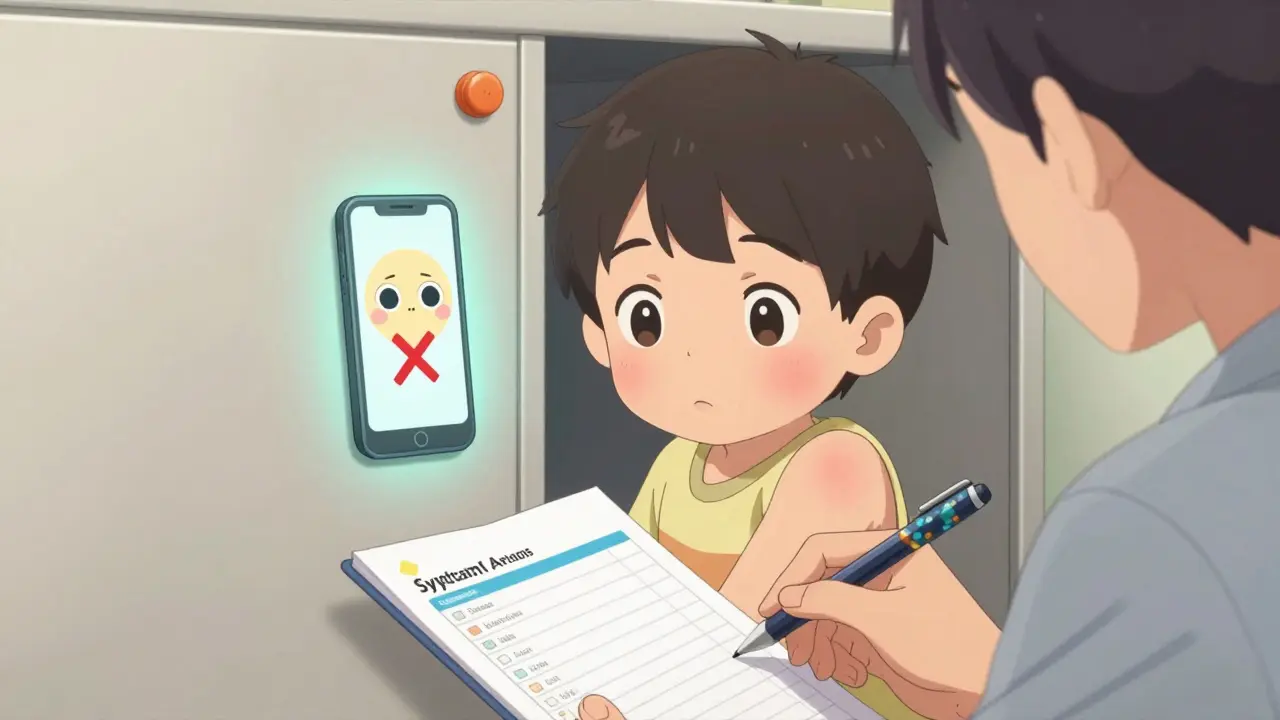
Storage That Keeps Kids Safe
Medications aren’t candy. But kids treat them like it. The Poison Prevention Packaging Act of 1970 requires child-resistant caps - and for good reason. Lockable cabinets at least 1.5 meters (5 feet) high reduce accidental ingestions by 65%. That’s from Children’s Hospital Los Angeles. Never transfer pills or liquids to unmarked containers. A 2022 study showed this increases poisoning risk by 41%. Keep everything in original bottles. Even if the label looks messy. Even if it’s a pill you’ve given 10 times before. Check storage temperatures. About 73% of pediatric liquid meds need refrigeration. The rest should stay at 20-25°C (68-77°F). Heat and moisture ruin medicine. Don’t leave it in the bathroom or the car.Antibiotics: Don’t Stop Early - Even If They Feel Better
This is critical. Parents often stop antibiotics when symptoms improve. That’s natural. But it’s also dangerous. Children’s Healthcare of Atlanta found that stopping early causes treatment failure in 29% of cases. It also increases the chance of the infection coming back - stronger and harder to treat. Finish the full course. Even if your child is smiling, eating, and playing. Even if the fever’s gone. The medicine is still killing the last of the bacteria. Skipping doses creates superbugs.
When to Call the Doctor (Not the ER)
You don’t need to rush to the hospital for every sniffle. But you should call your pediatrician if:- The side effect lasts more than 3 days
- Your child won’t drink or keep fluids down
- They have a new rash that’s spreading
- You’re unsure if the reaction is normal
New Tools Making Home Care Easier
Technology is helping. Apps like MedTrak Pediatric scan medication barcodes and warn you if the dose is wrong. In trials, they cut dosing errors by 68%. The FDA is also pushing for change. By 2027, 95% of pediatric meds will have standardized, picture-based instructions - no more confusing words like “take twice daily.” Just icons: a sun for morning, a moon for night. And while genetic testing to predict reactions is still experimental, early data shows it could prevent 73% of severe side effects in the future. That’s not here yet - but it’s coming.What You Can Do Today
You don’t need to be a doctor to keep your child safe. Just follow these simple steps:- Always measure with a syringe - never a spoon.
- Store meds up high, locked, in original bottles.
- Keep a log: date, time, dose, and any reaction.
- Know the emergency signs: swelling, trouble breathing, high fever.
- Finish antibiotics - no exceptions.
- Save the poison control number: 1-800-222-1222. Save it in your phone. Write it on the fridge.
What should I do if my child vomits right after taking medicine?
Wait 30 to 60 minutes. If they vomited the entire dose and it’s been less than 15 minutes since giving it, you may repeat the dose - but only if it’s not a medication like antibiotics or seizure drugs. For those, call your doctor first. If it’s been longer than 15 minutes, the medicine was likely absorbed. Don’t give another dose. Just wait and watch for side effects.
Can I give my child over-the-counter medicine with their prescription?
Never combine medications without checking with your pediatrician. Many OTC cold and cough medicines contain the same active ingredients as prescriptions - like acetaminophen or diphenhydramine. Double-dosing can cause liver damage or dangerous drowsiness. Always ask before mixing.
How do I get my toddler to take medicine without a struggle?
Try mixing liquid medicine with a small amount of applesauce or yogurt - but only if the label says it’s okay. Use a syringe to squirt it toward the inside of the cheek, not the back of the throat. For older kids, let them choose the flavor (if available) or use a reward chart. Some hospitals recommend practicing with small candies like Nerds, then Mini M&Ms, over two weeks to build confidence.
Is it safe to crush pills or open capsules for my child?
Only if your pharmacist or doctor says yes. Some pills are designed to release slowly. Crushing them can cause a dangerous overdose. Others have coatings that protect the stomach or prevent bad taste. Always ask before altering the form of any medication.
What if I give the wrong dose by accident?
Call Poison Control immediately at 1-800-222-1222. Don’t wait for symptoms. Have the medicine bottle ready - they’ll ask for the name, dose given, and your child’s weight. Most accidental overdoses are treatable if caught early. Never induce vomiting unless told to.
Why do some kids react badly to the same medicine that others handle fine?
Children’s bodies process drugs differently based on age, weight, liver and kidney function, and even genetics. A 2-year-old metabolizes medicine slower than a 6-year-old. Some kids are more sensitive to certain ingredients. That’s why dosing is always based on weight - not age. If your child has a strong reaction, document it. It helps future care.

Comments
So we're just supposed to trust the AAP like they're some kind of infallible oracle? What about the 2018 JAMA study that showed 68% of pediatric side effect guidelines were based on anecdotal pediatrician reports? We're treating kids like lab rats while the pharmaceutical lobby writes the rulebook. The real emergency is the lack of independent oversight.
And don't get me started on that BRAT diet - it's a 1950s relic. Modern nutrition science says fiber and probiotics are what actually heal the gut. But sure, keep feeding them bland toast like we're in the Eisenhower era.
Okay. I'm just going to say this. I'm a mom. I've been here. I've done this. I've given my son amoxicillin and he broke out in a rash that looked like someone spilled red paint on him. I panicked. I called 911. They laughed. It was a viral rash. But I didn't know that. And now I keep a printed copy of this post taped to the fridge. With highlighter. And a sticky note that says: 'IF IN DOUBT, CALL POISON CONTROL. NOT GOOGLE.'
Also. Never. Use. A. Kitchen. Spoon.
Ever.
Again.
Never.
You think this is about medicine? No. This is about control. The medical establishment needs you to feel helpless so you'll obey every instruction without question. The fact that they tell you to 'finish antibiotics' is a corporate strategy disguised as science. The real reason? They want you to keep buying more pills. The bacteria don't care if you finish the course - they evolve whether you do or not. This isn't medicine. It's behavioral conditioning.
And don't even get me started on the 'child-resistant caps.' They're designed to keep parents from accessing meds quickly in an emergency. Who benefits? The manufacturers. Who suffers? The child.
Question everything. Even this post. Especially this post.
OMG I JUST REALIZED 😱 my kid took ibuprofen from the bathroom cabinet last week and I didn't even know it was there 😭 I thought it was candy because it was rainbow colored!! I'm so scared!! I think the FDA is part of a secret pharmaceutical cabal that wants to poison our kids!! 🚨 I saw a video on TikTok where a mom said her child turned purple after one dose and now they're in a coma!! I'm deleting all meds from the house and only giving organic chamomile tea now 🌿💧 #MedicationSafety #PharmaLies #SaveOurKids 🤕👶💔
Thank you for the comprehensive guidelines. The emphasis on accurate dosing and storage is particularly valuable. In our household, we use a dedicated medicine cabinet with a lock, and we record all doses in a physical logbook. We also verify the medication name and dosage with our pediatrician at every visit. These practices have helped us avoid errors and maintain peace of mind.
My daughter had a bad reaction to amoxicillin last year - she got super hyper and couldn't sleep for three nights. We thought it was ADHD, turns out it was the medicine! I'm so glad someone wrote this. I wish I'd known about the syringe thing earlier - I was using a teaspoon and felt like a terrible mom. Now I keep a syringe in my purse and my diaper bag. And I take pics of the label at 2 a.m. 😅
Also - if you're scared, you're not alone. We all are. But we're learning. And that's enough. 💛
One cannot overstate the moral imperative of responsible pharmacological stewardship in pediatric care. The infantile assumption that ‘it’s just a side effect’ betrays a profound epistemological failure - we mistake the transient for the trivial, and the commonplace for the benign. The pharmaceutical apparatus, though ostensibly benevolent, operates within a framework of institutionalized risk normalization. The BRAT diet, while culturally entrenched, represents a regression to pre-scientific dietary dogma. We must elevate our discourse beyond mere procedural compliance and interrogate the ontological foundations of pediatric pharmacotherapy - not merely to prevent harm, but to affirm the dignity of the child as a sentient, biochemically unique subject.
I’ve been a pediatric nurse for 18 years and I still read this kind of stuff every time a new parent comes in. You’re not alone in feeling overwhelmed. The scariest thing isn’t the medicine - it’s the silence. Parents don’t ask questions because they’re afraid they’ll sound stupid.
So here’s my secret: I always say, ‘If you’re wondering if it’s normal, it probably isn’t.’ Trust your gut. Write it down. Call the clinic. Even if it’s 11 p.m.
And yes - use the syringe. Always.
You’re doing better than you think.
Interesting that the post mentions genetic testing as ‘experimental’ - but doesn’t reference the 2023 Stanford study on CYP2D6 polymorphisms in pediatric metabolizers. Kids with ultra-rapid metabolism can clear drugs like codeine in under 30 minutes, making standard doses ineffective. Conversely, poor metabolizers accumulate toxic levels. This isn’t theoretical - it’s already being used in children’s hospitals in California and Toronto.
Why aren’t we pushing for universal pharmacogenomic screening before prescribing? We screen for phenylketonuria at birth. Why not this?
It’s not about fear. It’s about precision.
These guidelines are dangerously naive. The American Academy of Pediatrics is a puppet of Big Pharma. The CDC and FDA are complicit. Why do you think they push ‘finish the antibiotics’? Because they profit from re-infections and resistant strains. This is not medicine - it’s economic warfare on the American family. We must reject these manufactured protocols and return to natural immunity, herbal remedies, and ancestral wisdom. The government does not have your child’s best interests at heart.
Bro, I used to give my son medicine with a spoon too. Then one night I spilled half the dose. I felt like an idiot. Now I got this little syringe from the pharmacy - like, $2 - and I keep it taped to the bottle. Best thing I ever did. Also, I take a pic of the label before I give it. Even if it’s the same medicine. Even if I’ve done it 100 times. My brain is tired at night. The camera isn’t. Simple. Works.