
When a pharmacist hands a patient a bottle of generic medication, it might seem like a simple swap. But behind that exchange is a web of state and federal laws, patient rights, and professional accountability that every pharmacist must get right-or risk legal consequences, disciplinary action, or worse, harm to a patient.
What Exactly Can a Pharmacist Substitute?
Not all generics are created equal under the law. The FDA’s Orange Book is the official source that lists drugs approved as therapeutically equivalent to brand-name products. Only drugs rated "A" in this book can be legally substituted without special permission. An "A" rating means the generic has the same active ingredient, strength, dosage form, route of administration, and bioequivalence as the brand. That’s the baseline. But here’s the catch: just because a drug is rated "A" doesn’t mean it can always be substituted. Some states ban substitution for certain drug classes no matter the rating. Antiepileptic drugs, for example, are off-limits for substitution in Tennessee and Hawaii unless the prescriber and patient both give explicit consent. In Florida, substitution is restricted for drugs with a narrow therapeutic index-like warfarin, digoxin, and levothyroxine-even if they’re FDA-approved as equivalent. Why? Because even tiny differences in absorption can lead to serious side effects or treatment failure. A 2019 JAMA Internal Medicine study found a 12.7% higher rate of adverse events when substituting certain cardiac glycosides, despite FDA approval.State Laws Vary Wildly-Here’s What Matters
There are 51 different sets of rules in the U.S. (50 states + D.C.). You can’t rely on one state’s practice to guide you in another. Two key factors determine what you can and cannot do:- Mandatory vs. Permissive Substitution: In 24 states, pharmacists must substitute a generic if it’s available and not prohibited by the prescriber. In the other 26, substitution is optional. New York and California are mandatory states, and they see generic dispensing rates above 92%. In permissive states like Texas or Pennsylvania, pharmacists have more discretion, especially with complex cases.
- Explicit vs. Presumed Consent: Thirty-two states require you to get the patient’s direct, verbal or written permission before substituting. Eighteen states allow substitution without asking, assuming the patient is okay with it unless they say otherwise. But even in presumed consent states, failing to inform the patient can lead to complaints, lawsuits, or board investigations.
Some states go further. In Florida, prescribers must write "MEDICALLY NECESSARY" by hand on paper prescriptions-or use specific electronic codes-to block substitution. In Oklahoma, you can’t substitute any drug without either the prescriber’s or the patient’s authorization. That’s one of the strictest rules in the country.
What Happens If You Get It Wrong?
The consequences aren’t theoretical. In 2022, state boards of pharmacy reported that 68% of all disciplinary actions related to generic substitution involved documentation errors. That means you didn’t record consent, didn’t note the prescriber’s "medically necessary" instruction, or didn’t update your pharmacy’s formulary properly. One real case from Reddit’s r/pharmacy community involved a pharmacist in Tennessee who substituted a generic antiepileptic for a patient with seizures. The patient had a breakthrough seizure and was rushed to the ER. The pharmacist didn’t know about Tennessee’s specific exemption for epilepsy drugs. The board revoked the pharmacist’s license for six months. No one was charged criminally, but the damage was done. Fines, license suspension, malpractice claims, and even criminal negligence charges are possible if a substitution leads to harm. And with electronic health records, every substitution you make is tracked. Boards audit records. Patients file complaints. Your pharmacy’s liability insurance can be affected.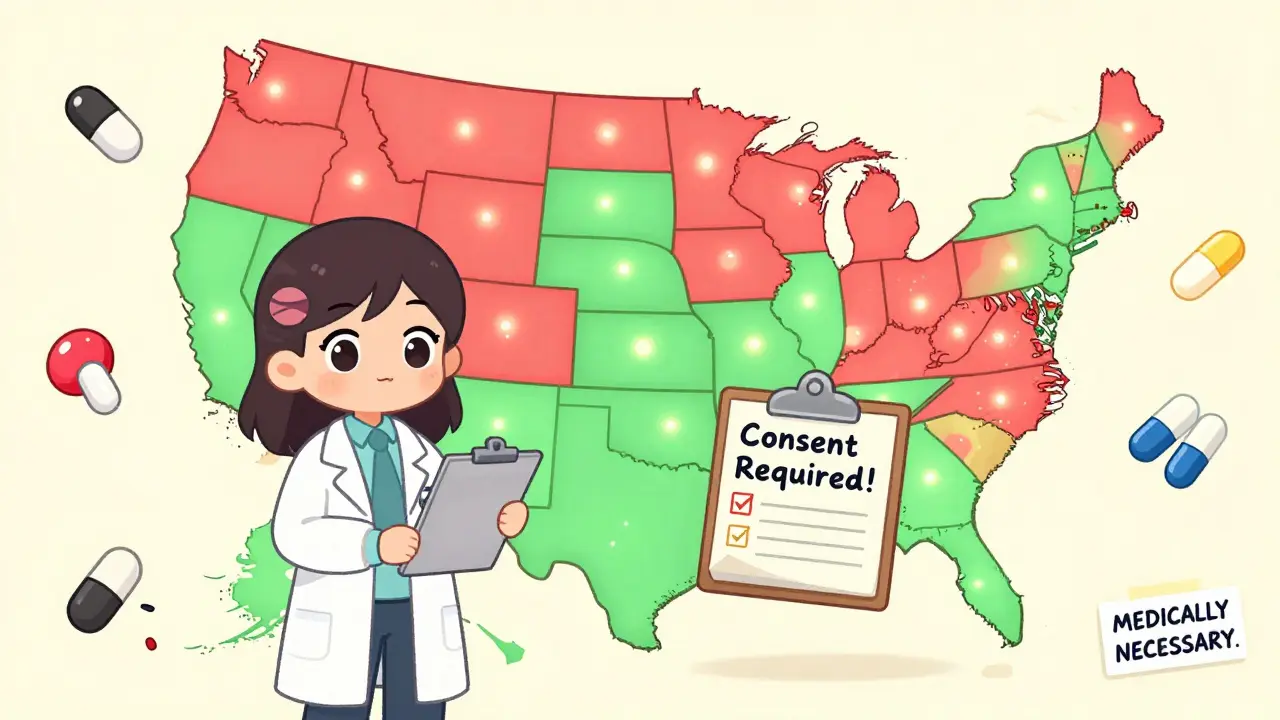
How to Stay Compliant Day-to-Day
Here’s what you need to do every single time you dispense a generic:- Check the Orange Book. Verify the generic has an "A" rating. Don’t assume-look it up. The FDA updates it monthly.
- Know your state’s rules. Keep a printed or digital copy of your state’s substitution law. Bookmark the state board of pharmacy website. Subscribe to their alerts-17 states changed their laws in 2022 alone.
- Check for "dispense as written" or "medically necessary" flags. If the prescriber wrote it on the script or marked it electronically, don’t substitute. Period.
- Get consent if required. If your state needs explicit consent, say it clearly: "I’m giving you the generic version of your medication. It’s the same as the brand, but cheaper. Do you want me to fill it this way?" Record the patient’s answer in your system.
- Document everything. Log the substitution, the consent (or lack thereof), the drug name, lot number, and your initials. If you don’t document it, it didn’t happen.
Many pharmacies use automated systems to flag restricted drugs or require pharmacist confirmation before dispensing. If your system doesn’t do that, build your own checklist. Don’t rely on memory.
Patients Don’t Always Understand
A 2023 survey of 1,247 patient reviews found that 78% were happy with generic substitution-mainly because they saved an average of $38.50 per prescription. But 63% of negative reviews cited one thing: "I wasn’t told I was getting a different drug." Patients think "brand name" means better. They don’t know about FDA equivalence standards. They worry the generic won’t work. When you don’t explain it, they assume you’re cutting corners. Your job isn’t just to fill the script. It’s to educate. A quick, clear sentence can prevent panic: "This is the generic version of your medication. It has the same active ingredient and works the same way. The FDA says it’s just as safe and effective. You’re saving about $40 on this refill." For high-risk drugs like thyroid meds or blood thinners, go further. Say: "Some states don’t allow substitutions for this drug because even small changes can affect how it works. I’m giving you the exact brand because your doctor asked for it."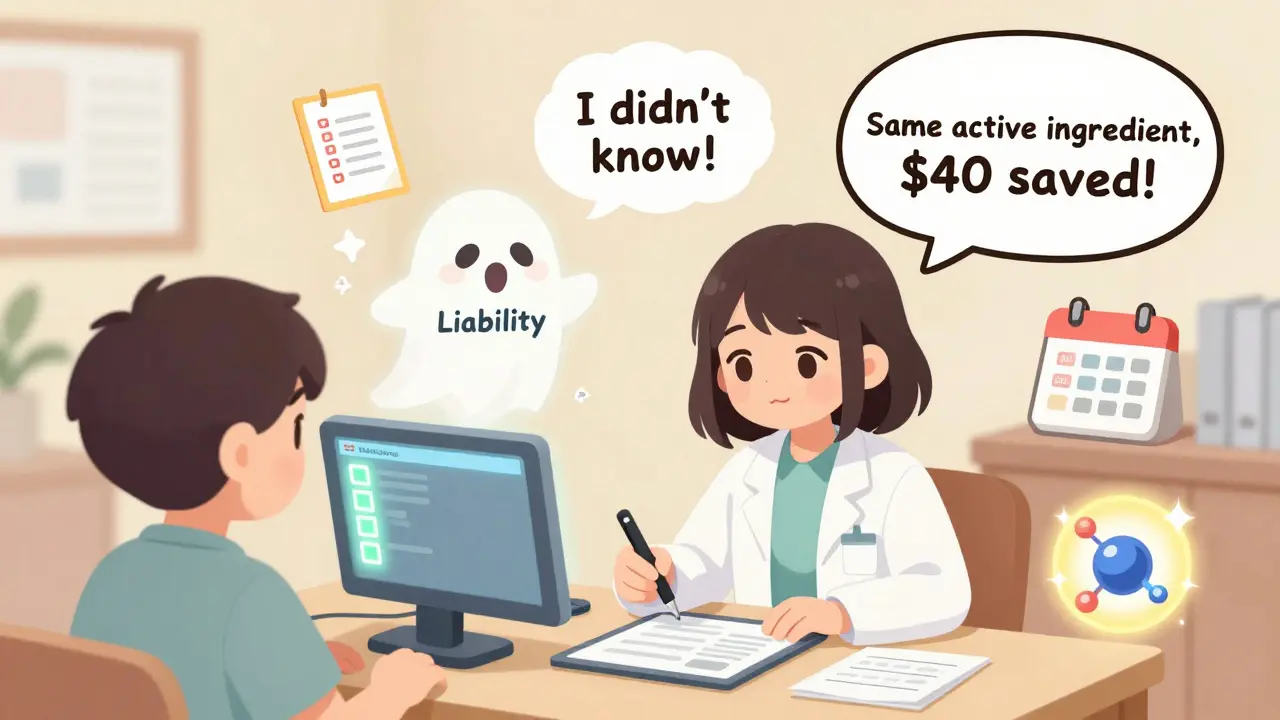
What About Biosimilars?
Biosimilars are a new category-complex biologic drugs that mimic brand-name biologics like Humira or Enbrel. They’re not the same as traditional generics. As of 2023, 32 states have passed laws specifically for biosimilar substitution, and most require additional consent and labeling. The rules are still evolving. Stay updated. The FDA and NABP are working on a model act to standardize this, but right now, it’s a patchwork.Bottom Line: Your License Is on the Line
Pharmacists are the last line of defense in the generic substitution system. You’re not just a dispenser-you’re a legal gatekeeper. Every time you substitute, you’re making a clinical and legal decision. The FDA says generics are safe. But state laws, patient safety, and professional ethics demand more than just following the letter of the law. You need to know the spirit of it too.Stay sharp. Stay informed. Document everything. And never assume a patient knows the difference between a brand and a generic. Your attention to detail isn’t just good practice-it’s your legal shield.
Can a pharmacist substitute a generic without telling the patient?
In 18 states, pharmacists can substitute without explicit consent, but they must still inform the patient after the fact. In 32 states, the patient must give direct permission before substitution. Even in states that allow presumed consent, failing to explain the change can lead to patient complaints or disciplinary action. Best practice: always notify the patient, regardless of state law.
Are all generic drugs approved by the FDA safe to substitute?
Only generics with an "A" rating in the FDA Orange Book are approved for substitution. But even "A"-rated drugs can’t be substituted if state law prohibits it-for example, antiepileptic drugs in Tennessee, or narrow therapeutic index drugs like warfarin in Florida. Always check your state’s restrictions before substituting, even if the FDA says it’s equivalent.
What should I do if the prescriber writes "dispense as written"?
Do not substitute. "Dispense as written" (DAW) or "medically necessary" instructions override all substitution laws. These are legally binding directives from the prescriber. Whether written by hand, checked electronically, or indicated in the prescription notes, you must fill the brand-name drug exactly as ordered. Ignoring this can result in disciplinary action, even if the generic is FDA-approved.
How often do state laws on generic substitution change?
State laws change frequently-17 states updated their substitution rules in 2022 alone. Many states are now adding rules for biosimilars and tightening restrictions on high-risk drugs. Pharmacists should subscribe to their state board of pharmacy’s updates, attend continuing education sessions annually, and review pharmacy policy manuals at least twice a year. Relying on outdated information is a leading cause of compliance errors.
Can a pharmacist be held liable if a patient has a bad reaction after a generic substitution?
Yes. If a substitution violates state law, lacks proper consent, or ignores a "medically necessary" flag, the pharmacist can be held legally liable-even if the drug is FDA-approved. A 2019 study showed higher adverse event rates with certain substituted cardiac drugs. If you failed to follow protocol, you could face malpractice claims, license suspension, or criminal charges. Documentation and compliance aren’t just paperwork-they’re your protection.

Comments
Let me get this straight - you’re telling me a pharmacist has to memorize 51 different state laws just to fill a prescription? And if they mess up one comma in the documentation, their license is gone? This isn’t healthcare, it’s legal Russian roulette. The FDA says generics are safe, but the system treats them like radioactive material. Who designed this mess? Someone who hates pharmacists.
Oh please. You think this is bad? Wait till you see what happens when a patient gets the wrong generic because the pharmacy’s software didn’t update the Orange Book. I’ve seen it. A guy got a generic for his thyroid med and went into cardiac arrest. The pharmacist didn’t even know Florida banned it. Now he’s unemployed and the patient’s on disability. This isn’t compliance - it’s a death sentence wrapped in paperwork.
From a Nigerian perspective, this is both absurd and admirable. We don’t have FDA oversight - generics are often unregulated, and patients die from substandard formulations. Yet here, you have such stringent protocols that even bioequivalence is scrutinized down to the milligram. The paradox? In the U.S., you’re punished for doing too much; in Nigeria, you’re punished for doing too little. The system is broken, but at least you’re trying to fix it with bureaucracy.
As an Indian pharmacist who’s worked in both Delhi and Chicago, let me tell you - this is the most insane version of responsibility I’ve ever seen. In India, we hand out generics like candy. No consent, no documentation, no Orange Book. But here? You’re a lawyer, a doctor, and a librarian all in one. And yet… I kinda respect it. The patient safety angle? Solid. The paperwork? A nightmare. But hey, if you’re gonna be the last line of defense, you better have a bulletproof vest made of PDFs.
Look - I get the fear. I really do. But let’s not turn pharmacists into prison guards for prescriptions. The system is designed to protect, but it’s crushing the people trying to help. Imagine being told you can’t give someone their $40 cheaper med because the state says so - even though the science says it’s identical. That’s not safety. That’s fear masquerading as policy. We need to simplify. Trust the science. Train the people. Stop punishing the good ones because of the few who messed up.
I once got a generic for my antidepressant. Didn’t know until I got the receipt. I cried. I felt betrayed. I thought they were trying to poison me. No one told me. I didn’t ask. I just assumed. Now I read every label like a legal document. Thanks, system.
So let me get this straight - you’re saying a pharmacist can be sued if they give a patient the exact same drug for $38 less? That’s capitalism. That’s greed. That’s not healthcare. That’s a scam where the patient pays more so the pharma bros can keep their profits. The FDA approves it. The patient wants it. The pharmacist knows it’s fine. But the state says no. Who’s the real villain here? Not the pharmacist. The system.
bro why do we even have brand names if the stuff is the same? like why does my blood pressure med cost 3x if its literally the same pill? the whole thing is a scam. i got the generic and my bp is fine. no one told me. i dont care. stop making pharmacists into cops.
It is imperative to underscore that the professional obligations incumbent upon pharmacists in the context of generic substitution are not merely administrative in nature, but constitute a sacrosanct fiduciary duty to the patient, grounded in the ethical precepts of nonmaleficence and autonomy. Failure to adhere to statutory mandates, regardless of perceived clinical equivalence, constitutes a material breach of professional standards and may result in irrevocable disciplinary consequences.
My uncle is a pharmacist in Texas. He told me he gets calls from patients every week asking why their meds look different. He says he has to explain it like they’re five years old. "This is the same medicine, just cheaper. Like buying the store-brand cereal." But then the state says he has to get them to sign something. So now he’s a teacher, a lawyer, and a therapist. I’m proud of him. But this is too much.
just wanted to say thank you to all the pharmacists out there. i had a bad reaction once because i didn’t know the generic was different and no one told me. now i always ask. but you guys are doing so much under pressure. i see you. you’re not just filling bottles - you’re keeping people alive. ❤️
sooo… if the FDA says it’s safe, why are we even doing this? like… is this just corporate greed dressed up as safety? 🤔 i mean, if i buy a generic battery and it works, i don’t call the cops. why is medicine different? also… who’s paying for all this paperwork? the patient? the pharmacist? the system is broken.
This is why we can’t have nice things. Every time someone tries to make healthcare safer, they turn it into a maze of legal landmines. Pharmacists are the ones holding the line, but they’re being set up to fail. And patients? They’re just confused. We need to fix the system, not punish the people trying to help. This isn’t protection. It’s punishment.