
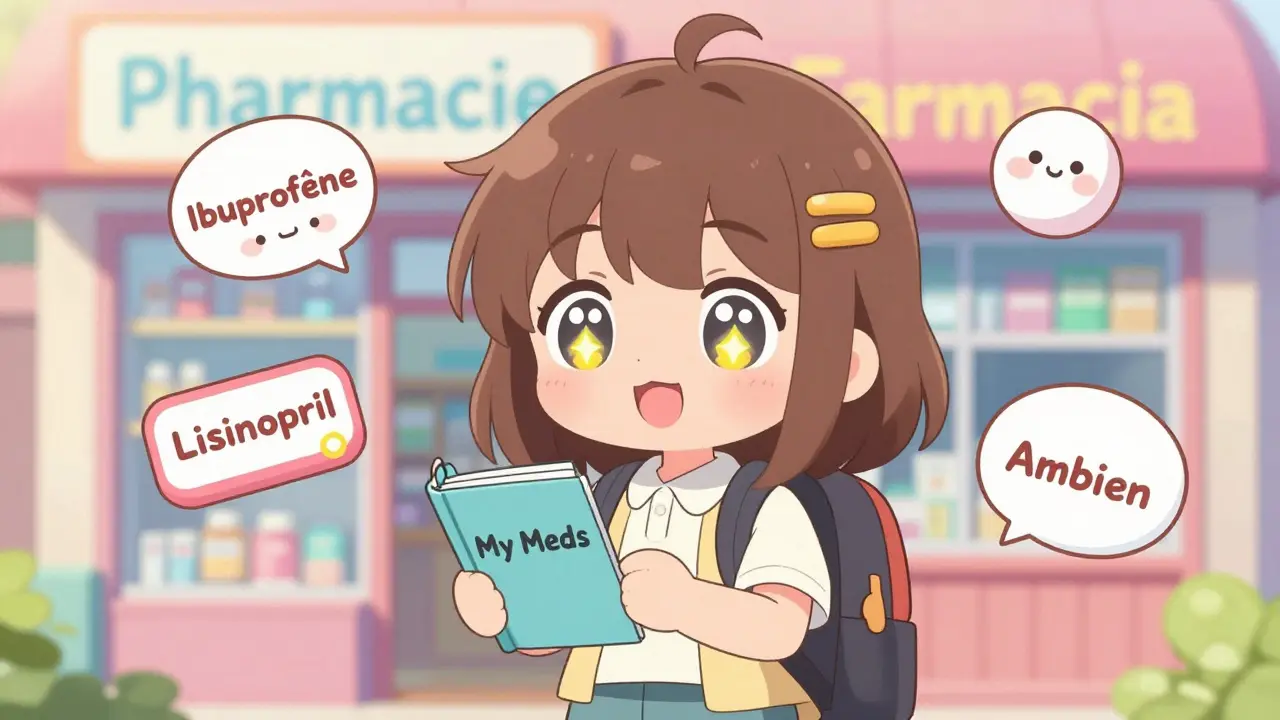
When you’re traveling abroad and need to refill a prescription, it’s not just about finding a pharmacy. It’s about making sure the pharmacist understands exactly what you’re taking - down to the milligram. A simple mix-up in drug names or dosage can lead to serious harm. In France, ibuprofen might be sold as Ibuprofène. In Poland, it’s Abfen. In the U.S., you know it as Advil. But if you hand a pharmacist a bottle labeled "Advil 200mg" and they assume it’s something else, you could end up with the wrong medicine entirely.
That’s not theoretical. In the UK, there’s a medication called Ambyen used for heart rhythm issues. In the U.S., Ambien is a sleep aid. The names look almost identical. Mix them up, and someone could take a sedative when they need a heart stabilizer. That’s the kind of mistake that ends in emergency rooms - and sometimes worse.
Why Medication Names Vary So Much
Every country has its own system for naming drugs. The World Health Organization created the International Nonproprietary Name (INN) to standardize generic drug names globally. That’s why you’ll see "ibuprofen" listed on most packaging, no matter where you are. But brand names? Those are completely different.
Pharmaceutical companies register their own brand names to sell the same active ingredient. So one pill with 200mg of ibuprofen might be called Advil in the U.S., Nurofen in Australia, or Brufen in South Africa. If you don’t know the active ingredient, you’re guessing. And guessing with medication is dangerous.
Even the way dosage is written varies. In the U.S., you’ll see "500 mg". In some European countries, it’s written as "0.5 g". A pharmacy assistant unfamiliar with this format might misread it as 5 grams - ten times the correct dose. That’s not a typo. That’s a life-threatening error.
What You Need to Bring When Traveling
Don’t wait until you’re out of pills to figure this out. Two weeks before your trip, prepare a clear, simple document with:
- The generic name of each medication (e.g., "lisinopril", not "Zestril")
- The dosage (e.g., "10 mg once daily")
- The frequency (morning, night, with food, etc.)
- The purpose (e.g., "for high blood pressure")
- The prescribing doctor’s name and contact info
Print this out. Carry it in your wallet. Take a photo of it on your phone. If you’re carrying pills, keep them in their original bottles with the pharmacy label intact. That label is your best proof of what’s inside.
Some travelers also write down the active ingredient in their native language and in the local language of their destination. For example, if you’re going to Spain, write: "Ibuprofeno 200 mg - para el dolor". It’s not fancy, but it’s clear. Pharmacists in foreign countries are used to seeing these kinds of notes.
How Foreign Pharmacies Handle Translations
Most large pharmacies in tourist-heavy cities - like those in Paris, Tokyo, or Dubai - have staff who speak multiple languages. But don’t assume they know your medication. Even if they speak English, they might not recognize a U.S. brand name.
Professional pharmacy translation systems use databases that map brand names to INNs. For example, RxTran’s system cross-references over 150 country-specific drug databases. When a pharmacist enters "Advil", the system instantly shows: "Active ingredient: ibuprofen. Equivalent in France: Ibuprofène. Dosage: 200mg per tablet. Common brand: Nurofen."
Smaller pharmacies may not have this tech. In those cases, they rely on printed drug equivalency guides or phone interpreters. Some hospitals in Dubai and Singapore now offer 24/7 translation lines just for medication questions. But if you’re in a rural area or a country with fewer resources, you’re on your own.
Why Google Translate Won’t Cut It
You might be tempted to use Google Translate or DeepL. Don’t. These tools are great for menus or street signs. They’re terrible for medicine.
Here’s why:
- They don’t know medical abbreviations. "q.d." means "once daily" - but Google might translate it as "queen daily".
- They mix up similar-sounding drugs. "Lisinopril" and "Lisinopril HCTZ" are different. Google can’t tell the difference.
- They don’t understand units. "5 mg" vs. "5 mL" - one is a pill, the other is liquid. Confusing them can kill someone.
- They ignore regulatory differences. In some countries, a drug you take daily is only available by prescription. In others, it’s over-the-counter. Translation tools don’t know that.
A 2022 study of international healthcare providers found that 68% had seen patients bring in prescriptions mistranslated by AI tools. In one case, a patient thought "3x daily" meant three tablets at once - not three separate doses. That’s not a translation error. That’s a misunderstanding caused by bad tools.
What to Do If You Need a Prescription Filled Abroad
If you’re traveling and run out of medication, here’s the step-by-step:
- Find a licensed pharmacy - not a convenience store or tourist shop. Look for signs like "Pharmacie" (France), "Farmacia" (Italy), or "Apotheke" (Germany).
- Bring your original prescription, bottle, and your written summary.
- Ask if they have a translator or if they can call a medical interpreter. Many pharmacies have access to phone-based services like Stepes or RxTran.
- Confirm the generic name and dosage with the pharmacist. Say: "Is this the same as [generic name] in my country?"
- Ask for the label in your language. If they can’t provide it, ask them to write down the instructions in simple words.
- Double-check the pill size and color. If it looks different, ask why. It might be a generic version - but you need to be sure.
Some countries require a local prescription even if you have one from home. That’s normal. Don’t panic. Just ask: "Can you write me a new prescription based on this?" Most will do it if you have proof of your original prescription.
When to Use a Translation Service
If you’re a frequent traveler, have a complex medication regimen, or manage chronic conditions, consider using a professional service. Companies like RxTran, Stepes, and First Databank offer:
- Accurate conversion of brand names to INNs
- Translated patient instructions in over 25 languages
- Warning labels that match local regulations
- Integration with pharmacy systems for real-time translation
These services cost money - often $3,500 a year for pharmacies - but they’re worth it. For individuals, some travel insurance plans now include medication translation as a benefit. Check yours.
For most travelers, though, the best tool is still your own preparation. Write down your meds. Know the generic names. Carry your original bottles. That’s your safety net.
Regulations and Legal Limits
Not every country allows you to bring in foreign prescriptions. Some, like Japan and the UAE, have strict rules. Others, like Canada and the UK, may let you refill a U.S. prescription if it’s recent and you have documentation.
In the U.S., New York State requires pharmacies to provide translated labels in Chinese, Italian, Russian, and Spanish. California is moving to add more languages based on local demographics. But outside the U.S., there’s no universal standard. That’s why you can’t rely on laws to protect you.
The bottom line: If you’re traveling, assume no one will understand your prescription unless you make it clear. Don’t wait for the system to help you. Help yourself first.
Real Stories, Real Risks
On Reddit’s r/pharmacy, a user named PharmTech2020 shared how a Spanish prescription said "1g" - meaning 1 gram. The patient thought it was 1 milligram. That’s a 1,000-fold difference. The pharmacist caught it because they knew "1g" in Spanish prescriptions often meant 1000mg, not 1mg. That’s expertise. That’s training. That’s what saves lives.
Another traveler in Paris ran out of her blood pressure medication. She showed the pharmacist a bottle labeled "Lisinopril 10 mg". He handed her a pill that looked different. She asked if it was the same. He said yes. She didn’t know he meant the generic version - but the active ingredient was identical. She took it. No problem. But she only knew to ask because she had written down the generic name.
These aren’t rare cases. They happen every day. And they’re preventable.
Can I just show my prescription bottle to a foreign pharmacist?
Yes, but only if the bottle has the generic drug name clearly printed. Many U.S. bottles only show the brand name. Always carry a separate note with the generic name, dosage, and purpose. Pharmacies in other countries rely on generic names to identify medications.
Are all pharmacies equipped to translate medications?
No. Large chain pharmacies in major cities often have translation tools or bilingual staff. Small or rural pharmacies may not. Never assume they can help. Bring your own written summary and ask if they can call a medical interpreter service.
What if the medication isn’t available in the country I’m visiting?
Ask the pharmacist for the active ingredient. Then search for that ingredient in local pharmacies. For example, if your U.S. drug is "Lipitor" (atorvastatin), ask for "atorvastatin" - it’s available in almost every country. Generic versions are often cheaper and just as effective.
Is it safe to buy medication from a foreign pharmacy online?
No. Online pharmacies outside your home country are not regulated the same way. You risk getting counterfeit, expired, or wrong-dosed pills. Even if the site looks professional, it’s not worth the risk. Always get medication from a licensed local pharmacy.
How do I know if a pill is the right one if it looks different?
Look for the active ingredient on the label. Ask the pharmacist to confirm it matches your original medication. Check the dosage. If you’re unsure, call your home doctor or use a trusted drug database like Drugs.com or MedlinePlus to verify the pill’s appearance and strength.

Comments
Man, I never thought about how wild it is that the same pill can have five different names depending on where you are. I once got confused in Italy because my Advil looked like a completely different drug-turned out it was just branded as Moment. I kept staring at the bottle like it was a alien artifact. Now I always write down the generic name in my phone notes. Best travel hack ever.
This is one of those things that sounds obvious until you need it-and then you realize how dangerously unprepared most people are. I’ve traveled to 17 countries and always carry a laminated card with my meds, dosages, and why I take them. Once, a pharmacist in Bangkok cried because she said no one had ever brought her that level of clarity before. It’s not just about safety-it’s about respect.
So let me get this straight-you’re telling me the entire global pharmaceutical system operates on a patchwork of brand-name chaos, and the only thing keeping people from overdosing on ‘Lisinopril’ instead of ‘Lisinopril HCTZ’ is whether they happened to write down the generic name? And we wonder why healthcare costs are insane? This isn’t an oversight. It’s a systemic failure dressed up as ‘trademark freedom.’
Wow. Just wow. You wrote a 2,000-word essay on something that could’ve been solved by one simple rule: ‘Only prescribe by generic name.’ But no, we let corporations sell the same chemical under 47 different names so they can charge $100 for ‘Advil’ and $3 for ‘ibuprofen.’ And now you want me to carry a cheat sheet? How about we fix the system instead of making travelers into pharmacists?
I love how you included the real stories. That one about the Spanish prescription saying ‘1g’ and the patient thinking it was 1mg? That’s terrifying-and it’s not even the worst case I’ve heard. My cousin once took a Mexican version of a sleep aid because the label said ‘para dormir’ and she didn’t realize it was a muscle relaxant. She slept for 18 hours and woke up thinking she’d been kidnapped. We all laugh now, but it could’ve killed her. This guide is a lifeline.
Google Translate is a death trap for meds and you know it. I’ve seen people try to translate ‘q4h’ as ‘every 4 hours’ and then take four pills at once because the AI said ‘every four hours’ meant ‘take four now.’ That’s not a translation error-that’s a failure of human judgment. Always. Always. Always. Know your generic name. Write it down. Print it. Carry it. No excuses.
Let’s be honest-this entire system is a corporate conspiracy. The WHO’s INN system exists, but big pharma lobbies to suppress it. Brand names aren’t just marketing-they’re profit traps. Countries are complicit because they profit from patent extensions disguised as ‘local branding.’ You think the pharmacist in Paris doesn’t know Advil is ibuprofen? Of course they do. They just can’t say it without violating a trademark agreement. This isn’t about language. It’s about control. And you’re just giving people bandaids while the bleeding continues.
While the preceding comments offer valuable perspectives, it is imperative to underscore the ethical and professional obligations incumbent upon healthcare providers and travelers alike. The variance in nomenclature is not merely a logistical inconvenience but a matter of public health integrity. The World Health Organization’s International Nonproprietary Names program was established precisely to mitigate the risks inherent in proprietary branding. Travelers who prepare written documentation containing generic names, dosages, and indications are not merely exercising caution-they are fulfilling a civic duty to safeguard both personal and communal health. Pharmacies, particularly in cosmopolitan centers, must be empowered with standardized translation infrastructure, and regulatory bodies must enforce the inclusion of INNs on all packaging, regardless of brand. This is not an individual responsibility alone-it is a collective imperative.